 Indietro
The Cell Cycle and Molecular Biology of Cancer: Study Notes
Guida di studio - Note intelligenti
 Appunti personalizzati basati sui tuoi materiali, ampliati con definizioni chiave, esempi e contesto.
The Cell Cycle
Overview of Cell Division
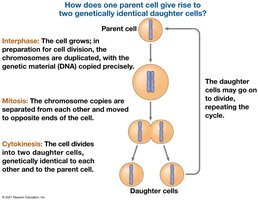
Cell division is a fundamental process that enables organisms to grow, develop, repair tissues, and reproduce. In multicellular organisms, cell division starts from a single cell and results in the formation of genetically identical daughter cells.
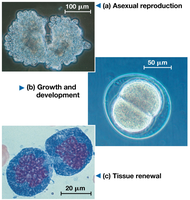
Cell division is essential for reproduction, growth, and repair.
Single-celled organisms reproduce by cell division, while multicellular organisms use it for development and tissue renewal.
Cell division ensures accurate distribution of genetic material (DNA) to daughter cells.
Genetic material is organized into chromosomes, which are duplicated and separated during cell division.
Cellular Organization of Genetic Material
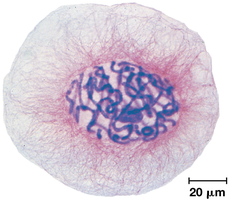
The genome of a cell consists of all its DNA, which is packaged into chromosomes. Chromosomes are made of chromatin, a complex of DNA and proteins that condenses during cell division.
Somatic cells (nonreproductive) have two sets of chromosomes.
Gametes (reproductive cells) have half as many chromosomes as somatic cells.
Each chromosome contains hundreds to thousands of genes.
Chromosome Structure and Replication
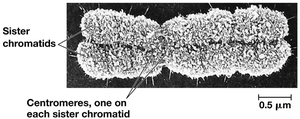
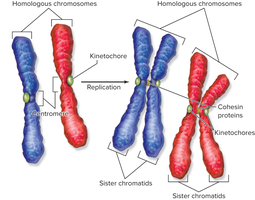
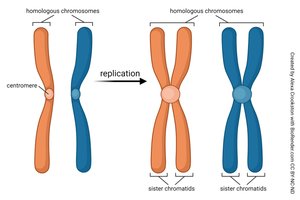
Before cell division, chromosomes are duplicated, resulting in two sister chromatids joined at the centromere. During division, chromatids separate and become individual chromosomes.
Chromatin: DNA-protein complex that condenses into chromosomes.
Chromosome: Structure carrying genetic material.
Chromatid: Each of the two identical halves of a duplicated chromosome.
Centromere: Region where sister chromatids are joined.
Phases of the Cell Cycle
Interphase and M Phase
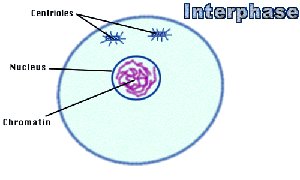
The cell cycle consists of interphase (cell growth and DNA replication) and the mitotic (M) phase (mitosis and cytokinesis). Interphase is divided into G1, S, and G2 phases.
G1 phase: Cell grows and prepares for DNA replication.
S phase: DNA is replicated.
G2 phase: Cell prepares for mitosis; chromosomes condense, centrioles replicate.
M phase: Includes mitosis (nuclear division) and cytokinesis (cytoplasmic division).
Mitosis: Stages and Events
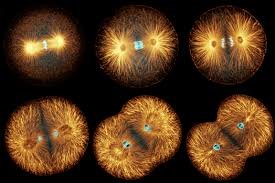
Mitosis is conventionally divided into five stages: prophase, prometaphase, metaphase, anaphase, and telophase. Each stage is characterized by specific events that ensure accurate chromosome segregation.
Prophase: Chromosomes condense, spindle apparatus forms, nuclear envelope breaks down.
Prometaphase: Microtubules attach to kinetochores, chromosomes begin moving to cell center.
Metaphase: Chromosomes align at the metaphase plate.
Anaphase: Sister chromatids separate and move to opposite poles.
Telophase: Spindle disassembles, nuclear envelope reforms, chromosomes decondense.
Cytokinesis: Division of cytoplasm; cleavage furrow in animals, cell plate in plants.
Regulation of the Cell Cycle
Cell Cycle Control System
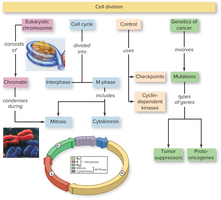
The cell cycle is regulated by a molecular control system involving checkpoints, cyclins, cyclin-dependent kinases (Cdks), and maturation-promoting factor (MPF). These mechanisms ensure proper cell division and prevent errors.
Checkpoints: G1, G2, and M checkpoints monitor cell cycle progression.
Cyclins: Proteins with cyclically fluctuating concentrations.
Cyclin-dependent kinases (Cdks): Enzymes that must bind cyclins to be active.
MPF: Cyclin-Cdk complex that triggers entry into M phase.
Molecular Biology of Cancer
Genetic Changes Leading to Cancer
Cancer results from genetic changes that disrupt normal cell cycle control. Mutations in proto-oncogenes, oncogenes, and tumor-suppressor genes can lead to uncontrolled cell division.
Proto-oncogenes: Genes that stimulate normal cell growth; mutations convert them to oncogenes.
Oncogenes: Mutated genes that promote excessive cell division.
Tumor-suppressor genes: Inhibit cell division; mutations reduce their function, contributing to cancer.
Ras proto-oncogene: Mutations produce hyperactive Ras protein, stimulating cell division.
p53 tumor suppressor gene: Mutations prevent suppression of cell cycle, allowing damaged cells to proliferate.
Example: Mutations in BRCA1 or BRCA2 genes are associated with inherited breast cancer.
Summary Table: Key Terms and Concepts
Term | Definition | Role in Cell Cycle |
|---|---|---|
Chromatin | DNA-protein complex | Condenses to form chromosomes |
Chromosome | Structure carrying genetic material | Segregated during mitosis |
Chromatid | Identical halves of a duplicated chromosome | Separated during anaphase |
Centromere | Region joining sister chromatids | Attachment site for spindle fibers |
Cyclin | Regulatory protein | Activates Cdks |
Cdk | Cyclin-dependent kinase | Regulates cell cycle progression |
MPF | Maturation-promoting factor | Triggers entry into M phase |
Proto-oncogene | Normal gene promoting cell growth | Mutation can lead to cancer |
Oncogene | Mutated proto-oncogene | Causes excessive cell division |
Tumor-suppressor gene | Gene inhibiting cell division | Mutation increases cancer risk |
Key Equations and Concepts
DNA Replication:
Cell Cycle Phases:
Chromosome Number in Humans:
Additional info: Expanded explanations and definitions were added for clarity and completeness. Images included only where directly relevant to the adjacent content.
