 Indietro
The Cell Cycle and Molecular Biology of Cancer: Study Notes
Guida di studio - Note intelligenti
 Appunti personalizzati basati sui tuoi materiali, ampliati con definizioni chiave, esempi e contesto.
Chapter 12: The Cell Cycle
Big Idea and Overview
The cell cycle is fundamental to understanding how organisms grow, reproduce, and maintain their tissues. Cell division is the process by which a single cell gives rise to two genetically identical daughter cells, ensuring continuity of life and accurate transmission of genetic material.
Key Roles of Cell Division
Functions in Life
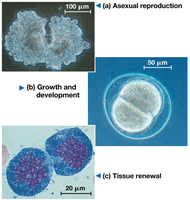
Asexual reproduction: Single-celled organisms reproduce by cell division.
Growth and development: Multicellular organisms develop from a single cell through repeated cell divisions.
Tissue renewal and repair: Cell division replaces damaged or dead cells in multicellular organisms.
Cellular Organization of Genetic Material
Genome, Chromosomes, and Chromatin
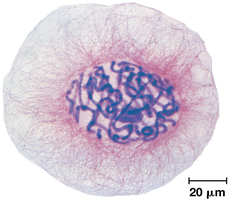
All the DNA in a cell constitutes its genome. In prokaryotes, the genome is usually a single DNA molecule, while in eukaryotes, it consists of multiple DNA molecules packaged into chromosomes. Chromatin is the complex of DNA and protein found in eukaryotic chromosomes, which condenses during cell division.
Somatic cells: Nonreproductive cells with two sets of chromosomes.
Gametes: Reproductive cells (sperm and eggs) with half the chromosome number.
Distribution of Chromosomes During Eukaryotic Cell Division
Chromosome Replication and Separation
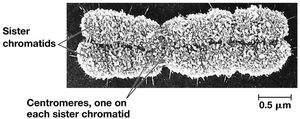
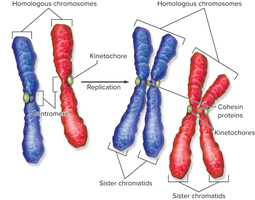
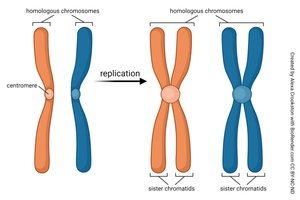
Before cell division, DNA is replicated and chromosomes condense. Each duplicated chromosome consists of two sister chromatids joined at the centromere. During division, sister chromatids separate and are distributed to two daughter cells.
Chromatid: Each of the two identical halves of a duplicated chromosome.
Centromere: The region where sister chromatids are most closely attached.
Phases of the Cell Cycle
Interphase and M Phase
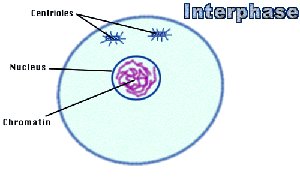
The cell cycle consists of interphase (cell growth and DNA replication) and mitotic (M) phase (mitosis and cytokinesis). Interphase is divided into G1 (growth), S (DNA synthesis), and G2 (preparation for mitosis).
G1 phase: Major cell growth.
S phase: DNA replication.
G2 phase: Preparation for mitosis, including chromosome condensation and centriole replication.
Mitosis: Stages and Events
Stages of Mitosis
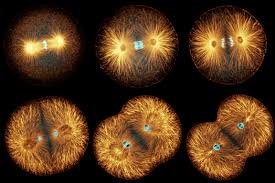
Mitosis is conventionally divided into five stages: prophase, prometaphase, metaphase, anaphase, and telophase. Each stage is characterized by specific events that ensure accurate chromosome segregation.
Prophase: Chromosomes condense, spindle apparatus forms, nuclear envelope breaks down.
Prometaphase: Microtubules attach to kinetochores, chromosomes begin moving to the cell center.
Metaphase: Chromosomes align at the metaphase plate.
Anaphase: Sister chromatids separate and move to opposite poles.
Telophase: Spindle disassembles, nuclear envelope reforms, chromosomes decondense.
Cytokinesis
Division of Cytoplasm
Cytokinesis is the process by which the cytoplasm divides, resulting in two daughter cells. In animal cells, this occurs via cleavage furrow formation; in plant cells, a cell plate forms.
Binary Fission in Bacteria
Prokaryotic Cell Division
Prokaryotes reproduce by binary fission, where the chromosome replicates and the cell divides into two. This process is simpler than eukaryotic mitosis and may represent an evolutionary precursor to mitosis.
Cell Cycle Control System
Checkpoints and Regulation
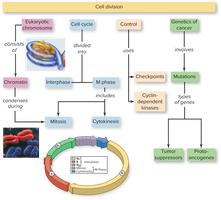
The cell cycle is regulated by checkpoints (G1, G2, M) that ensure proper progression. Regulatory proteins such as cyclins and cyclin-dependent kinases (Cdks) control the cycle. The maturation-promoting factor (MPF) is a cyclin-Cdk complex that triggers entry into M phase.
G1 checkpoint: Determines if the cell will proceed or enter G0 (non-dividing state).
G2 checkpoint: Ensures DNA replication is complete and undamaged.
M checkpoint: Ensures all chromosomes are properly attached to the spindle.
Loss of Cell Cycle Controls in Cancer
Cancer and Cell Cycle Regulation
Cancer cells escape normal cell cycle controls, leading to uncontrolled division. Tumors may be benign (localized) or malignant (invasive and metastatic). Cancer treatments target rapidly dividing cells, but also affect normal dividing cells.
Molecular Biology of Cancer
Genetic Changes and Cancer Development
Cancer results from mutations in genes that regulate the cell cycle. Proto-oncogenes can become oncogenes through mutations that increase their activity. Tumor-suppressor genes inhibit cell division; mutations in these genes can lead to cancer.
Ras proto-oncogene: Mutations can cause excessive cell division.
p53 tumor suppressor gene: Loss of function leads to failure in DNA repair and cell cycle suppression.
Multistep model: Multiple mutations are required for cancer development, often involving both oncogenes and tumor-suppressor genes.
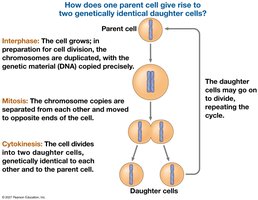
Summary: How One Parent Cell Gives Rise to Two Genetically Identical Daughter Cells
Overview of Cell Division
Cell division involves interphase (growth and DNA replication), mitosis (chromosome separation), and cytokinesis (cytoplasmic division). This process ensures genetic continuity and supports growth, development, and tissue maintenance.
Additional info:
Cell cycle regulation is crucial for preventing uncontrolled cell growth and cancer.
Inherited mutations in genes such as BRCA1 and BRCA2 can predispose individuals to certain cancers.
Binary fission in prokaryotes is simpler than mitosis in eukaryotes, but both ensure accurate genetic transmission.
