 Indietro
The Cell Cycle: Mechanisms and Regulation
Guida di studio - Note intelligenti
 Appunti personalizzati basati sui tuoi materiali, ampliati con definizioni chiave, esempi e contesto.
The Cell Cycle
Overview of the Cell Cycle
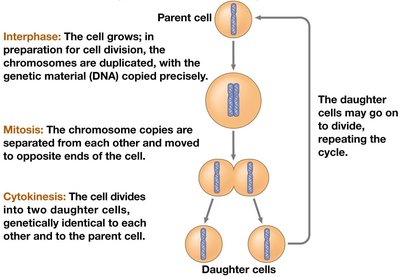
The cell cycle is the series of events that cells go through as they grow and divide. It ensures that genetic material is accurately duplicated and distributed to daughter cells. The cell cycle is essential for growth, development, tissue repair, and reproduction in living organisms.
Interphase: The cell grows, performs normal functions, and duplicates its DNA in preparation for division.
Mitosis (M phase): The nucleus divides, separating duplicated chromosomes into two sets.
Cytokinesis: The cytoplasm divides, producing two genetically identical daughter cells.
Biological Importance of Cell Division
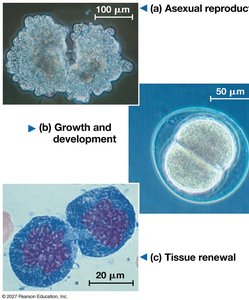
Cell division is fundamental for the continuity of life. In unicellular organisms, it enables asexual reproduction. In multicellular organisms, it is required for development, growth, and tissue renewal.
Asexual reproduction: Single-celled organisms reproduce by dividing into two identical cells.
Growth and development: Multicellular organisms grow by increasing cell number through division.
Tissue renewal: Damaged or old cells are replaced by new cells formed through division.
Chromosomes and Genetic Material
Chromatin and Chromosome Structure
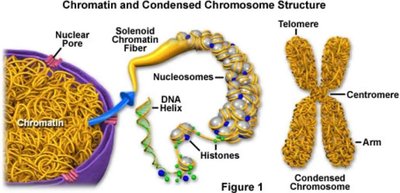
All the DNA in a cell constitutes its genome. In eukaryotes, DNA is packaged with proteins into chromatin, which condenses to form chromosomes during cell division. Each chromosome consists of a single, long DNA molecule associated with proteins called histones.
Chromatin: The complex of DNA and proteins in the nucleus.
Condensed chromosome: Highly organized structure visible during cell division, with distinct regions such as the centromere and telomeres.
Somatic Cells vs. Gametes
Somatic cells are non-reproductive cells containing two sets of chromosomes (diploid), while gametes (sperm and eggs) contain one set (haploid). In humans, somatic cells have 46 chromosomes, and gametes have 23.
Chromosome Duplication and Sister Chromatids
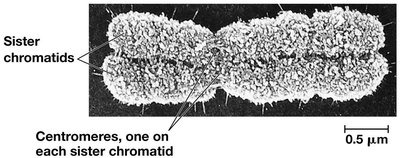
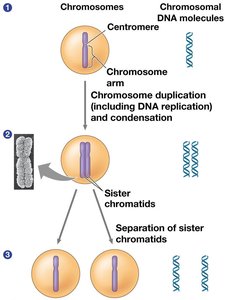
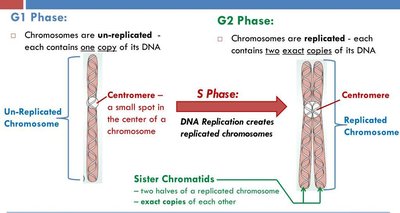
Before cell division, chromosomes are duplicated. Each duplicated chromosome consists of two identical sister chromatids joined at a region called the centromere. During mitosis, sister chromatids separate and are distributed to daughter cells.
 .
Phases of the Cell Cycle
Interphase
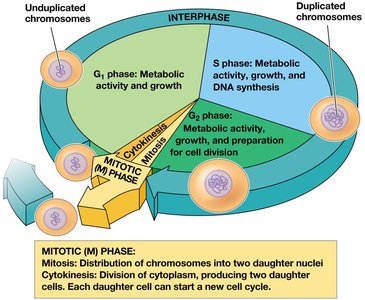
Interphase is the longest phase of the cell cycle, consisting of three subphases:
G1 phase (First Gap): Cell growth and normal metabolic activities.
S phase (Synthesis): DNA replication occurs, producing duplicated chromosomes.
G2 phase (Second Gap): Further growth and preparation for mitosis.
Mitotic (M) Phase
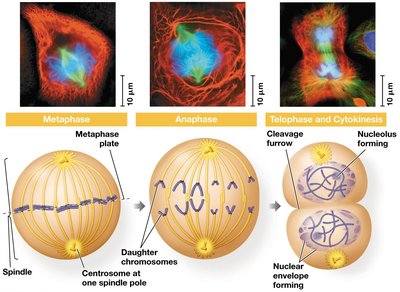
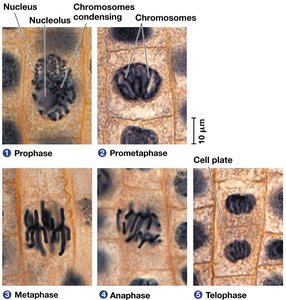
The M phase includes mitosis (nuclear division) and cytokinesis (cytoplasmic division). Mitosis is divided into several stages:
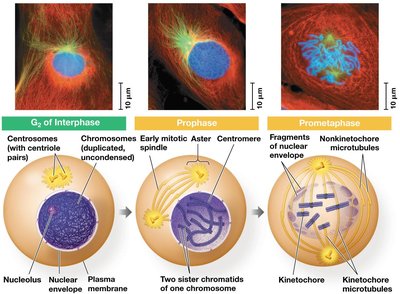
Prophase: Chromosomes condense, spindle apparatus forms.
Prometaphase: Nuclear envelope breaks down, spindle fibers attach to chromosomes.
Metaphase: Chromosomes align at the metaphase plate.
Anaphase: Sister chromatids separate and move to opposite poles.
Telophase: Nuclear envelopes reform around the two sets of chromosomes.
Cytokinesis: Division of the cytoplasm, resulting in two daughter cells.
Cytokinesis in Animal and Plant Cells
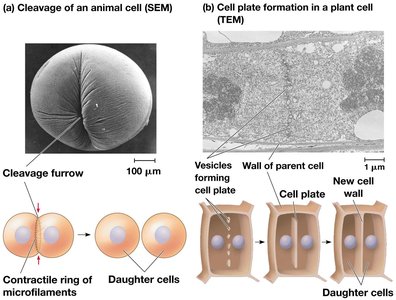
Cytokinesis differs between animal and plant cells:
Animal cells: A cleavage furrow forms, pinching the cell into two.
Plant cells: Vesicles form a cell plate that develops into a new cell wall, separating the daughter cells.
Regulation of the Cell Cycle
Cell Cycle Control System and Checkpoints
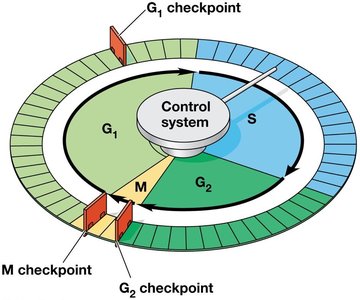
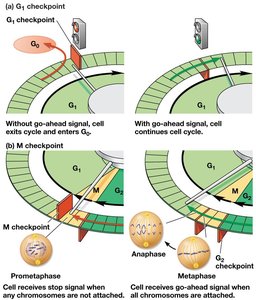
The cell cycle is regulated by a molecular control system with checkpoints at critical stages (G1, G2, and M). These checkpoints ensure that the cell only proceeds to the next phase when conditions are favorable and previous steps are properly completed.
G1 checkpoint: Checks for cell size, nutrients, and DNA integrity.
G2 checkpoint: Ensures DNA replication is complete and correct.
M checkpoint: Verifies that all chromosomes are properly attached to the spindle before separation.
Cyclins and Cyclin-Dependent Kinases (CDKs)
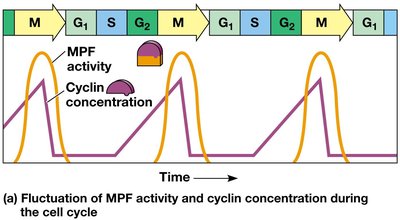
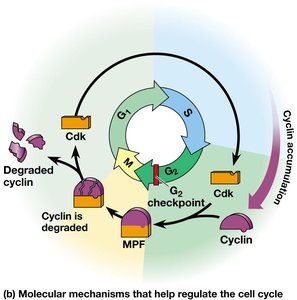
Progression through the cell cycle is controlled by regulatory proteins called cyclins and cyclin-dependent kinases (CDKs). Cyclin levels fluctuate during the cell cycle, activating CDKs at specific points. The cyclin-CDK complex triggers key events, such as the transition from G2 to M phase (e.g., MPF: maturation-promoting factor).
Internal and External Signals
Cell cycle progression is influenced by both internal surveillance mechanisms and external signals:
Internal signals: Ensure proper chromosome attachment and DNA integrity.
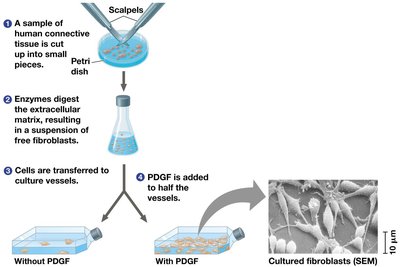
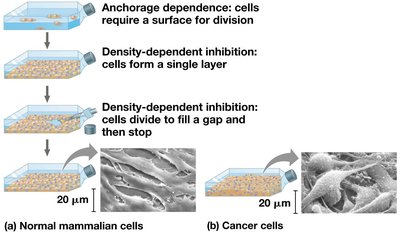
External signals: Growth factors such as PDGF stimulate cell division. Cells may also exhibit density-dependent inhibition and anchorage dependence.
Loss of Cell Cycle Control and Cancer
Cancer and Uncontrolled Cell Division
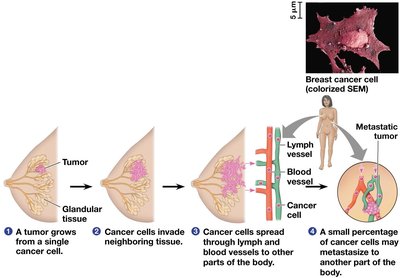
Cancer cells lose normal cell cycle controls, allowing them to divide uncontrollably. They may not require external growth signals and can ignore signals that normally inhibit division. Cancer progression involves:
Transformation: Cells acquire the ability to divide indefinitely.
Benign tumor: Abnormal cells remain at the original site.
Malignant tumor: Cells invade surrounding tissues and can metastasize to other parts of the body.
Summary Table: Key Events of the Cell Cycle
Phase | Main Events |
|---|---|
G1 | Cell growth, normal function |
S | DNA replication |
G2 | Preparation for division |
Mitosis | Nuclear division (prophase, prometaphase, metaphase, anaphase, telophase) |
Cytokinesis | Cytoplasmic division, two daughter cells formed |
