 Indietro
The Cell Cycle: Mechanisms and Regulation
Guida di studio - Note intelligenti
 Appunti personalizzati basati sui tuoi materiali, ampliati con definizioni chiave, esempi e contesto.
Chapter 12: The Cell Cycle
Introduction to the Cell Cycle
The cell cycle is the series of events that cells go through as they grow and divide. It is fundamental to the continuity of life, enabling organisms to grow, develop, and repair tissues. The process ensures that genetic material is accurately distributed to daughter cells.
Cell Division: The process by which a parent cell divides into two or more daughter cells. In multicellular organisms, this process is essential for growth, development, and tissue repair.
Genetic Continuity: Cell division ensures that each daughter cell receives an identical set of genetic material.
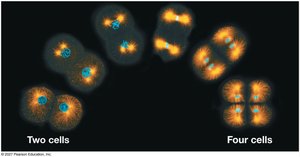
Roles of Cell Division
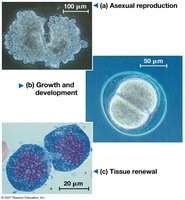
Cell division plays several critical roles in the life of an organism:
Asexual Reproduction: Single-celled organisms reproduce by dividing, producing genetically identical offspring.
Growth and Development: Multicellular organisms grow and develop from a single cell through repeated cell divisions.
Tissue Renewal: In mature organisms, cell division replaces cells that are lost due to normal wear and tear or injury.
Genetic Material and Chromosomes
The Genome and Chromosome Structure
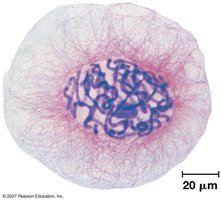
All the DNA in a cell constitutes its genome. In eukaryotes, the genome is divided among multiple chromosomes, each consisting of a single DNA molecule associated with proteins (chromatin).
Chromosomes: Structures that carry genetic information. Each chromosome contains hundreds to thousands of genes.
Somatic Cells: Non-reproductive cells with two sets of chromosomes (diploid).
Gametes: Reproductive cells (sperm and eggs) with one set of chromosomes (haploid).
Chromosome Duplication and Distribution
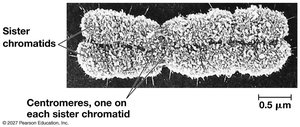
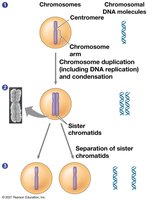
Before a cell divides, its chromosomes are duplicated. Each duplicated chromosome consists of two sister chromatids joined at a region called the centromere. During cell division, sister chromatids separate, ensuring each daughter cell receives an identical set of chromosomes.
Sister Chromatids: Identical copies of a chromosome connected by cohesins at the centromere.
Centromere: The region where sister chromatids are most closely attached.
Phases of the Cell Cycle
Overview of the Cell Cycle
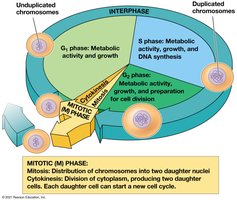
The cell cycle consists of two main phases: interphase and the mitotic (M) phase. Interphase is the period of cell growth and DNA replication, while the M phase includes mitosis and cytokinesis.
Interphase: Comprises G1 (growth), S (DNA synthesis), and G2 (preparation for division) phases.
M Phase: Includes mitosis (nuclear division) and cytokinesis (cytoplasmic division).
Chromosome Duplication and Separation
During the S phase of interphase, chromosomes are duplicated. In mitosis, sister chromatids are separated and distributed to daughter cells.
Mitosis: Stages and Mechanisms
Stages of Mitosis
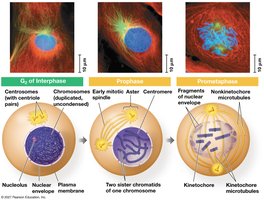
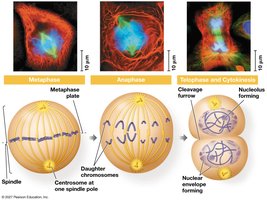
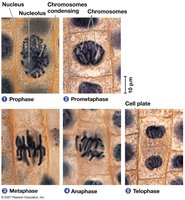
Mitosis is conventionally divided into five stages: prophase, prometaphase, metaphase, anaphase, and telophase. Each stage is characterized by specific events that ensure accurate chromosome segregation.
Prophase: Chromosomes condense, spindle apparatus begins to form.
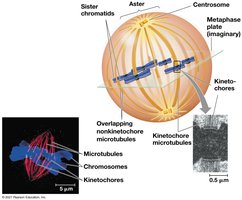
Prometaphase: Nuclear envelope fragments, spindle microtubules attach to kinetochores.
Metaphase: Chromosomes align at the metaphase plate.
Anaphase: Sister chromatids separate and move toward opposite poles.
Telophase: Nuclear envelopes reform, chromosomes decondense.
The Mitotic Spindle and Chromosome Movement
The mitotic spindle, composed of microtubules, orchestrates the movement of chromosomes during mitosis. Centrosomes organize spindle formation, and kinetochores on chromosomes serve as attachment points for spindle microtubules.
Centrosome: Microtubule-organizing center that duplicates and migrates to opposite poles.
Kinetochore: Protein complex at the centromere where spindle fibers attach.
Metaphase Plate: Imaginary plane where chromosomes align during metaphase.
Mechanisms of Chromosome Movement
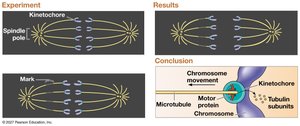
During anaphase, sister chromatids are separated by the action of separase, which cleaves cohesins. Chromatids are moved toward spindle poles by motor proteins and microtubule depolymerization, described as the "Pac-man" mechanism and the "reeling in" mechanism.
Cytokinesis: Division of the Cytoplasm
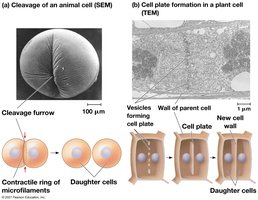
Cytokinesis is the process by which the cytoplasm divides, forming two distinct daughter cells. In animal cells, this occurs via cleavage, forming a cleavage furrow. In plant cells, a cell plate forms, eventually developing into a new cell wall.
Cell Division in Prokaryotes
Binary Fission
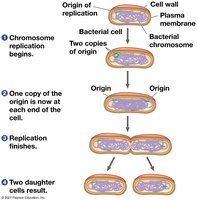
Prokaryotic cells (bacteria and archaea) divide by binary fission, a simpler process than mitosis. The single, circular chromosome replicates, and the cell splits into two genetically identical daughter cells.
Regulation of the Cell Cycle
Cell Cycle Control System
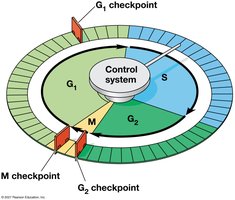
The cell cycle is regulated by a control system with checkpoints at critical stages (G1, G2, and M). These checkpoints ensure that key processes are completed before the cell proceeds to the next stage.
Checkpoints: Control points where stop and go-ahead signals regulate the cycle.
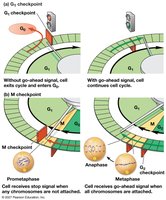
G1 Checkpoint: The most important checkpoint for many cells; cells may enter a non-dividing state (G0) if they do not receive the go-ahead signal.
Internal and External Signals: Internal signals ensure proper chromosome attachment; external signals include growth factors.
Growth Factors and External Regulation
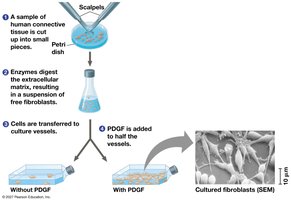
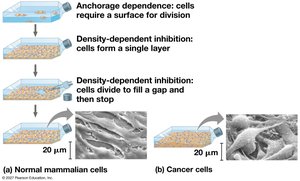
Growth factors are proteins released by certain cells that stimulate other cells to divide. Platelet-derived growth factor (PDGF) is an example that stimulates fibroblast division. Physical factors such as density-dependent inhibition and anchorage dependence also regulate cell division.
Cancer and the Cell Cycle
Loss of Cell Cycle Control in Cancer
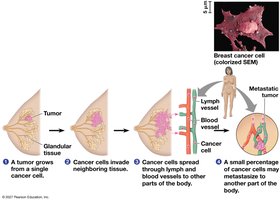
Cancer cells do not respond to normal regulatory signals. They may divide uncontrollably, form tumors, and invade other tissues (metastasis). Cancer cells can produce their own growth factors, ignore inhibitory signals, and have abnormal cell cycle control systems.
Benign Tumors: Remain at the original site and usually do not cause serious problems.
Malignant Tumors: Invade surrounding tissues and can spread to other parts of the body (metastasis).
Chemotherapy: Drugs that target dividing cells, often causing side effects due to effects on normal dividing cells.
Summary Table: Key Differences in Cell Division
Feature | Normal Cells | Cancer Cells |
|---|---|---|
Growth Factor Dependence | Require external growth factors | May produce own or ignore signals |
Density-Dependent Inhibition | Present | Absent |
Anchorage Dependence | Present | Absent |
Ability to Metastasize | No | Yes (malignant tumors) |
Additional info: Understanding the cell cycle and its regulation is crucial for fields such as cancer biology, regenerative medicine, and developmental biology. Modern research continues to uncover new molecular mechanisms and therapeutic targets related to cell division and its dysregulation.
