 Indietro
The Cell Cycle: Mechanisms and Regulation
Guida di studio - Note intelligenti
 Appunti personalizzati basati sui tuoi materiali, ampliati con definizioni chiave, esempi e contesto.
The Cell Cycle
Introduction to the Cell Cycle
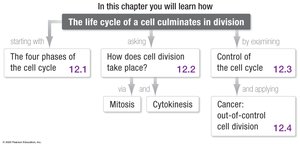
The cell cycle is the series of events that cells go through as they grow and divide. It is fundamental to the growth, development, and maintenance of all living organisms. Cell division can occur via mitosis, which produces genetically identical somatic cells, or meiosis, which produces genetically unique gametes. Cytokinesis, the division of the cytoplasm, usually follows both processes.
Cell division is essential for growth, repair, and reproduction in multicellular organisms.
Mitosis produces somatic cells that are genetically identical to the parent cell.
Meiosis produces gametes (sperm and eggs) with half the genetic material of the parent cell.
Cytokinesis divides the cytoplasm, resulting in two daughter cells.
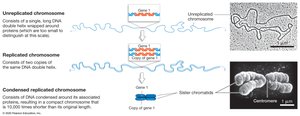
Chromosome Structure and Replication
Chromosomes are structures composed of DNA and proteins that carry genetic information. Before a cell divides, its chromosomes are replicated, resulting in two identical sister chromatids joined at a region called the centromere.
Chromosome: A single, long DNA double helix wrapped around histone proteins.
Gene: A region of DNA that codes for a specific RNA and, consequently, a protein.
Chromatid: Each of the two identical DNA molecules after chromosome replication.
Sister chromatids: The two chromatids of a replicated chromosome, attached at the centromere.
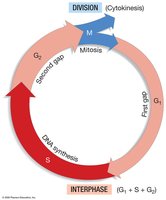
Phases of the Cell Cycle
The eukaryotic cell cycle consists of four main phases: G1, S, G2, and M. Interphase includes G1, S, and G2, during which the cell grows, replicates its DNA, and prepares for division. The M phase includes mitosis and cytokinesis.
G1 phase (First gap): Cell grows and performs normal functions.
S phase (Synthesis): DNA is replicated.
G2 phase (Second gap): Cell prepares for mitosis.
M phase (Mitosis and Cytokinesis): Cell divides its chromosomes and cytoplasm.
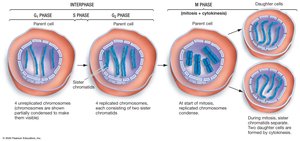
Events of M Phase: Mitosis and Cytokinesis
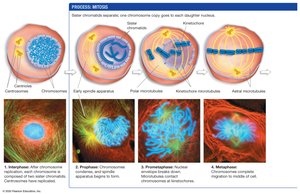
M phase consists of mitosis, where the replicated chromosomes are separated into two nuclei, and cytokinesis, where the cytoplasm divides to form two daughter cells. Mitosis is divided into five subphases: prophase, prometaphase, metaphase, anaphase, and telophase.
Prophase: Chromatin condenses into visible chromosomes; spindle apparatus forms.
Prometaphase: Nuclear envelope breaks down; spindle fibers attach to kinetochores.
Metaphase: Chromosomes align at the metaphase plate.
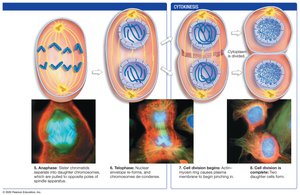
Anaphase: Sister chromatids separate and move to opposite poles.
Telophase: Nuclear envelopes reform around chromosomes; chromosomes decondense.
Cytokinesis: Cytoplasm divides, resulting in two daughter cells.
Regulation of the Cell Cycle
Cell Cycle Control and Checkpoints
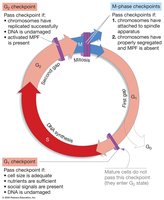
The cell cycle is tightly regulated by checkpoints that ensure each phase is completed accurately before the next begins. These checkpoints prevent the division of damaged or incomplete cells, reducing the risk of cancer.
G1 checkpoint: Checks for cell size, nutrients, growth signals, and DNA damage.
G2 checkpoint: Ensures DNA replication is complete and undamaged before mitosis.
M-phase checkpoints: Ensure chromosomes are properly attached to the spindle and segregated before cell division completes.
M Phase-Promoting Factor (MPF)
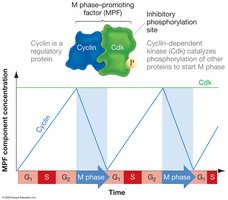
MPF is a key regulatory complex that triggers the cell's entry into M phase. It consists of a cyclin-dependent kinase (Cdk) and a regulatory protein called cyclin. MPF activity is regulated by the concentration of cyclin and phosphorylation status of Cdk.
Cyclin: Regulatory protein whose concentration fluctuates during the cell cycle.
Cdk (Cyclin-dependent kinase): Enzyme that is active only when bound to cyclin; phosphorylates target proteins to initiate M phase.
MPF is activated when cyclin binds to Cdk and an inhibitory phosphate is removed.
MPF is deactivated by negative feedback and cyclin degradation.
How Checkpoints Prevent Uncontrolled Division
Checkpoints use regulatory proteins to halt the cell cycle if conditions are not met. For example, the tumor suppressor protein p53 can pause the cycle or trigger apoptosis if DNA is damaged. Defects in checkpoint regulation can lead to cancer.
p53: Tumor suppressor protein that responds to DNA damage by pausing the cell cycle or initiating cell death.
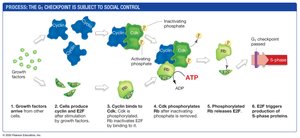
Rb protein: Inhibits cell cycle progression by binding E2F, a transcription factor required for S phase entry.
Growth factors stimulate cyclin production, leading to Rb phosphorylation and release of E2F, allowing the cell to proceed to S phase.
Cancer and the Cell Cycle
Cancer: Out-of-Control Cell Division
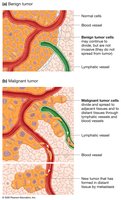
Cancer is a group of diseases characterized by uncontrolled cell division due to failures in cell-cycle regulation. Cancer cells often have mutations that activate growth-promoting proteins or inactivate tumor suppressors, allowing them to divide unchecked and invade other tissues.
Malignant tumors: Cancerous, invasive, and capable of metastasis (spreading to other parts of the body).
Benign tumors: Noncancerous and noninvasive.
Cancer cells may overproduce G1 cyclin or have defective Rb, leading to loss of cell-cycle control.
Summary Table: Cell Cycle Phases and Checkpoints
Phase | Main Events | Checkpoint Purpose |
|---|---|---|
G1 | Cell growth, normal function | Checks size, nutrients, DNA damage, growth signals |
S | DNA replication | — |
G2 | Preparation for mitosis | Checks DNA replication and damage |
M | Mitosis and cytokinesis | Checks chromosome attachment and segregation |
Key Equations and Concepts
MPF activation:
Negative feedback in regulation:
Additional info: The cell cycle is a highly conserved process across eukaryotes, and its dysregulation is a hallmark of cancer. Understanding the molecular mechanisms of cell-cycle control is crucial for developing cancer therapies.
