 Indietro
The Cell Cycle: Structure, Function, and Phases
Guida di studio - Note intelligenti
 Appunti personalizzati basati sui tuoi materiali, ampliati con definizioni chiave, esempi e contesto.
The Cell Cycle
Overview of Cell Division
The cell cycle is a fundamental process by which cells reproduce, ensuring continuity of life. It encompasses the events that occur from the formation of a cell to its division into two daughter cells. Cell division is essential for growth, development, tissue repair, and reproduction in all living organisms.
Cell Division: The process by which a parent cell divides into two genetically identical daughter cells.
Genetic Continuity: Ensures accurate transmission of genetic material (DNA) from one generation to the next.
Roles: Includes asexual reproduction, growth and development, and tissue renewal.

Key Functions of Cell Division
Cell division serves several critical functions in both unicellular and multicellular organisms.
Asexual Reproduction: Single-celled organisms reproduce by dividing, producing new organisms.
Growth and Development: Multicellular organisms grow and develop through repeated cell divisions.
Tissue Renewal: Cell division replaces damaged or dead cells in mature organisms.

Cellular Organization of Genetic Material
Chromosomes and Chromatin
Genetic material in cells is organized into chromosomes, which are composed of DNA and associated proteins. The structure and number of chromosomes vary between species and cell types.
Genome: All the DNA in a cell; can be a single DNA molecule (prokaryotes) or multiple DNA molecules (eukaryotes).
Chromatin: The complex of DNA and protein that condenses to form chromosomes during cell division.
Somatic Cells: Nonreproductive cells with two sets of chromosomes.
Gametes: Reproductive cells (sperm and eggs) with half the chromosome number of somatic cells.

Chromosome Duplication and Distribution
Before cell division, chromosomes are duplicated, resulting in two sister chromatids joined at the centromere. During division, chromatids separate, ensuring each daughter cell receives an identical set of chromosomes.
Sister Chromatids: Identical copies of a chromosome, joined at the centromere.
Centromere: The region where sister chromatids are most closely attached.
Chromosome Distribution: Chromatids separate and move to opposite nuclei, becoming individual chromosomes.


Phases of the Cell Cycle
Interphase and Mitotic Phase
The cell cycle consists of two main phases: interphase and the mitotic (M) phase. Interphase is the period of cell growth and DNA replication, while the M phase includes mitosis and cytokinesis.
Interphase: Divided into three subphases: G1 (growth), S (DNA synthesis), and G2 (preparation for division).
Mitotic (M) Phase: Includes mitosis (nuclear division) and cytokinesis (cytoplasmic division).

Stages of Mitosis
Mitosis is conventionally divided into five stages, each characterized by specific events that ensure accurate chromosome segregation.
Prophase: Chromatin condenses into visible chromosomes; spindle begins to form.
Prometaphase: Nuclear envelope fragments; spindle microtubules attach to kinetochores.
Metaphase: Chromosomes align at the metaphase plate.
Anaphase: Sister chromatids separate and move toward opposite poles.
Telophase: Nuclear envelopes reform; chromosomes decondense.


The Mitotic Spindle: Structure and Function
Mitotic Spindle Assembly
The mitotic spindle is a dynamic structure composed of microtubules and associated proteins, responsible for chromosome movement during mitosis.
Centrosome: Microtubule-organizing center; replicates and migrates to opposite cell poles.
Aster: Radial array of short microtubules extending from each centrosome.
Spindle Components: Includes centrosomes, spindle microtubules, and asters.
Chromosome Movement and Separation
During mitosis, chromosomes are moved by the spindle apparatus, with motor proteins and microtubule dynamics playing key roles.
Kinetochore: Protein complex at the centromere; attaches chromosomes to spindle microtubules.
Pac-man Mechanism: Motor proteins "walk" chromosomes along microtubules, which depolymerize at kinetochore ends.
Spindle Pole Mechanism: Chromosomes are "reeled in" by motor proteins at spindle poles; microtubules depolymerize after passing motor proteins.
Nonkinetochore Microtubules: Overlap and push against each other, elongating the cell.
Summary Table: Cell Cycle Phases
Phase | Main Events |
|---|---|
G1 Phase | Cell growth, metabolic activity |
S Phase | DNA synthesis, chromosome duplication |
G2 Phase | Preparation for cell division |
Mitosis | Nuclear division (prophase, prometaphase, metaphase, anaphase, telophase) |
Cytokinesis | Cytoplasmic division, formation of two daughter cells |
Key Terms and Definitions
Cell Cycle: The ordered sequence of events in the life of a cell, from its origin to its division into two daughter cells.
Mitosis: Division of the nucleus, resulting in two genetically identical daughter nuclei.
Cytokinesis: Division of the cytoplasm, producing two daughter cells.
Chromosome: A DNA molecule with associated proteins, carrying genetic information.
Chromatin: The complex of DNA and proteins that forms chromosomes.
Centromere: The region of a chromosome where sister chromatids are joined.
Kinetochore: Protein structure on the centromere that attaches to spindle microtubules.
Important Equations
While the cell cycle is primarily a biological process, the following equation represents the DNA content change during the S phase:
DNA Content After S Phase:
Example: Cell Division Cycle
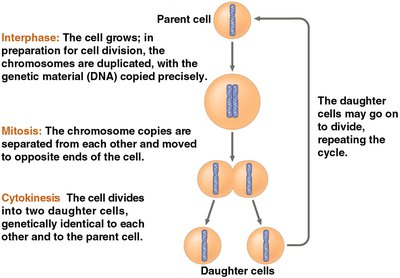
Consider a parent cell undergoing the cell cycle:
During interphase, the cell grows and duplicates its DNA.
In mitosis, the duplicated chromosomes are separated.
During cytokinesis, the cell splits into two genetically identical daughter cells.
Additional info:
Meiosis is a variation of cell division that produces gametes with half the chromosome number, leading to genetic diversity.
Cell cycle regulation is crucial for preventing uncontrolled cell division, which can result in cancer.
