 Indietro
The Cell Cycle: Structure, Function, and Regulation
Guida di studio - Note intelligenti
 Appunti personalizzati basati sui tuoi materiali, ampliati con definizioni chiave, esempi e contesto.
The Cell Cycle
Key Roles of Cell Division
Cell division is a fundamental process in biology, essential for reproduction, growth, renewal, and repair in organisms. It ensures the continuity of life by accurately distributing genetic material to daughter cells.
Reproduction: Single-celled organisms reproduce by cell division, creating new individuals.
Growth and Development: Multicellular organisms grow and develop through repeated cell divisions.
Renewal and Repair: Cell division replaces damaged or dead cells in tissues.
Genetic Continuity: Cell division passes identical DNA from one generation to the next.
Cellular Organization of Genetic Material
The genetic material in cells is organized as DNA, which forms the cell’s genome. DNA is packaged into chromosomes, each carrying many genes.
Genome: All DNA in a cell; may be a single molecule (prokaryotes) or multiple molecules (eukaryotes).
Chromatin: Complex of DNA and protein that condenses to form chromosomes during cell division.
Chromosomes: Structures that carry genetic information; each consists of a DNA molecule and associated proteins.
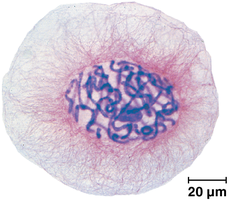
Eukaryotic Chromosomes
Eukaryotic chromosomes are made of chromatin and exist in characteristic numbers in each species.
Somatic Cells: Nonreproductive cells with two sets of chromosomes.
Gametes: Reproductive cells (sperm and eggs) with half the chromosome number of somatic cells.
Chromosome Duplication and Distribution
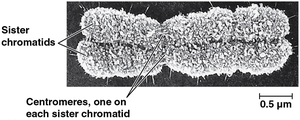
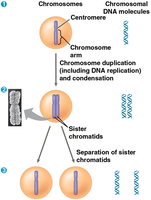
Before cell division, DNA is replicated and chromosomes condense. Each duplicated chromosome consists of two sister chromatids joined at the centromere. During division, chromatids separate and become individual chromosomes.
Sister Chromatids: Identical copies of a chromosome, joined by cohesins.
Centromere: Region where chromatids are most closely attached.
The Mitotic Cell Cycle
Phases of the Cell Cycle
The cell cycle consists of the mitotic (M) phase and interphase. Interphase is divided into three phases:
G1 Phase: Cell growth (first gap).
S Phase: DNA synthesis and chromosome duplication.
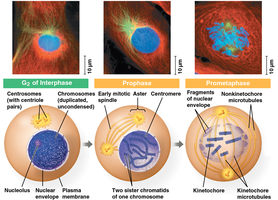
G2 Phase: Cell growth (second gap) and preparation for division.
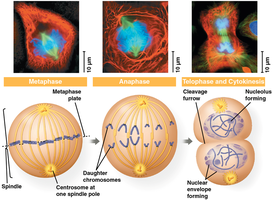
Phases of Mitosis
Mitosis is conventionally divided into five stages:
Prophase: Chromosomes condense, spindle forms.
Prometaphase: Nuclear envelope fragments, spindle microtubules attach to chromosomes.
Metaphase: Chromosomes align at the metaphase plate.
Anaphase: Sister chromatids separate and move to opposite poles.
Telophase: Nuclear envelopes reform, chromosomes decondense.
Cytokinesis
Cytokinesis is the division of the cytoplasm.
Animal Cells: Occurs by cleavage, forming a cleavage furrow.
Plant Cells: Occurs by formation of a cell plate.
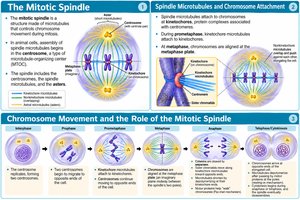
The Mitotic Spindle
The mitotic spindle is a structure made of microtubules that orchestrates chromosome movement during mitosis.
Centrosomes: Organize spindle microtubules.
Kinetochore Microtubules: Attach to chromosomes at the kinetochore.
Nonkinetochore Microtubules: Interact with those from the opposite pole.
Asters: Short microtubules radiating from centrosomes.
Binary Fission in Bacteria
Process of Binary Fission
Prokaryotes reproduce by binary fission, a simpler process than mitosis.
Chromosome Replication: Begins at the origin of replication.
Chromosome Segregation: Daughter chromosomes move apart.
Cell Division: Plasma membrane pinches inward, dividing the cell.
Regulation of the Cell Cycle
Cell Cycle Control System
The cell cycle is regulated by a molecular control system, acting like a clock with checkpoints.
Checkpoints: Points where the cell cycle stops until a go-ahead signal is received (G1, G2, M).
Cyclins: Proteins with cyclically fluctuating concentrations.
Cyclin-Dependent Kinases (Cdks): Enzymes that must bind cyclins to be active.
Maturation-Promoting Factor (MPF): Cyclin-Cdk complex that triggers passage past the G2 checkpoint into M phase.
Internal and External Signals
Internal Signals: Surveillance mechanisms ensure proper chromosome attachment before anaphase.
External Signals: Growth factors stimulate cell division; density-dependent inhibition and anchorage dependence regulate cell growth.
Loss of Cell Cycle Controls in Cancer Cells
Cancer and Cell Cycle Regulation
Cancer cells escape normal cell cycle controls, leading to uncontrolled division.
Transformation: Conversion of a normal cell to a cancerous cell.
Tumors: Masses of abnormal cells; benign tumors remain localized, malignant tumors invade and metastasize.
Chemotherapy: Targets the cell cycle in metastatic cancers, but affects normal dividing cells as well.
Summary Table: Cell Cycle Regulation
Regulatory Component | Function |
|---|---|
Cyclins | Regulate cell cycle progression by fluctuating in concentration |
Cdks | Enzymes activated by cyclins to phosphorylate target proteins |
MPF | Triggers entry into M phase |
Checkpoints | Ensure proper conditions before proceeding |
Growth Factors | Stimulate cell division externally |
Density-dependent inhibition | Stops division when cells are crowded |
Anchorage dependence | Requires cells to be attached to a substrate to divide |
Key Equations and Concepts
DNA Replication: Occurs during S phase, ensuring each daughter cell receives a complete genome.
Cell Cycle Progression: Driven by cyclin-Cdk complexes.
Equation for Cdk activity:
Equation for cell division:
Additional info: The notes include expanded explanations of cell cycle regulation, mitosis, and cancer, providing context for exam preparation.
