 Indietro
The Cell Cycle: Structure, Regulation, and Significance Chpt. 9
Guida di studio - Note intelligenti
 Appunti personalizzati basati sui tuoi materiali, ampliati con definizioni chiave, esempi e contesto.
The Cell Cycle
Introduction to the Cell Cycle
The cell cycle is a fundamental process in biology, enabling cells to grow, replicate their genetic material, and divide. This process is essential for the development, maintenance, and reproduction of all living organisms. The cell cycle consists of a series of phases that ensure the accurate duplication and distribution of chromosomes to daughter cells.
Key Roles of Cell Division
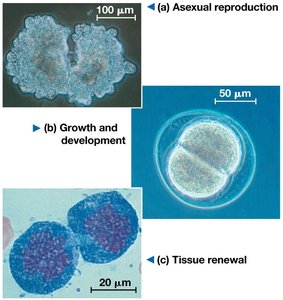
Asexual Reproduction: Single-celled organisms reproduce by cell division, creating genetically identical offspring.
Growth and Development: Multicellular organisms grow and develop through repeated cell divisions.
Tissue Renewal and Repair: Cell division replaces damaged or dead cells in tissues.
Accuracy: Cell division is highly regulated to ensure genetic fidelity.
Cellular Organization of Genetic Material
Chromosomes and Chromatin
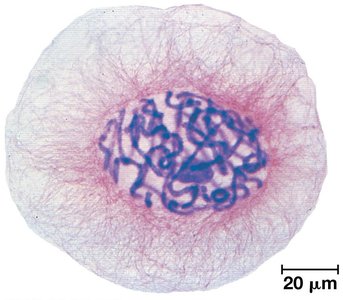
All the DNA in a cell constitutes its genome. In prokaryotes, the genome is typically a single DNA molecule, while eukaryotes possess multiple DNA molecules organized into chromosomes. Eukaryotic chromosomes are composed of chromatin, a complex of DNA and protein. Each species has a characteristic number of chromosomes.
Somatic Cells: Non-reproductive cells with a full set of chromosomes (e.g., humans have 46).
Gametes: Reproductive cells (sperm and eggs) with half the chromosome number (e.g., humans have 23).
Chromosome Duplication and Distribution
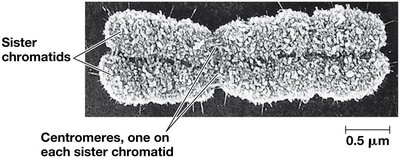
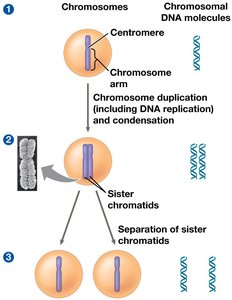
Before cell division, chromosomes are duplicated, forming two sister chromatids joined at the centromere. During division, chromatids separate and are distributed to daughter cells.
Chromatin Fiber: Chromosomes exist as extended chromatin fibers when not dividing.
Condensation: Chromosomes condense before division.
Sister Chromatids: Duplicated chromosomes consist of two identical chromatids.
Phases of the Cell Cycle
Overview of Cell Cycle Phases
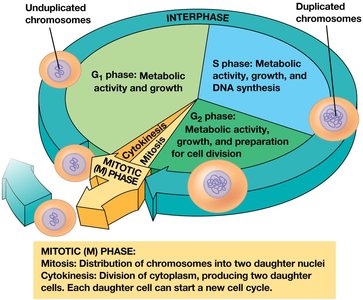
The cell cycle is divided into two main phases: Interphase and the Mitotic (M) phase. Interphase is further subdivided into three stages: G1 (first gap), S (synthesis), and G2 (second gap). The M phase includes mitosis and cytokinesis.
G1 phase: Cell growth and metabolic activity.
S phase: DNA synthesis and chromosome duplication.
G2 phase: Preparation for cell division.
M phase: Distribution of chromosomes and division of cytoplasm.
Mitosis: The Five Phases
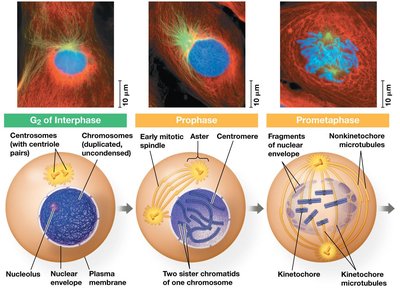
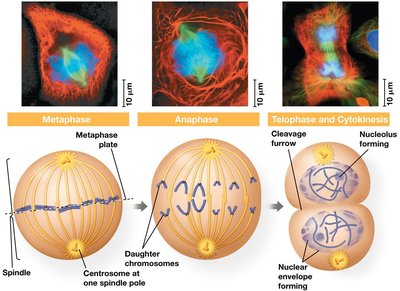
Mitosis is conventionally divided into five phases:
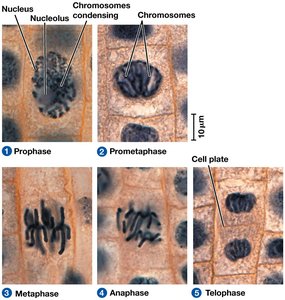
Prophase: Chromosomes condense, spindle forms.
Prometaphase: Nuclear envelope fragments, spindle microtubules attach to kinetochores.
Metaphase: Chromosomes align at the metaphase plate.
Anaphase: Sister chromatids separate and move to opposite poles.
Telophase: Nuclear envelopes reform, chromosomes decondense.
Cytokinesis overlaps the latter stages of mitosis, dividing the cytoplasm.
The Mitotic Spindle
Structure and Function
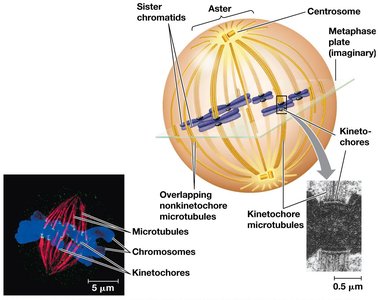
The mitotic spindle is a structure made of microtubules and proteins, essential for chromosome movement during mitosis. In animal cells, spindle assembly begins at the centrosome, which duplicates and migrates to opposite poles.
Aster: Radial array of short microtubules extending from each centrosome.
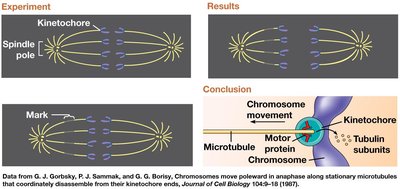
Kinetochores: Protein complexes at centromeres where spindle microtubules attach.
Metaphase Plate: Imaginary plane where chromosomes align during metaphase.
Chromosome Movement
During anaphase, microtubules shorten by depolymerizing at their kinetochore ends, and motor proteins help "reel in" chromosomes. Nonkinetochore microtubules elongate the cell by pushing against each other.
Cytokinesis
Mechanisms in Animal and Plant Cells
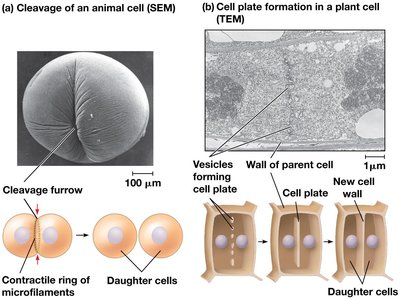
Cytokinesis is the process of cytoplasmic division. In animal cells, it occurs by cleavage, forming a cleavage furrow. In plant cells, a cell plate forms, eventually becoming the new cell wall.
Binary Fission in Prokaryotes
Bacterial Cell Division
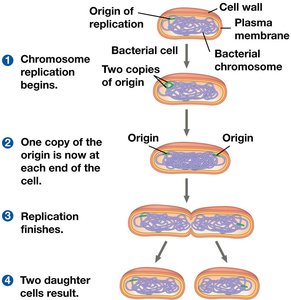
Prokaryotes divide by binary fission. The single chromosome replicates, and the cell elongates. When replication is complete, the plasma membrane pinches inward, dividing the cell into two genetically identical daughter cells.
Evolution of Mitosis
Intermediate Cell Division Mechanisms
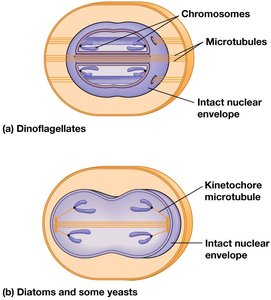
Mitosis likely evolved from binary fission. Some protists exhibit intermediate forms of cell division, where the nuclear envelope remains intact throughout mitosis.
Regulation of the Cell Cycle
Molecular Control System
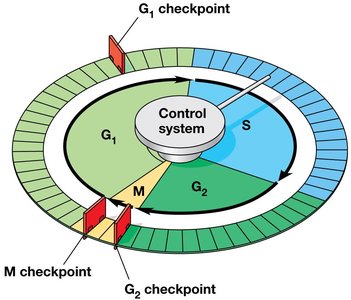
The cell cycle is regulated by a molecular control system, with checkpoints ensuring proper progression. Cancer cells can escape these controls, leading to uncontrolled division.
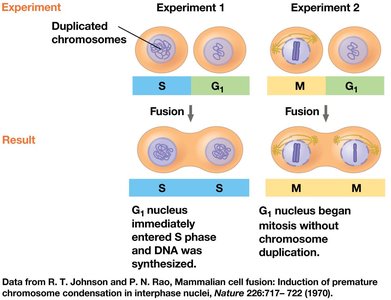
Cytoplasmic Signals: Experiments show that cytoplasmic factors regulate cell cycle progression.
Cell Cycle Checkpoints
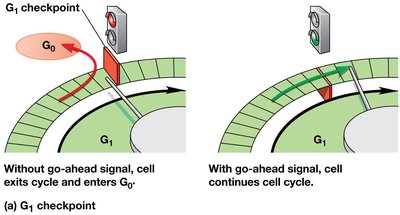
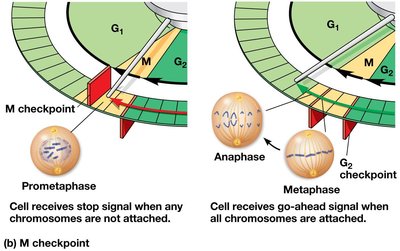
Checkpoints are control points where the cell cycle can be halted until certain conditions are met. The G1 checkpoint (restriction point) is especially important. If a cell does not receive a go-ahead signal, it enters a nondividing state (G0 phase).
Regulatory Proteins
Cyclins and Kinases: Regulatory proteins and complexes control cell cycle progression.
Internal Signals: For example, anaphase does not begin until all kinetochores are attached to spindle microtubules.
External Signals: Growth factors stimulate cell division; density-dependent inhibition and anchorage dependence regulate division in multicellular organisms.
Loss of Cell Cycle Controls in Cancer Cells
Cancer Cell Characteristics
Cancer cells do not respond to normal cell cycle signals. They may produce their own growth factors, convey signals without external factors, or have abnormal control systems. Cancer cells can divide indefinitely, evade apoptosis, and form tumors.
Benign Tumors: Remain at the original site.
Malignant Tumors: Invade tissues and metastasize to other parts of the body.
Treatment: Radiation and chemotherapy target dividing cells; personalized medicine is emerging based on tumor DNA sequencing.
Summary Table: Cell Cycle Phases and Key Events
Phase | Main Events |
|---|---|
G1 | Cell growth, metabolic activity |
S | DNA synthesis, chromosome duplication |
G2 | Preparation for division |
Mitosis | Chromosome segregation |
Cytokinesis | Division of cytoplasm |
Key Equations
DNA Replication:
Chromosome Number in Humans:
Additional info: The notes expand on brief points from the original slides, providing definitions, examples, and context for each concept. Images are included only when directly relevant to the explanation.
