 Indietro
The Cell Membrane: Structure, Fluidity, and Function
Guida di studio - Note intelligenti
 Appunti personalizzati basati sui tuoi materiali, ampliati con definizioni chiave, esempi e contesto.
The Membrane
Membrane Composition & The Phospholipid Bilayer
The cell membrane is primarily composed of a double layer of phospholipids, which are amphipathic molecules with both hydrophilic and hydrophobic regions. This unique structure is essential for forming the selective barrier that separates the cell from its environment.
Phosphate Head: The phosphate group is polar and negatively charged, making it hydrophilic (water-attracting). This allows the head to interact with aqueous environments inside and outside the cell.
Fatty Acid Tails: These are long chains of carbon and hydrogen atoms, nonpolar and hydrophobic (water-repelling), which orient away from water.
Amphipathic Nature: The combination of hydrophilic heads and hydrophobic tails causes phospholipids to spontaneously arrange into a bilayer, with heads facing outward and tails inward, forming the basic structure of the membrane.
Behavior in Nonpolar Solvents: In a nonpolar environment, the bilayer inverts, with hydrophobic tails facing outward and hydrophilic heads clustering inside, disrupting membrane function and leading to cell breakdown.
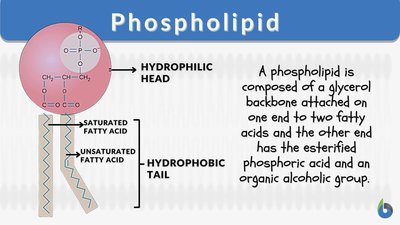
Additional info: The amphipathic property of phospholipids is fundamental to membrane formation and function, influencing membrane fluidity and permeability.
Membrane Fluidity & Environmental Adaptations
Membrane fluidity is crucial for cell survival and function, allowing for flexibility, self-healing, and the movement of proteins within the membrane. Cells adapt their membrane composition to maintain optimal fluidity under different environmental conditions.
Hot Spring Bacteria: To withstand high temperatures, these organisms increase the proportion of saturated fatty acids in their membranes. Saturated fats have straight tails that pack tightly, preventing the membrane from becoming too fluid or melting.
Role of Unsaturated Fats: Unsaturated fatty acids have kinks due to double bonds, increasing membrane fluidity. In high heat, cells minimize these to avoid excess fluidity.
Cholesterol as a Regulator: Cholesterol acts as a negative feedback mechanism, stabilizing membrane fluidity. At high temperatures, it restricts phospholipid movement, while at low temperatures, it prevents tight packing of fatty acid tails, avoiding membrane rigidity.
Additional info: Membrane fluidity is also influenced by the length of fatty acid chains and the presence of other lipids.
Protein Diversity & Cell Recognition
Membrane proteins and carbohydrates play key roles in cell recognition, signaling, and immune response. The diversity of these molecules allows cells to communicate and distinguish self from non-self.
Glycolipids and Glycoproteins: Carbohydrate chains attached to lipids and proteins act as molecular ID tags, enabling immune cells to recognize body cells and detect foreign invaders.
Blood Types: Differences in carbohydrate markers on red blood cells determine blood types. Transfusion of incompatible blood triggers immune reactions, leading to agglutination and hemolysis.
Integral Proteins: These span the membrane, with hydrophobic regions anchoring them within the bilayer and hydrophilic regions exposed to aqueous environments. They serve as receptors for drugs and signaling molecules.
Additional info: Peripheral proteins are attached to the membrane surface and play roles in signaling and maintaining cell shape.
Selective Permeability & Transport Systems
The cell membrane is selectively permeable, allowing only certain substances to cross. This property is essential for maintaining homeostasis and controlling the internal environment of the cell.
Ion Transport: Small ions (e.g., Na+) require channel proteins to cross the membrane because their charge attracts water molecules, forming a hydration shell. The hydrophobic core of the membrane repels these charged particles, so channel proteins provide a hydrophilic passageway.
Carrier Proteins: These proteins bind specific molecules, undergo a conformational change, and transport the molecules across the membrane. This mechanism ensures that only target substances are transported, maintaining selective permeability.
Additional info: Other transport mechanisms include passive diffusion, facilitated diffusion, and active transport, each with distinct energy requirements and specificity.
