 Indietro
chapter 8 study guide
Guida di studio - Note intelligenti
 Appunti personalizzati basati sui tuoi materiali, ampliati con definizioni chiave, esempi e contesto.
Introduction to Cell Division and Cancer
Cell division is a fundamental process in all living organisms, essential for growth, development, and maintenance. While normal cell division is tightly regulated, mutations can disrupt this control, leading to uncontrolled cell proliferation and cancer. Cancer cells lose the ability to regulate their division, invade other tissues, and can ultimately be fatal.
Cell Division and Reproduction
Roles of Cell Division
Cell division is central to the reproduction of cells and organisms, as all cells arise from preexisting cells.
Asexual reproduction produces genetically identical offspring (clones) from a single parent.
Sexual reproduction generates genetically diverse offspring through the combination of genetic material from two parents.
Prokaryotic Cell Division: Binary Fission
Mechanism of Binary Fission
Prokaryotes reproduce asexually by binary fission, a process in which a single cell divides into two genetically identical daughter cells.
Most prokaryotic genes are located on a single, circular DNA molecule (chromosome).
During binary fission:
The chromosome is duplicated and the copies move apart.
The cell elongates and the plasma membrane pinches inward.
New cell wall material is deposited, dividing the cell into two.
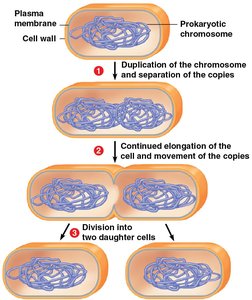
Additional info: Binary fission is classified as asexual reproduction because the offspring are genetically identical to the parent cell.
The Eukaryotic Cell Cycle and Mitosis
Chromosomes and Chromatin
Eukaryotic cells contain multiple, linear chromosomes located in the nucleus.
Each chromosome consists of a long DNA molecule and associated proteins, forming chromatin.
Chromosomes are visible under a microscope only during cell division; otherwise, they exist as diffuse chromatin.
Chromosome Duplication and Sister Chromatids
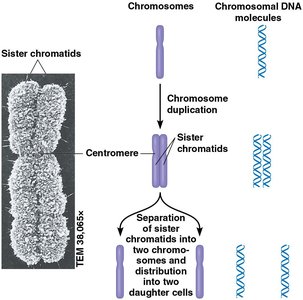
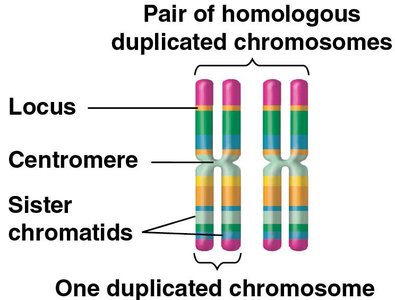
Before division, chromosomes duplicate, forming sister chromatids joined at the centromere.
During cell division, sister chromatids separate, ensuring each daughter cell receives an identical set of chromosomes.
The Cell Cycle
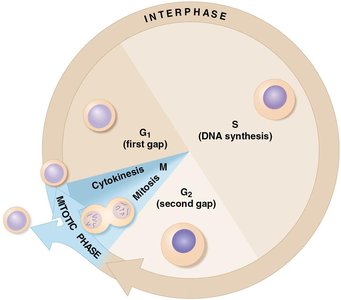
The cell cycle is an ordered sequence of events from the formation of a cell to its own division.
Interphase: Period of cell growth and DNA replication, consisting of G1 (first gap), S (DNA synthesis), and G2 (second gap) phases.
Mitotic (M) phase: Includes mitosis (nuclear division) and cytokinesis (cytoplasmic division).
Mitosis: Distribution of Chromosomes
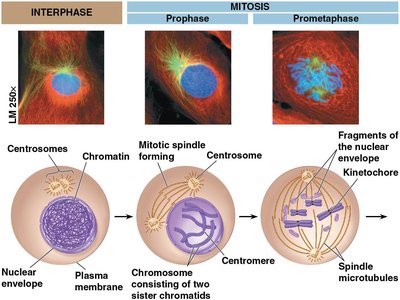
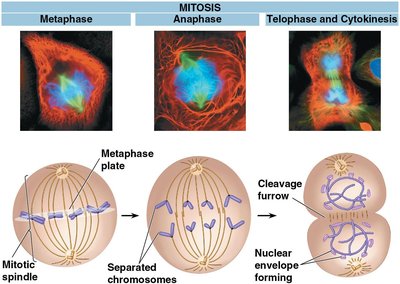
Mitosis ensures equal distribution of duplicated chromosomes to two daughter nuclei.
The mitotic spindle, composed of microtubules, orchestrates chromosome movement.
Sister chromatids are separated and moved to opposite poles, forming two new nuclei.
Cytokinesis in Animal and Plant Cells
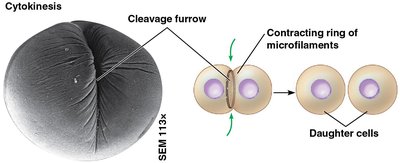
Animal cells: Cytokinesis occurs via a cleavage furrow, where a contracting ring of microfilaments pinches the cell in two.
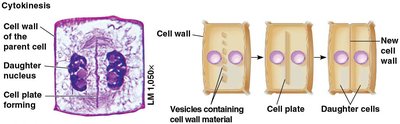
Plant cells: Cytokinesis involves the formation of a cell plate, which develops into a new cell wall, dividing the cell.
Regulation of the Cell Cycle
Environmental Factors Affecting Cell Division
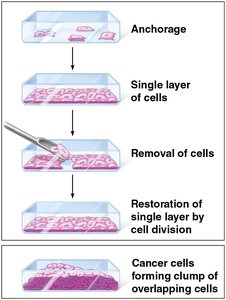
Most normal cells require attachment to a surface (anchorage dependence) and stop dividing when they contact neighboring cells (density-dependent inhibition).
Growth factors are proteins that stimulate cell division; some cells require external growth factors to divide.
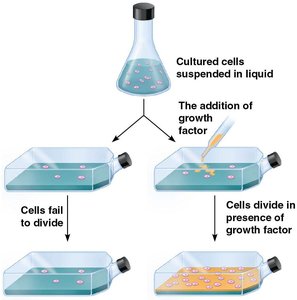
Cell Cycle Control System
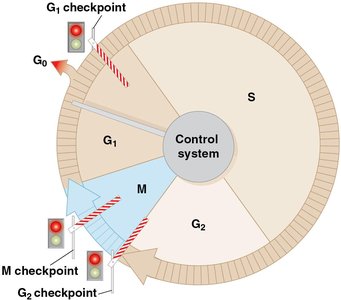
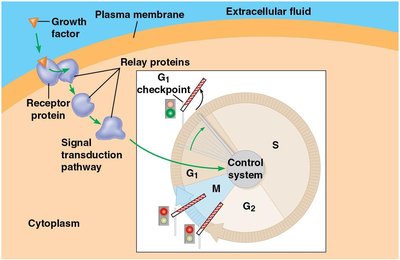
The cell cycle is regulated by a set of proteins that control progression through critical checkpoints (G1, G2, and M).
Signals, such as growth factors binding to receptors, determine whether a cell proceeds through the cycle and divides.
Meiosis and Sexual Life Cycles
Homologous Chromosomes
Somatic cells contain pairs of homologous chromosomes (e.g., humans have 23 pairs).
Homologous chromosomes carry genes for the same traits at the same loci but may have different versions (alleles).
Haploid and Diploid Cells
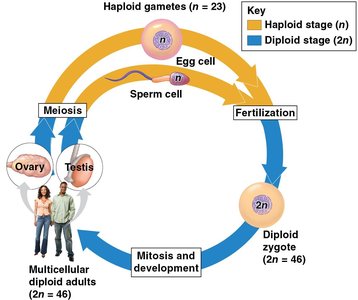
Diploid (2n) cells have two sets of homologous chromosomes.
Haploid (n) gametes (sperm and egg) have one set of chromosomes.
Sexual life cycles alternate between haploid and diploid stages.
Meiosis: Reduction Division
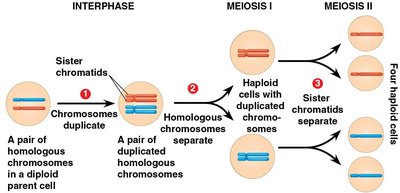
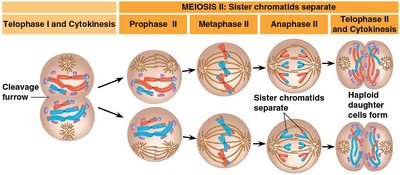
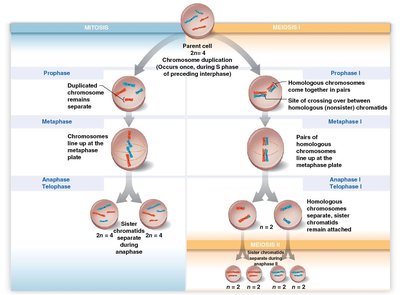
Meiosis reduces the chromosome number from diploid to haploid, producing four genetically unique gametes.
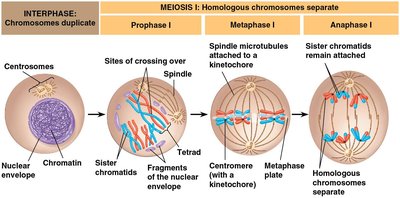
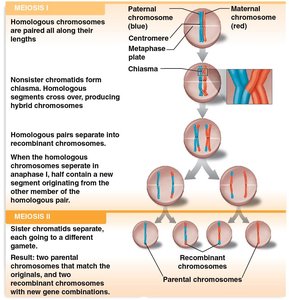
Meiosis I separates homologous chromosomes; crossing over occurs, increasing genetic diversity.
Meiosis II separates sister chromatids, similar to mitosis.
Comparing Mitosis and Meiosis
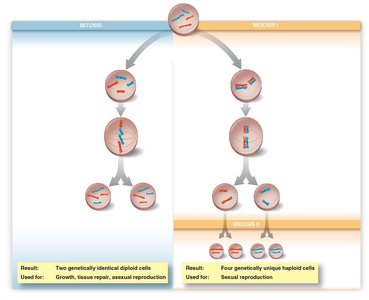
Both start with diploid cells that have duplicated chromosomes.
Mitosis produces two genetically identical diploid cells for growth and repair.
Meiosis produces four genetically unique haploid gametes for sexual reproduction.
Genetic Variation in Sexual Reproduction
Independent Assortment and Random Fertilization
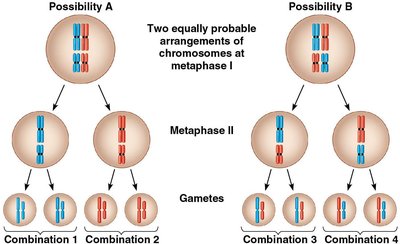
Random orientation of homologous chromosomes during metaphase I leads to many possible combinations in gametes.
Random fertilization further increases genetic diversity among offspring.
Crossing Over and Genetic Recombination
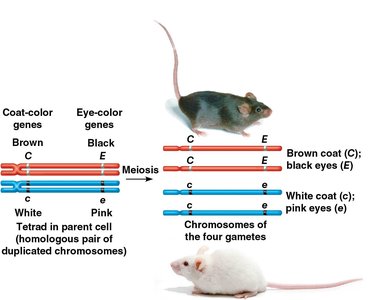
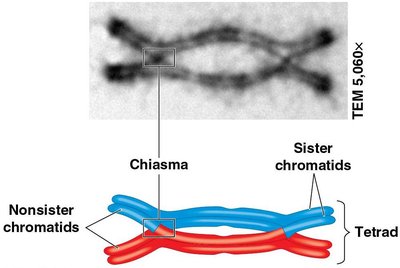
Homologous chromosomes can exchange segments during crossing over in prophase I, producing new combinations of alleles.
This process, called genetic recombination, increases genetic variability in gametes.
Alterations of Chromosome Number and Structure
Nondisjunction
Nondisjunction is the failure of homologous chromosomes or sister chromatids to separate properly during meiosis.
This can result in gametes with abnormal chromosome numbers, leading to disorders such as Down syndrome.
Additional info: Nondisjunction can occur during either meiosis I or II, and may result in gametes that are diploid or lack certain chromosomes entirely.
Summary Table: Mitosis vs. Meiosis
Feature | Mitosis | Meiosis |
|---|---|---|
Number of divisions | 1 | 2 |
Number of daughter cells | 2 | 4 |
Genetic composition | Identical to parent | Unique (genetic variation) |
Chromosome number | Diploid (2n) | Haploid (n) |
Role | Growth, repair, asexual reproduction | Sexual reproduction |
