 Indietro
The Chemical Basis of Life: Atoms, Elements, and Water
Guida di studio - Note intelligenti
 Appunti personalizzati basati sui tuoi materiali, ampliati con definizioni chiave, esempi e contesto.
The Chemical Basis of Life
Atoms and Elements
All matter is composed of atoms, which are the smallest units of elements that retain the properties of those elements. Elements are pure substances consisting of only one type of atom and are defined by their atomic number, which is the number of protons in the nucleus.
Atom: The basic unit of matter, composed of protons, neutrons, and electrons.
Element: A substance that cannot be broken down into simpler substances by chemical means. Each element is defined by its atomic number.
Atomic Number (Z): Number of protons in the nucleus; determines the identity of the element.
Atomic Mass (A): The sum of protons and neutrons in the nucleus.
Isotopes: Atoms of the same element with different numbers of neutrons.
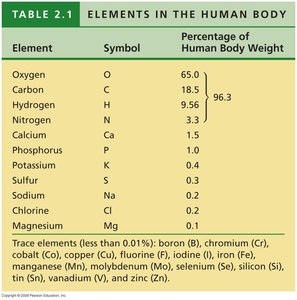
Example: Carbon has an atomic number of 6, meaning every carbon atom has 6 protons. Its most common isotope has 6 neutrons, giving it an atomic mass of 12.
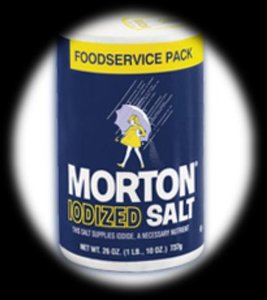
Additional info: Trace elements, such as iodine, are required in small amounts but are essential for health. Iodine deficiency can lead to goiter, as shown below.

Structure of the Atom
Atoms consist of a central nucleus containing protons and neutrons, surrounded by electrons in orbitals. The arrangement of electrons determines the chemical behavior of the atom.
Proton: Positively charged particle in the nucleus; mass ≈ 1.67 × 10⁻²⁷ kg.
Neutron: Neutral particle in the nucleus; mass ≈ 1.67 × 10⁻²⁷ kg.
Electron: Negatively charged particle orbiting the nucleus; mass ≈ 9.1 × 10⁻³¹ kg.
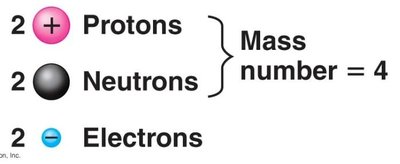
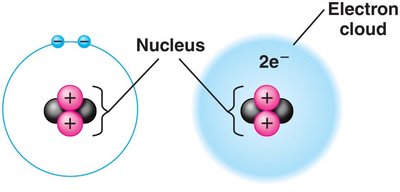
Example: Helium (He) has 2 protons, 2 neutrons, and 2 electrons.
Electron Configuration and the Periodic Table
The arrangement of electrons in shells or energy levels around the nucleus determines how atoms interact. The periodic table organizes elements by increasing atomic number and similar chemical properties.
Electron Shells: Electrons occupy energy levels (shells) around the nucleus. The first shell holds up to 2 electrons, the second up to 8, and so on.
Valence Electrons: Electrons in the outermost shell; determine chemical reactivity.

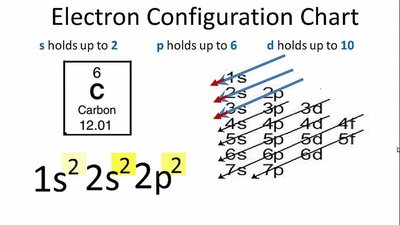
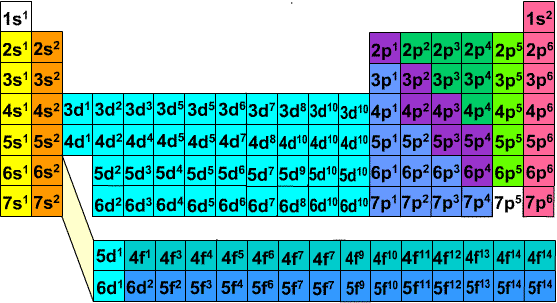
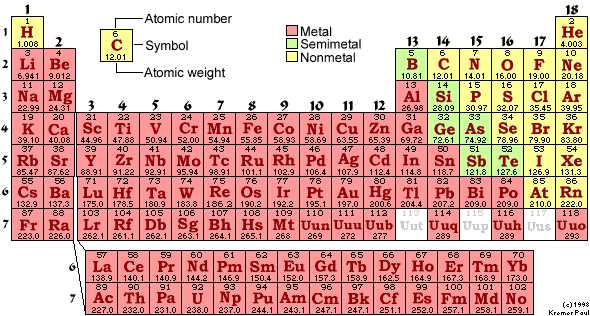
Example: The electron configuration for carbon (atomic number 6) is .
Compounds and Molecules
Atoms combine to form compounds and molecules through chemical bonds. A compound consists of two or more different elements joined in a fixed ratio.
Molecule: Two or more atoms held together by covalent bonds.
Compound: A substance formed from two or more elements in a fixed ratio.
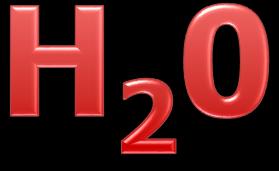
Example: Water (H2O) is a molecule and a compound; oxygen gas (O2) is a molecule but not a compound.
Chemical Bonds
Chemical bonds are forces that hold atoms together in compounds. The main types are ionic, covalent, and hydrogen bonds.
Ionic Bond: Formed when electrons are transferred from one atom to another, creating oppositely charged ions that attract each other.
Covalent Bond: Formed when two atoms share one or more pairs of electrons.
Hydrogen Bond: A weak attraction between a hydrogen atom in one molecule and an electronegative atom in another molecule.
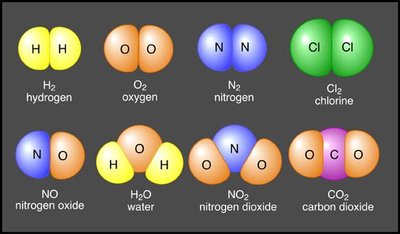
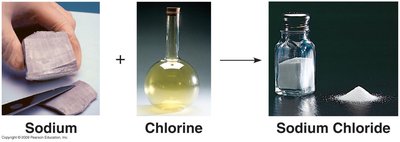
Example: Sodium chloride (NaCl) forms via ionic bonding; water (H2O) forms via covalent bonding.
Electronegativity and Polarity
Electronegativity is an atom's ability to attract shared electrons. Differences in electronegativity lead to polar covalent bonds, where electrons are unequally shared, creating partial charges.
Nonpolar Covalent Bond: Electrons are shared equally (e.g., O2).
Polar Covalent Bond: Electrons are shared unequally, resulting in partial charges (e.g., H2O).
Example: In water, oxygen is more electronegative than hydrogen, so electrons are pulled closer to oxygen, making water a polar molecule.
Properties of Water
Water's polarity leads to hydrogen bonding, giving rise to unique properties essential for life.
Cohesion: Water molecules stick to each other, allowing for surface tension.
Adhesion: Water molecules stick to other substances.
High Specific Heat: Water can absorb or release large amounts of heat with little temperature change.
Solvent Properties: Water dissolves many substances, making it the "universal solvent."
Evaporative Cooling: As water evaporates, it removes heat, cooling surfaces.
Example: Dew on a spider web demonstrates water's cohesion and surface tension.

Acids, Bases, and pH
Water can dissociate into hydrogen ions (H+) and hydroxide ions (OH-). The concentration of H+ ions determines the acidity or basicity (alkalinity) of a solution, measured by the pH scale.
Acid: Substance that increases H+ concentration in solution (pH < 7).
Base: Substance that decreases H+ concentration or increases OH- (pH > 7).
pH Scale: Ranges from 0 (most acidic) to 14 (most basic); each unit represents a tenfold change in H+ concentration.
Neutralization: Mixing an acid and a base produces water and a salt.
Buffers: Substances that minimize changes in pH by accepting or donating H+ ions.
Example: Human blood is buffered to maintain a pH near 7.4, essential for proper physiological function.
Chemical Reactions
Chemical reactions involve the making and breaking of chemical bonds, transforming reactants into products. The rearrangement of atoms during reactions is fundamental to all biological processes.
Reactants: Starting substances in a chemical reaction.
Products: Substances formed as a result of the reaction.
Example: The formation of water from hydrogen and oxygen:
