 Indietro
The Chemical Basis of Life: Atoms, Bonds, and Water in Biology
Guida di studio - Note intelligenti
 Appunti personalizzati basati sui tuoi materiali, ampliati con definizioni chiave, esempi e contesto.
Chapter 2: The Chemical Basis of Life
Atoms, Elements, and Compounds
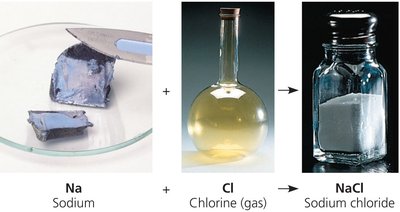
All living organisms are composed of matter, which is anything that takes up space and has mass. Matter is made up of elements, substances that cannot be broken down into other substances by chemical means. Compounds are substances consisting of two or more elements combined in a fixed ratio, exhibiting emergent properties distinct from their constituent elements.
Atom: The smallest unit of an element, composed of protons, neutrons, and electrons.
Element: A pure substance consisting entirely of one type of atom (e.g., Oxygen, Carbon).
Compound: A substance formed from two or more elements in a fixed ratio (e.g., H2O, NaCl).
Essential Elements of Life
About 25 elements are essential for life. Four elements—carbon (C), hydrogen (H), nitrogen (N), and oxygen (O)—make up approximately 96% of living matter. Other important elements include phosphorus (P), sulfur (S), calcium (Ca), and potassium (K). Trace elements, such as iron (Fe) and iodine (I), are required in minute amounts but are vital for proper biological function.
CHNOPS: Acronym for the six most important chemical elements in biological molecules: Carbon, Hydrogen, Nitrogen, Oxygen, Phosphorus, Sulfur.
Trace Elements: Elements required by an organism in only minute quantities (e.g., iron for oxygen transport in blood).
Structure of Atoms
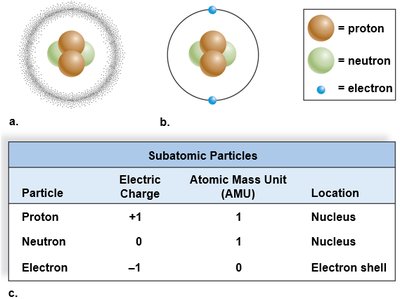
Atoms consist of a nucleus containing protons (positively charged) and neutrons (neutral), surrounded by electrons (negatively charged) in electron shells. The atomic number equals the number of protons, while the mass number is the sum of protons and neutrons.
Proton: Positive charge, located in the nucleus.
Neutron: No charge, located in the nucleus.
Electron: Negative charge, orbits the nucleus in energy shells.
Particle | Electric Charge | Atomic Mass Unit (AMU) | Location |
|---|---|---|---|
Proton | +1 | 1 | Nucleus |
Neutron | 0 | 1 | Nucleus |
Electron | -1 | 0 | Electron shell |
Isotopes and Ions
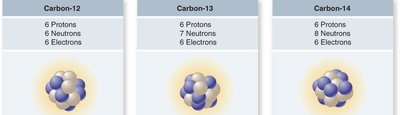
Isotopes are atoms of the same element with different numbers of neutrons, resulting in different mass numbers. Some isotopes are radioactive and can be used in biological research and medicine. Ions are atoms that have gained or lost electrons, resulting in a net charge.
Isotope: Atoms of the same element with different numbers of neutrons (e.g., Carbon-12, Carbon-13, Carbon-14).
Ion: An atom or molecule with a net electric charge due to the loss or gain of electrons.
Electron Shells and Energy Levels
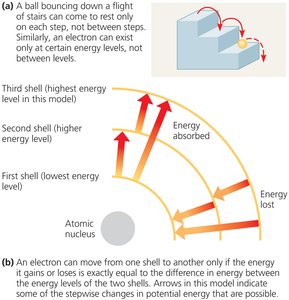
Electrons occupy energy levels or shells around the nucleus. The chemical behavior of an atom is largely determined by the number of electrons in its outermost shell (valence shell). Atoms tend to complete their valence shell by gaining, losing, or sharing electrons, leading to chemical bonding.
Octet Rule: Atoms are most stable when they have eight electrons in their valence shell (except for the first shell, which is full with two electrons).
Valence Electrons: Electrons in the outermost shell, involved in chemical bonding.
Chemical Bonds and Molecules
Chemical bonds form when atoms interact to complete their valence shells. The main types of chemical bonds in biology are covalent bonds, ionic bonds, and hydrogen bonds.
Covalent Bond: Sharing of electron pairs between atoms. Can be nonpolar (equal sharing) or polar (unequal sharing).
Ionic Bond: Transfer of electrons from one atom to another, resulting in oppositely charged ions that attract each other.
Hydrogen Bond: Weak attraction between a hydrogen atom (partially positive) and an electronegative atom (such as oxygen or nitrogen).
Properties of Water and Its Importance to Life
Water is essential for life due to its unique chemical and physical properties, which arise from its polar covalent bonds and ability to form hydrogen bonds. These properties include cohesion, adhesion, high specific heat, expansion upon freezing, and versatility as a solvent.
Cohesion: Attraction between water molecules due to hydrogen bonding, leading to surface tension.
Adhesion: Attraction between water molecules and other substances, important for capillary action in plants.
High Specific Heat: Water can absorb or release large amounts of heat with little temperature change, stabilizing environments.
Expansion Upon Freezing: Ice is less dense than liquid water, allowing it to float and insulate aquatic life.
Universal Solvent: Water dissolves many substances due to its polarity, facilitating chemical reactions in cells.

Acids, Bases, pH, and Buffers
The pH scale measures the concentration of hydrogen ions (H+) in a solution. Acids increase H+ concentration, while bases decrease it. Buffers are substances that minimize changes in pH by accepting or donating H+ ions, maintaining homeostasis in biological systems.
pH Scale: Ranges from 0 (most acidic) to 14 (most basic), with 7 being neutral.
Acid: Substance that increases H+ concentration (pH < 7).
Base: Substance that decreases H+ concentration (pH > 7).
Buffer: Substance that resists changes in pH, crucial for maintaining stable conditions in cells and blood.
Equation: The relationship between pH and hydrogen ion concentration is given by:
Example: Human blood is maintained at a pH of 7.35–7.45 by buffer systems such as the bicarbonate buffer system.
Summary Table: Types of Chemical Bonds
Bond Type | Description | Relative Strength | Biological Importance |
|---|---|---|---|
Nonpolar Covalent | Equal sharing of electrons | Strong | Stability in molecules like O2, CH4 |
Polar Covalent | Unequal sharing of electrons | Strong | Polarity of water, solubility |
Ionic | Transfer of electrons, attraction of ions | Moderate | Formation of salts, nerve function |
Hydrogen | Attraction between H and electronegative atom | Weak | Stabilizes DNA, protein structure, water properties |
Key Terms and Concepts
Reactants and Products: In a chemical reaction, reactants are transformed into products.
Kinetic Energy: Energy of motion.
Potential Energy: Stored energy due to position or structure.
Example: The reaction 2H2 + O2 → 2H2O shows hydrogen and oxygen (reactants) forming water (product).
Additional info: These foundational chemical principles are essential for understanding the structure and function of biological molecules, cellular processes, and the maintenance of life.
