 Indietro
The Chemical Context of Life: Atoms, Molecules, and Bonds
Guida di studio - Note intelligenti
 Appunti personalizzati basati sui tuoi materiali, ampliati con definizioni chiave, esempi e contesto.
The Chemical Context of Life
Atoms, Elements, and Molecules
All living organisms are composed of chemicals, which are organized into atoms, elements, and molecules. Understanding the structure and properties of atoms is fundamental to biology, as it explains how elements interact to form the molecules essential for life.
Atom: The smallest unit of matter that retains the properties of an element.
Element: A substance that cannot be broken down into other substances by chemical reactions. Examples include carbon, oxygen, hydrogen, and nitrogen.
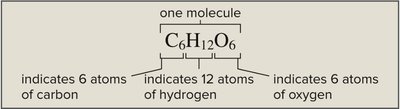
Molecule: Two or more atoms bonded together, such as H2O (water) or C6H12O6 (glucose).
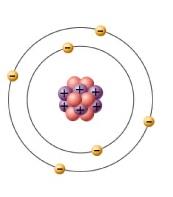
Subatomic particles: Atoms are made of protons (+), neutrons (0), and electrons (-).
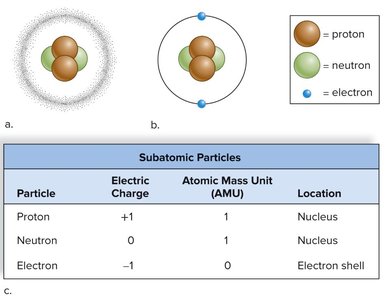
Major Elements in Biological Systems
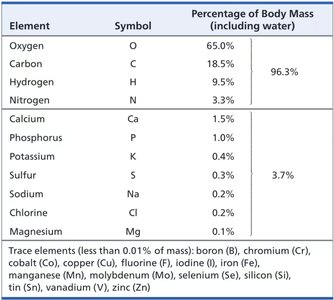
Four elements make up about 96% of living matter: oxygen, carbon, hydrogen, and nitrogen. Other elements, such as calcium, phosphorus, potassium, and sulfur, are also essential in smaller amounts.
Oxygen (O): Most abundant element in the human body.
Carbon (C): Backbone of organic molecules.
Hydrogen (H): Found in water and organic compounds.
Nitrogen (N): Key component of amino acids and nucleic acids.
Atomic Structure and Electron Shells
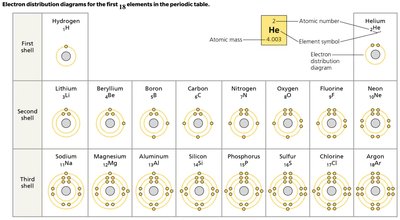
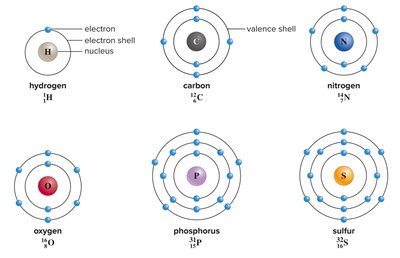
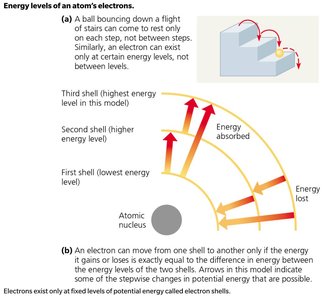
The chemical behavior of an atom is determined by the arrangement of electrons in its shells, especially the outermost (valence) shell. Atoms are most stable when their valence shell is full.
Valence electrons: Electrons in the outermost shell; determine chemical reactivity.
Octet rule: Atoms tend to fill their valence shell with 8 electrons (except for hydrogen and helium).
Stability: Atoms with full valence shells are chemically stable.
Electron Configuration of Key Elements
Electron configuration determines how atoms interact and bond. The number of valence electrons influences the number of bonds an atom can form.
Hydrogen: 1 valence electron, forms 1 bond.
Oxygen: 6 valence electrons, forms 2 bonds.
Nitrogen: 5 valence electrons, forms 3 bonds.
Carbon: 4 valence electrons, forms 4 bonds.
Phosphorus: Can form 3 or 5 bonds depending on context.
Chemical Bonds: Ionic and Covalent
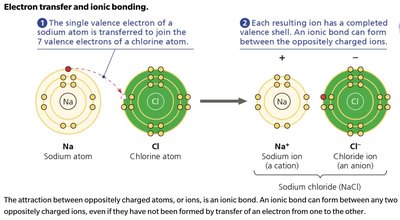
Atoms achieve stability by forming chemical bonds. The two main types are ionic and covalent bonds.
Ionic bonds: Formed when electrons are transferred from one atom to another, resulting in oppositely charged ions (e.g., Na+ and Cl-).
Covalent bonds: Formed when atoms share electrons. Can be polar (unequal sharing) or nonpolar (equal sharing).
Polarity and Electronegativity
Polarity arises when atoms in a covalent bond have different electronegativities, causing unequal sharing of electrons. This results in partial charges (δ+ and δ-) and affects molecular interactions.
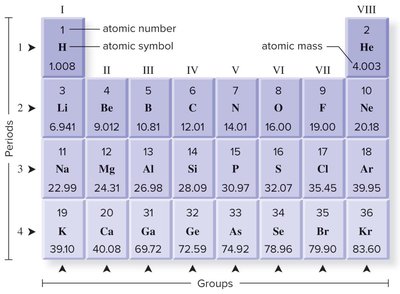
Electronegativity: The ability of an atom to attract shared electrons. Oxygen and nitrogen are highly electronegative.
Polar covalent bond: Unequal sharing of electrons, leading to partial charges.
Nonpolar covalent bond: Equal sharing of electrons, no charge difference.
Redox Reactions
Redox reactions involve the transfer of electrons between atoms. These reactions are fundamental to cellular metabolism.
Oxidation: Loss of electrons.
Reduction: Gain of electrons.
OIL RIG: "Oxidation Is Loss, Reduction Is Gain" of electrons.
Biological Molecules and Their Chemical Properties
Biomolecules such as proteins, lipids, carbohydrates, and nucleic acids are formed by specific types of chemical bonds. Their structure and function are determined by the chemical properties of their constituent atoms.
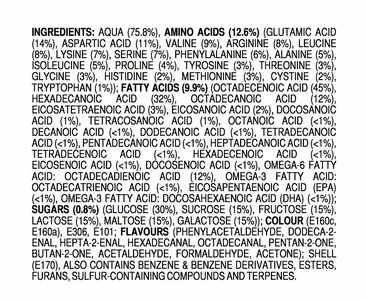
Proteins: Polymers of amino acids, held together by peptide bonds.
Lipids: Composed mainly of nonpolar covalent bonds, making them hydrophobic.
Carbohydrates: Polymers of sugars, with polar covalent bonds.
Nucleic acids: Polymers of nucleotides, with both polar and nonpolar regions.
Summary Table: Elements and Their Properties
The following table summarizes the main elements found in biological systems, their symbols, and their percentage of body mass.
Element | Symbol | Percentage of Body Mass |
|---|---|---|
Oxygen | O | 65.0% |
Carbon | C | 18.5% |
Hydrogen | H | 9.5% |
Nitrogen | N | 3.3% |
Calcium | Ca | 1.5% |
Phosphorus | P | 1.0% |
Potassium | K | 0.4% |
Sulfur | S | 0.3% |
Sodium | Na | 0.2% |
Chlorine | Cl | 0.2% |
Magnesium | Mg | 0.1% |
Key Equations
Atomic number:
Mass number:
Molecular formula: (glucose)

Fundamental Concept
Atoms interact via bonds to form molecules. The structure and function of biomolecules depend on the types of bonds and the chemical properties of their constituent atoms. Polarity, electronegativity, and electron configuration are key factors in determining molecular behavior and biological function.
Additional info:
Some content was inferred and expanded for clarity, including definitions and context for atomic structure, chemical bonds, and biological molecules.
