 Indietro
The Chemical Context of Life: Elements, Atoms, and Chemical Bonds
Guida di studio - Note intelligenti
 Appunti personalizzati basati sui tuoi materiali, ampliati con definizioni chiave, esempi e contesto.
The Chemical Context of Life
Introduction to Chemistry in Biology
Biology is fundamentally linked to chemistry, as all living organisms are composed of matter and are governed by the laws of physics and chemistry. Understanding the chemical basis of life is essential for studying biological processes.
Matter: Anything that takes up space and has mass.
Organisms are composed of matter, which exists as elements and compounds.
Elements: Substances that cannot be broken down into other substances by chemical reactions.
Compounds: Substances consisting of two or more elements in a fixed ratio, with properties different from their constituent elements.
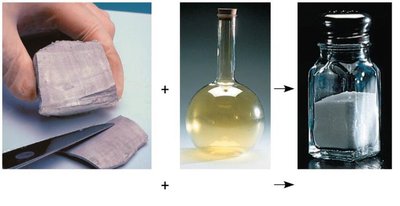
Elements Essential to Life
Major and Trace Elements in Living Organisms
Of the 92 naturally occurring elements, only a small fraction are essential for life. These elements are required for the structure and function of biomolecules.
Essential elements: About 20–25% of elements are required for life.
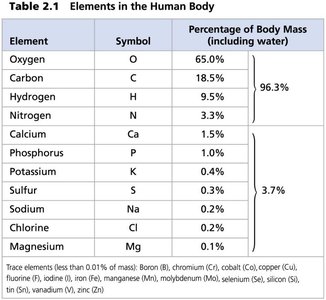
Major elements: Carbon (C), hydrogen (H), oxygen (O), and nitrogen (N) make up about 96% of living matter.
Other important elements: Calcium (Ca), phosphorus (P), potassium (K), sulfur (S), sodium (Na), chlorine (Cl), and magnesium (Mg) make up most of the remaining 4%.
Trace elements: Required in minute quantities (e.g., iron, zinc, iodine).
Element | Symbol | Percentage of Body Mass (including water) |
|---|---|---|
Oxygen | O | 65.0% |
Carbon | C | 18.5% |
Hydrogen | H | 9.5% |
Nitrogen | N | 3.3% |
Calcium | Ca | 1.5% |
Phosphorus | P | 1.0% |
Potassium | K | 0.4% |
Sulfur | S | 0.3% |
Sodium | Na | 0.2% |
Chlorine | Cl | 0.2% |
Magnesium | Mg | 0.1% |
Atoms and Subatomic Particles
Structure of Atoms
An atom is the smallest unit of matter that retains the properties of an element. Atoms are composed of subatomic particles:
Protons: Positively charged particles found in the nucleus.
Neutrons: Electrically neutral particles found in the nucleus.
Electrons: Negatively charged particles that orbit the nucleus in electron shells.
The number of protons determines the atomic number and the identity of the element. The sum of protons and neutrons gives the mass number.
Isotopes and Atomic Mass
Isotopes: Atoms of the same element with different numbers of neutrons.
Radioactive isotopes: Unstable isotopes that decay, releasing energy and particles.
Electron Configuration and Chemical Properties
Energy Levels and Electron Shells
Electrons occupy specific energy levels or shells around the nucleus. The arrangement of electrons determines the chemical behavior of an atom.
Valence electrons: Electrons in the outermost shell, crucial for chemical bonding.
Atoms with full valence shells are chemically inert (unreactive).
Chemical Bonds
Covalent Bonds
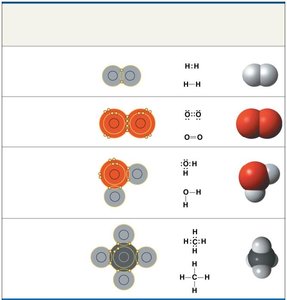
Covalent bonds involve the sharing of pairs of valence electrons between atoms. These bonds can be single, double, or triple, depending on the number of shared electron pairs.
Single bond: Sharing of one pair of electrons.
Double bond: Sharing of two pairs of electrons.
Molecule: Two or more atoms held together by covalent bonds.
Electronegativity and Bond Polarity
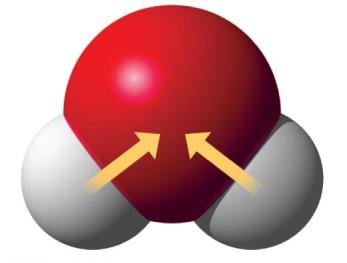
Electronegativity is an atom's attraction for electrons in a covalent bond. Differences in electronegativity lead to:
Nonpolar covalent bonds: Electrons are shared equally.
Polar covalent bonds: Electrons are shared unequally, resulting in partial charges (δ+ and δ−) on atoms.
Ionic Bonds
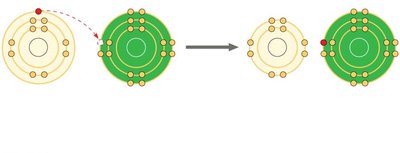
Ionic bonds form when one atom transfers electrons to another, resulting in oppositely charged ions that attract each other.
Cation: Positively charged ion (loss of electrons).
Anion: Negatively charged ion (gain of electrons).
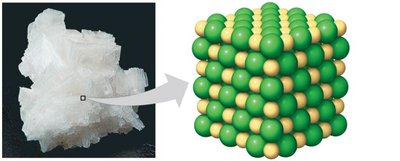
Ionic compound (salt): Compound formed by ionic bonds, often forming crystalline structures.
Weak Chemical Interactions
Hydrogen Bonds
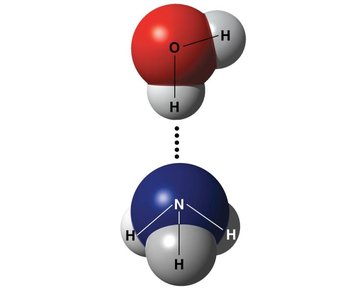
Hydrogen bonds are weak attractions between a hydrogen atom covalently bonded to an electronegative atom (like oxygen or nitrogen) and another electronegative atom. These bonds are crucial for the structure and function of biological molecules, such as DNA and proteins.
Van der Waals Interactions
Van der Waals interactions are weak attractions that occur when transient, uneven electron distributions create temporary dipoles in molecules that are close together. These interactions are important for the three-dimensional structure of large biological molecules.
Molecular Shape and Function
Importance of Molecular Shape
The shape of a molecule is determined by the positions of its atoms' orbitals and is critical for its function. Molecular shape determines how biological molecules recognize and interact with each other, influencing processes such as enzyme-substrate binding and signal transduction.
