 Indietro
The Chemical Context of Life: Essential Chemistry for Biology
Guida di studio - Note intelligenti
 Appunti personalizzati basati sui tuoi materiali, ampliati con definizioni chiave, esempi e contesto.
The Chemical Context of Life
Introduction to Chemistry in Biology
Chemistry forms the foundation for understanding biological processes. All living organisms are composed of matter, which is anything that occupies space and has mass. The study of matter and its interactions is essential for grasping the molecular basis of life.
Matter: Anything that takes up space and has mass.
Mass: The amount of matter in an object, independent of gravity.
Weight: The force exerted by gravity on an object’s mass; varies with location.
Elements and Atoms
Elements Essential for Life
Elements are pure substances that cannot be broken down by ordinary chemical means. Of the 92 naturally occurring elements, about 25 are essential for life. Six elements—carbon, hydrogen, nitrogen, oxygen, phosphorus, and sulfur (CHNOPS)—make up the majority of living matter.
Element: Substance that cannot be decomposed into simpler substances by chemical reactions.
CHNOPS: The six most abundant elements in living organisms.
Trace Elements: Required in minute amounts (e.g., Fe, Mg, Ca, I).
Atoms: Structure and Properties
An atom is the smallest unit of an element that retains its chemical properties. Atoms are composed of subatomic particles: protons, neutrons, and electrons.
Proton (p+): Positive charge, mass = 1 atomic mass unit (amu).
Neutron (n): No charge, mass = 1 amu.
Electron (e-): Negative charge, negligible mass.
Subatomic Particle | Charge | Mass |
|---|---|---|
Proton | +1 | 1 amu |
Neutron | 0 | 1 amu |
Electron | -1 | ~0 amu |
Atomic Number and Mass Number
The atomic number is the number of protons in an atom, defining the element. The mass number is the sum of protons and neutrons.
Atomic Number (Z): Number of protons; written as a subscript (e.g., 6C).
Mass Number (A): Number of protons + neutrons; written as a superscript (e.g., 12C).
Number of neutrons:
Isotopes and Radioactivity
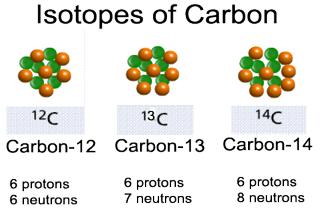
Isotopes are atoms of the same element with different numbers of neutrons. Some isotopes are radioactive and decay over time, emitting radiation. Radioactive isotopes are used in dating fossils and as tracers in biological research.
Isotope: Same number of protons, different number of neutrons.
Radioactive Isotope: Unstable nucleus, decays over time.
Half-life: Time required for half the atoms in a sample to decay.
Chemical Bonds and Molecules
Molecules and Compounds
A molecule consists of two or more atoms held together by chemical bonds. A compound is a molecule composed of two or more different elements in a fixed ratio.
Molecule: Two or more atoms bonded together (e.g., O2).
Compound: Molecule with atoms of different elements (e.g., H2O, NaCl).
Ions and Ionic Bonds
Ionic bonds form when electrons are transferred from one atom to another, resulting in oppositely charged ions that attract each other. This process helps atoms achieve stable electron configurations.
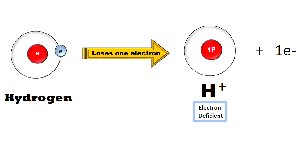
Ion: Atom with a net electric charge due to loss or gain of electrons.
Ionic Bond: Electrostatic attraction between oppositely charged ions.
Example: Formation of NaCl (table salt).
Covalent Bonds
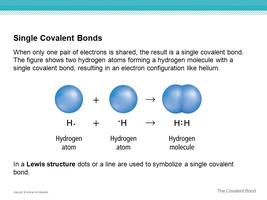
Covalent bonds involve the sharing of electron pairs between atoms, allowing each atom to attain a stable outer shell. These bonds are fundamental to the structure of biological molecules.
Covalent Bond: Sharing of electron pairs between atoms.
Single Bond: One pair of electrons shared.
Double/Triple Bonds: Two or three pairs of electrons shared, respectively.
Water: Structure and Properties
Chemical Structure of Water
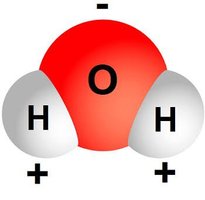
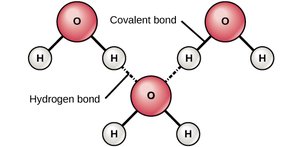
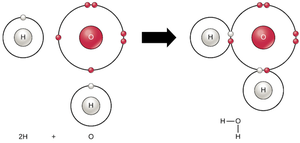
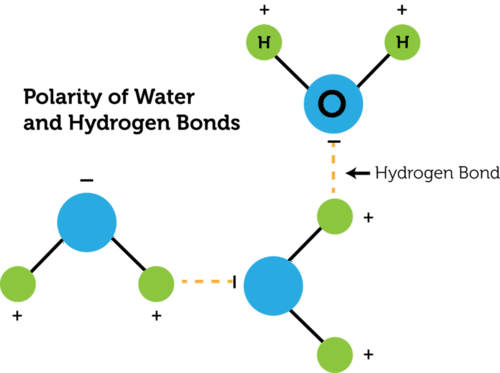
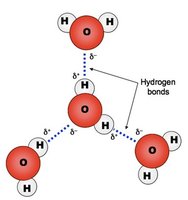
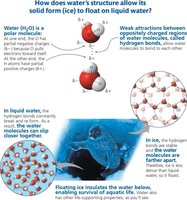
Water (H2O) is a polar molecule formed by covalent bonds between one oxygen and two hydrogen atoms. The polarity of water molecules leads to hydrogen bonding, which is responsible for many of water’s unique properties.
Polar Molecule: Unequal sharing of electrons creates partial charges.
Hydrogen Bond: Weak attraction between the positive hydrogen of one molecule and the negative oxygen of another.
Unique Properties of Water
Water’s structure gives rise to several important properties essential for life:
Expansion upon Freezing: Water expands as it freezes due to the locking of hydrogen bonds, making ice less dense than liquid water. This allows ice to float, insulating aquatic life in cold climates.
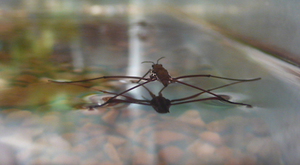
Cohesion: Water molecules stick together due to hydrogen bonding, resulting in high surface tension.
Adhesion: Water molecules can also stick to other substances, aiding in processes like capillary action.
Acids, Bases, and the pH Scale
Acids and Bases
Acids are substances that increase the concentration of hydrogen ions (H+) in solution, while bases decrease H+ concentration by accepting protons or releasing hydroxide ions (OH-).
Acid: H+ donor in aqueous solution.
Base: H+ acceptor or OH- donor.
Example: HCl (hydrochloric acid) releases H+; NaOH (sodium hydroxide) releases OH-.
pH Scale
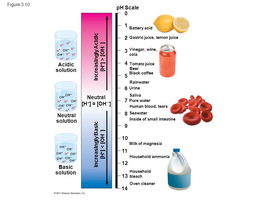
The pH scale measures the concentration of hydrogen ions in a solution, indicating its acidity or alkalinity. Each unit represents a tenfold change in H+ concentration.
pH = -log[H+]
Acidic: pH < 7
Neutral: pH = 7
Basic (Alkaline): pH > 7
Acid Rain and Environmental Impact
Normal rainwater is slightly acidic (pH ≈ 5.6) due to dissolved CO2 forming carbonic acid. Industrial pollutants can lower rainwater pH further, causing acid precipitation that harms ecosystems and accelerates soil erosion.
Acid Precipitation: Rain with pH < 5.6, often due to industrial emissions.
Ecological Effects: Damages forests, aquatic life, and soil formation.
Mitigation: Use of industrial scrubbers to reduce emissions.
Summary Table: Key Terms and Concepts
Term | Definition | Example |
|---|---|---|
Element | Pure substance, cannot be broken down | Oxygen (O), Carbon (C) |
Atom | Smallest unit of an element | Helium atom |
Isotope | Atoms with same protons, different neutrons | 12C, 13C, 14C |
Molecule | Two or more atoms bonded | O2, H2O |
Compound | Molecule with different elements | NaCl, H2O |
Ionic Bond | Transfer of electrons | NaCl |
Covalent Bond | Sharing of electrons | H2O |
Hydrogen Bond | Weak attraction between molecules | Between water molecules |
Acid | H+ donor | HCl |
Base | H+ acceptor | NaOH |
pH | Measure of acidity/alkalinity | pH 7 = neutral |
