 Indietro
The Chemical Foundation of Life: Elements, Atoms, Bonds, Water, Acids, and Bases
Guida di studio - Note intelligenti
 Appunti personalizzati basati sui tuoi materiali, ampliati con definizioni chiave, esempi e contesto.
Chemical Elements
Definition and Importance of Elements
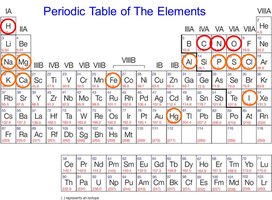
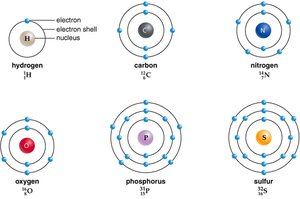
Elements are pure substances that cannot be broken down into simpler substances by ordinary chemical methods. There are 92 naturally-occurring elements on Earth, but only a handful are essential for life. The six major elements that make up 95% of the body weight are carbon (C), hydrogen (H), nitrogen (N), oxygen (O), phosphorus (P), and sulfur (S).
Element: A substance composed of only one type of atom.
Atomic symbol: One or two letters representing an element (e.g., C for carbon).
Examples: Oxygen (O), Carbon (C), Hydrogen (H), Nitrogen (N), Calcium (Ca), Phosphorus (P), Potassium (K), Sodium (Na), Sulfur (S), Magnesium (Mg), Chlorine (Cl), Iodine (I), Iron (Fe).
Atoms
Structure and Properties of Atoms
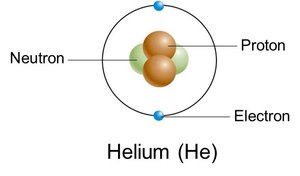
Atoms are the basic units of elements, consisting of a nucleus (containing protons and neutrons) and electrons orbiting the nucleus.
Proton: Positively charged particle, mass = 1 AMU.
Neutron: Uncharged particle, mass = 1 AMU.
Electron: Negatively charged particle, mass ≈ 0.
Nucleus: Composed of protons and neutrons.
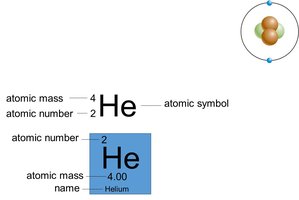
Atomic number: Number of protons in the nucleus.
Atomic mass: Sum of protons and neutrons.
Atoms are electrically neutral: number of protons = number of electrons.
Isotopes and Radioactivity
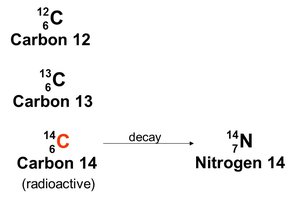
Isotopes are atoms of the same element that differ in the number of neutrons. Some isotopes are radioactive and decay, releasing energy.
Isotope: Atoms with the same number of protons but different numbers of neutrons.
Radioactive decay: The process by which unstable isotopes lose energy by emitting particles or radiation.
Types of radiation: Alpha (α), Beta (β), Gamma (γ), and X-ray.
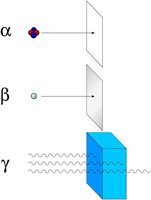
Applications and Effects of Radiation
Radiation has various applications in science and medicine, but can also be harmful.
Used for sterilization (e.g., anthrax), cancer treatment, dating fossils, and as tracers in medical diagnosis (e.g., PET scans).
Can cause cancer if exposure is excessive.

Electron Shells and the Periodic Table
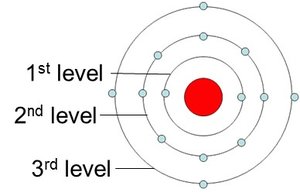
Electrons occupy shells around the nucleus. The arrangement of electrons determines chemical properties.
Lower shells are filled first.
Period number (row) indicates the number of shells.
Group number (column) indicates the number of electrons in the outermost shell.
Octet Rule and Reactivity
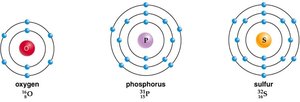
The octet rule states that atoms are most stable when their valence shell contains eight electrons (except for the first shell, which is stable with two). Atoms with incomplete valence shells are reactive.
Noble gases: Inert due to full valence shells.
Molecules and Compounds
Definitions and Examples
Molecule: Two or more atoms joined by chemical bonds (e.g., H2, O2, H2O).
Compound: Two or more different elements joined by chemical bonds (e.g., H2O, CO2, NaCl).
Chemical Bonds
Ionic Bonds
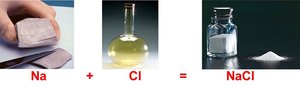
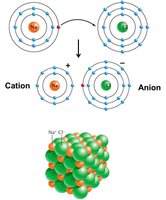
Ionic bonds form when atoms gain or lose electrons to achieve a stable valence shell.
Cation: Atom that loses electrons, becoming positively charged.
Anion: Atom that gains electrons, becoming negatively charged.
Ionic bond: Attraction between cation and anion.
Ionic compound: Held together by ionic bonds (e.g., NaCl).
Covalent Bonds
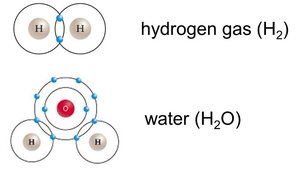
Covalent bonds involve the sharing of electrons between atoms to satisfy the octet rule.
Electronegativity: The ability of an atom to attract electrons.
Equality of sharing depends on electronegativity.
Nonpolar and Polar Covalent Bonds
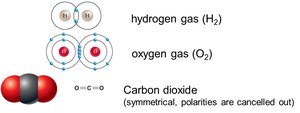
Nonpolar covalent bond: Equal sharing of electrons (e.g., H2, O2, CO2).
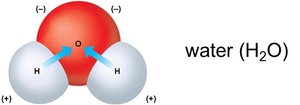
Polar covalent bond: Unequal sharing of electrons (e.g., H2O).
Hydrogen Bonds
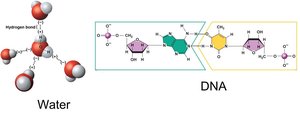
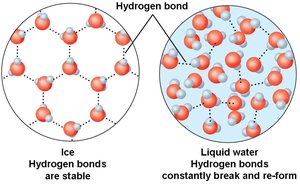
Hydrogen bonds are weak attractions between electropositive hydrogen and electronegative oxygen or nitrogen, either within the same molecule or between molecules.
Important in water and DNA structure.
Properties of Water
Heat Capacity and Heat of Evaporation
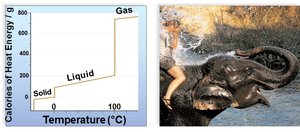
Water has a high heat capacity and high heat of evaporation due to hydrogen bonding.
Large amounts of heat are needed to warm up water or to evaporate it.
Water releases heat when it freezes.
Solvent Properties
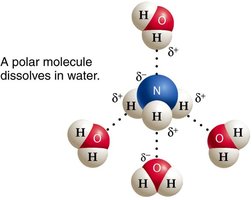
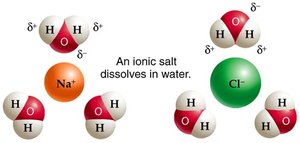
Water is an excellent solvent for hydrophilic molecules, including ions and polar molecules.
Allows for dissolution and transport of substances in biological systems.
Cohesion, Adhesion, Surface Tension, and Density
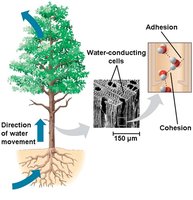
Water molecules stick together (cohesion) and to other surfaces (adhesion) due to hydrogen bonds.
High surface tension allows small organisms to walk on water.
Ice is less dense than liquid water, allowing it to float.

Acids and Bases
Acids
Acids dissociate in water and release H+ ions.
Strong acid: Complete dissociation (e.g., HCl).
Weak acid: Partial dissociation (e.g., H2CO3).
Bases
Bases dissociate in water and either take up H+ or release OH-.
Strong base: Complete dissociation (e.g., NaOH).
Weak base: Partial dissociation (e.g., NH3).
Acid and base neutralization produces water and salt.
pH Scale
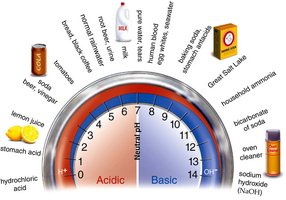
The pH scale measures the concentration of H+ ions in a solution.
pH ranges from 0 (acidic) to 14 (basic).
Neutral: pH = 7, [H+] = [OH-] = M.
Acidic: pH < 7, [H+] > [OH-].
Alkaline: pH > 7, [H+] < [OH-].
Acid Deposition
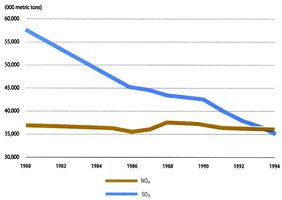
Acid deposition (acid rain) occurs when rain pH drops below 5, often due to sulfuric and nitric acids from fossil fuels.
Can cause environmental and health problems, including toxic mercury formation, soil degradation, respiratory diseases, and damage to buildings.
Buffers
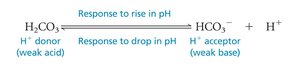
Buffers are chemicals that resist changes in pH, usually weak acids or bases.
The carbonic acid-bicarbonate system maintains human blood pH between 7.35 and 7.45.
Summary Table: Key Concepts
Concept | Definition | Example |
|---|---|---|
Element | Pure substance, one type of atom | Oxygen (O), Carbon (C) |
Atom | Basic unit of element | Helium atom |
Isotope | Same element, different neutrons | Carbon-12, Carbon-14 |
Molecule | Two or more atoms bonded | H2, O2 |
Compound | Two or more elements bonded | H2O, NaCl |
Ionic bond | Electron transfer, cation-anion attraction | NaCl |
Covalent bond | Electron sharing | H2O, O2 |
Hydrogen bond | Weak attraction, H to O/N | Water, DNA |
Acid | Releases H+ in water | HCl |
Base | Takes up H+ or releases OH- | NaOH |
Buffer | Resists pH change | Carbonic acid-bicarbonate |
Additional info:
Atoms with 2, 8, 10, and 12 electrons: Atoms with full shells (2 or 8) are stable; others are reactive.
Relationship between [H+] and pH: As [H+] increases, pH decreases.
Normal human blood pH: 7.35–7.45.
