 Indietro
The Chemistry of Life: Elements, Atoms, and Measurement in Biology
Guida di studio - Note intelligenti
 Appunti personalizzati basati sui tuoi materiali, ampliati con definizioni chiave, esempi e contesto.
Chemistry of Life
Introduction to the Chemistry of Life
Understanding the chemistry of life is fundamental to biology. Living organisms are composed of matter, which is made up of chemical elements. These elements combine to form compounds that are essential for life processes.
Basic Laboratory Equipment and Measurements
Metric System in Biology
The metric system is the standard system of measurement in science, including biology. It provides a universal language for scientists to communicate data accurately.
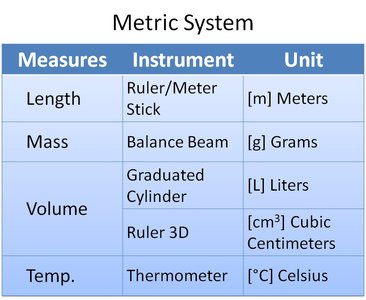
Measures | Instrument | Unit |
|---|---|---|
Length | Ruler/Meter Stick | [m] Meters |
Mass | Balance Beam | [g] Grams |
Volume | Graduated Cylinder | [L] Liters |
Volume | Ruler 3D | [cm3] Cubic Centimeters |
Temp. | Thermometer | [°C] Celsius |
Measuring Volume
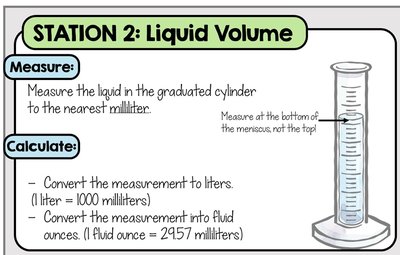
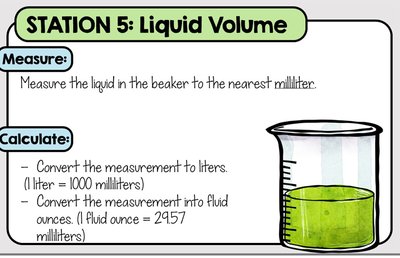
Volume is commonly measured in liters (L) or milliliters (mL) using a graduated cylinder or beaker. Accurate measurement requires reading the bottom of the meniscus at eye level.
1 liter (L) = 1000 milliliters (mL)
1 fluid ounce = 29.57 milliliters (mL)
Measuring Mass
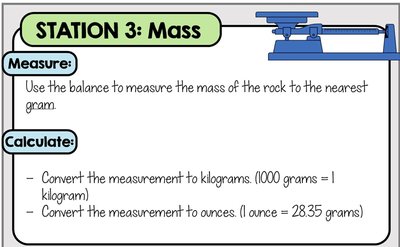
Mass is measured in grams (g) using a balance beam. For larger quantities, kilograms (kg) are used, where 1 kg = 1000 g. Mass can also be converted to ounces (oz).
1 kilogram (kg) = 1000 grams (g)
1 ounce (oz) = 28.35 grams (g)
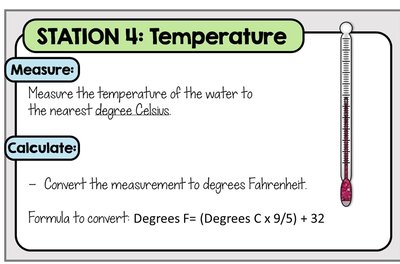
Measuring Temperature
Temperature in biology is measured in degrees Celsius (°C) using a thermometer. To convert Celsius to Fahrenheit (°F), use the following formula:
Degrees F = (Degrees C × 9/5) + 32
Elements, Atoms, and Compounds
Essential Elements for Life
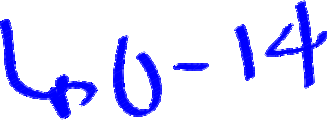
About 25 elements are essential for human life. Four elements—oxygen (O), carbon (C), hydrogen (H), and nitrogen (N)—make up about 96% of the weight of most living organisms. Trace elements are required in small amounts to prevent disease.
Oxygen (O): 65%
Carbon (C): 18.5%
Hydrogen (H): 9.5%
Nitrogen (N): 3.3%
Other elements include calcium, phosphorus, potassium, sulfur, sodium, chlorine, and magnesium.
Atoms: Structure and Properties
An atom is the smallest unit of matter that retains the properties of an element. Atoms are composed of three subatomic particles:
Protons (positively charged, found in the nucleus)
Neutrons (neutral, found in the nucleus)
Electrons (negatively charged, orbit the nucleus)
Atomic Number, Mass Number, and Isotopes
The atomic number is the number of protons in an atom. The mass number is the sum of protons and neutrons. Isotopes are atoms of the same element with different numbers of neutrons.
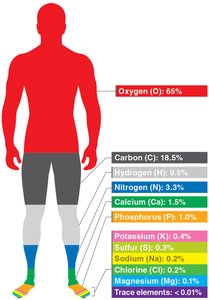
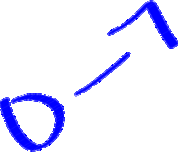
Carbon-12 | Carbon-13 | Carbon-14 | |
|---|---|---|---|
Protons | 6 | 6 | 6 |
Neutrons | 6 | 7 | 8 |
Electrons | 6 | 6 | 6 |
Mass Number | 12 | 13 | 14 |

Radioactive Isotopes
Radioactive isotopes are unstable and emit radiation. They are useful as tracers in biological research and medicine but can also be hazardous.
Used in medical imaging and dating fossils
Can damage living tissue if not handled properly
Chemical Bonds and Molecules
Types of Chemical Bonds
The distribution of electrons in an atom determines its chemical properties and ability to form bonds. The main types of chemical bonds are:
Ionic Bonds: Formed when electrons are transferred from one atom to another, resulting in oppositely charged ions.
Covalent Bonds: Formed when two atoms share one or more pairs of electrons. Can be polar (unequal sharing) or nonpolar (equal sharing).
Hydrogen Bonds: Weak bonds important in the chemistry of life, especially in water and biological molecules like DNA.

Solubility and Polarity
Polarity refers to the distribution of electrical charge over the atoms joined by the bond. Polar molecules, like water, dissolve other polar substances, making water an excellent solvent for biological reactions.
Chemical Reactions
Chemical reactions involve breaking existing chemical bonds and forming new ones. For example, cellular respiration is a chemical reaction that converts glucose and oxygen into carbon dioxide and water:
Applications and Examples
Importance of Trace Elements
Trace elements such as iron, iodine, and fluoride are required in small amounts for proper physiological function. Deficiency can lead to diseases such as goiter (iodine deficiency).

Summary Table: Key Concepts in Chemistry of Life
Concept | Description |
|---|---|
Element | Pure substance consisting of one type of atom |
Atom | Smallest unit of an element |
Isotope | Atoms of the same element with different numbers of neutrons |
Ionic Bond | Bond formed by transfer of electrons |
Covalent Bond | Bond formed by sharing of electrons |
Hydrogen Bond | Weak bond important in water and biological molecules |
Solvent | Substance that dissolves other substances (water is the universal solvent) |
Additional info: The notes above expand on the provided content with definitions, examples, and context suitable for a General Biology college course, following the structure and requirements of introductory biology chapters on the chemical basis of life.
