 Indietro
The Chemistry of Life: Foundations for Biology
Guida di studio - Note intelligenti
 Appunti personalizzati basati sui tuoi materiali, ampliati con definizioni chiave, esempi e contesto.
Chemistry of Life: Foundations for Biology
Introduction: The Interdisciplinary Nature of Biology
Biology is deeply interconnected with chemistry, as understanding the chemical properties of matter is essential for studying life. The principles of chemistry provide the foundation for comprehending biological molecules and processes.
The Atom
Definition and Structure of Atoms
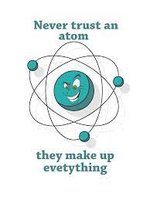
Atoms are the fundamental units of matter, possessing mass and occupying space. All matter, including biological molecules, is composed of atoms. Understanding atomic structure is crucial for grasping the nature of biological molecules.
Proton: Positively charged particle located in the nucleus.
Neutron: Neutral particle (no charge) also found in the nucleus.
Electron: Negatively charged particle found in orbitals surrounding the nucleus.
Atomic Number, Atomic Mass, and Isotopes
Atomic Number and Atomic Mass
The atomic number is the number of protons in an atom's nucleus and uniquely identifies each element. Atoms are electrically neutral when the number of protons equals the number of electrons. The mass number is the sum of protons and neutrons in the nucleus. Mass is measured in daltons (Da).
Element: A substance that cannot be broken down into other substances by ordinary chemical means.
Mass vs. Weight: Mass is the amount of substance; weight is the force gravity exerts on that substance.

Isotopes
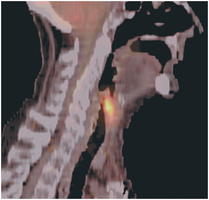
Isotopes are atoms of the same element with different numbers of neutrons, resulting in different masses. Some isotopes are radioactive and decay spontaneously, emitting particles and energy. Radioactive isotopes have important applications in dating fossils, tracing atoms through metabolic processes, and diagnosing medical disorders.
Ions
Definition and Types of Ions
Ions are atoms or molecules that have gained or lost electrons, resulting in a net charge. When an atom loses electrons, it becomes a cation (positively charged). When it gains electrons, it becomes an anion (negatively charged).
Cation: Protons > Electrons (positive charge)
Anion: Protons < Electrons (negative charge)
Electrons and Energy Levels
Electron Energy and Orbitals
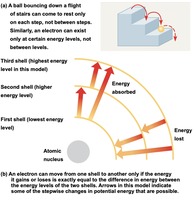
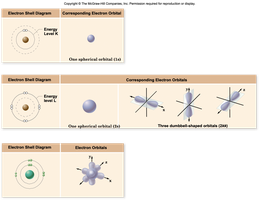
Electrons possess potential energy based on their position relative to the nucleus. Electrons farther from the nucleus have higher energy. Energy levels (often depicted as rings) indicate the energy of electrons, while orbitals are three-dimensional regions where electrons are most likely to be found. Do not confuse energy levels with orbitals.
Atomic Models
There are two main models for describing atomic structure:
Bohr Model: Electrons occupy fixed rings (energy levels) around the nucleus. The maximum number of electrons in a shell is given by .
Electron Cloud Model: Electrons occupy orbitals, which are regions of space with a high probability of finding an electron. Each orbital can hold up to two electrons.
Redox Reactions
Oxidation and Reduction
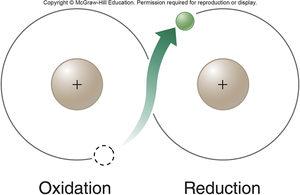
Redox (reduction-oxidation) reactions involve the transfer of electrons between atoms. Electrons retain their energy during transfer. Common mnemonics include "OIL RIG" (Oxidation Is Loss, Reduction Is Gain) and "LEO the Lion says GER" (Lose Electrons = Oxidation, Gain Electrons = Reduction).
Summary Table: Key Atomic Concepts
Term | Definition | Example/Application |
|---|---|---|
Atom | Smallest unit of matter retaining properties of an element | Hydrogen atom (H) |
Isotope | Atoms of the same element with different numbers of neutrons | Carbon-12, Carbon-14 |
Cation | Positively charged ion (lost electrons) | Na+ |
Anion | Negatively charged ion (gained electrons) | Cl- |
Redox Reaction | Transfer of electrons between atoms | Cellular respiration |
Additional info:
Understanding atomic structure and chemical properties is foundational for later topics in biology, such as metabolism, cell structure, and genetics.
Radioactive isotopes are widely used in biological research and medicine for tracing and imaging.
