 Indietro
The Chromosomal Basis of Inheritance: Linkage, Sex Chromosomes, and Genetic Disorders
Guida di studio - Note intelligenti
 Appunti personalizzati basati sui tuoi materiali, ampliati con definizioni chiave, esempi e contesto.
Locating Genes Along Chromosomes
Chromosome Theory of Inheritance
The chromosome theory of inheritance states that genes are located on chromosomes, and the behavior of chromosomes during meiosis accounts for inheritance patterns. Mendel's "hereditary factors" are now understood as genes, which can be physically located on chromosomes using techniques such as fluorescent tagging.
Gene: A segment of DNA that codes for a specific protein or trait.
Chromosome: A structure composed of DNA and proteins that carries genetic information.
Fluorescent tagging: A method to visualize specific genes on chromosomes.
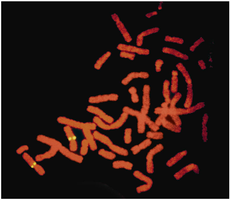
Additional info: Chromosome visualization is a key tool in cytogenetics for mapping gene locations.
Mendelian Inheritance and Chromosome Behavior
Historical Development
Biologists observed parallels between chromosome behavior and Mendel's hereditary units, leading to the chromosome theory of inheritance. Thomas Hunt Morgan provided the first solid evidence by associating a specific gene with a specific chromosome.
Sutton and Boveri: Early proponents of the chromosome theory.
Thomas Hunt Morgan: Used fruit flies to demonstrate gene-chromosome association.
Morgan’s Choice of Experimental Organism
Drosophila melanogaster (Fruit Fly)
Morgan chose Drosophila melanogaster for genetic studies due to its short generation time, high offspring number, and simple chromosome structure (four pairs).
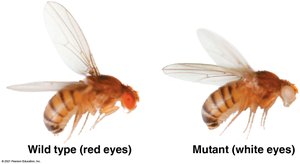
Wild type: The normal phenotype common in a population.
Mutant phenotype: Traits that differ from the wild type, such as white eyes instead of red.
Correlating Gene Behavior with Chromosome Behavior
Scientific Inquiry: Eye Color in Fruit Flies
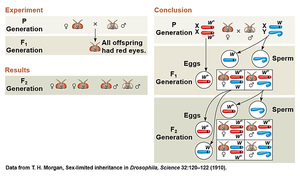
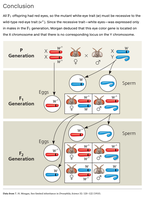
Morgan crossed wild-type females (red eyes) with mutant males (white eyes). The F1 generation all had red eyes, while the F2 generation showed a 3:1 ratio, with only males exhibiting white eyes. This led to the conclusion that the white-eye gene is located on the X chromosome.
X chromosome: Sex chromosome present in both males and females.
Y chromosome: Sex chromosome present only in males.
Recessive trait: Expressed only when two copies are present (in females) or one copy (in males).
The Chromosomal Basis of Mendel’s Laws
Law of Segregation and Law of Independent Assortment
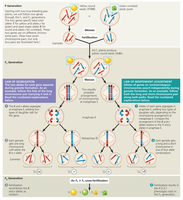
The chromosomal basis of Mendel’s laws is illustrated by the behavior of chromosomes during meiosis. The law of segregation explains how alleles separate, while the law of independent assortment describes how different genes independently segregate.
Law of Segregation: Each parent passes one allele for each gene to offspring.
Law of Independent Assortment: Genes on different chromosomes assort independently.
Sex-Linked Genes and Patterns of Inheritance
The Chromosomal Basis of Sex
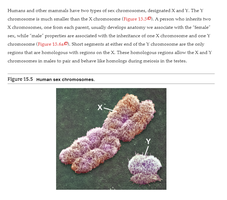
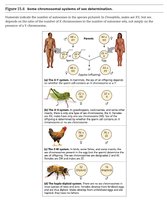
Humans and other mammals have two types of sex chromosomes: X and Y. The presence of two X chromosomes results in female development, while one X and one Y chromosome result in male development. Other organisms use different systems for sex determination.
SRY gene: Located on the Y chromosome, responsible for male development.
Sex-linked gene: Located on either sex chromosome.
Inheritance of X-Linked Genes
Patterns and Disorders
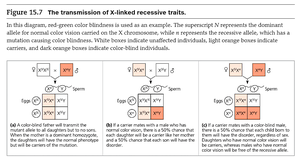
X-linked genes follow unique inheritance patterns. Fathers pass X-linked alleles to daughters, while mothers can pass them to both sons and daughters. Recessive X-linked traits are more common in males.
Hemizygous: Males have only one X chromosome, so a single recessive allele causes expression.
X-linked disorders: Color blindness, Duchenne muscular dystrophy, hemophilia.
X Inactivation in Female Mammals
Barr Body Formation and Mosaicism
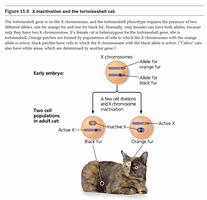
In female mammals, one X chromosome in each cell is randomly inactivated, forming a Barr body. Heterozygous females are mosaics for X-linked traits, as seen in tortoiseshell cats.
Barr body: Inactivated X chromosome.
XIST gene: Responsible for X inactivation.
Linked Genes and Genetic Recombination
Linkage and Inheritance
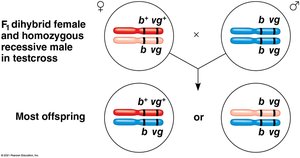
Genes located near each other on the same chromosome are called linked genes and tend to be inherited together. Morgan's experiments with fruit flies showed that linked genes do not assort independently, but recombination can occur through crossing over.
Linked genes: Genes located close together on the same chromosome.
Genetic recombination: Production of offspring with new combinations of traits.
Recombination of Unlinked Genes
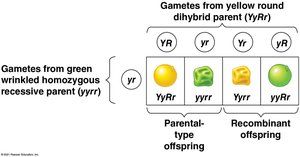
Genes on different chromosomes assort independently, resulting in a 50% recombination frequency. Parental types match the original phenotypes, while recombinant types show new combinations.
Parental type: Offspring with phenotypes matching parents.
Recombinant type: Offspring with new trait combinations.
Recombination of Linked Genes: Crossing Over
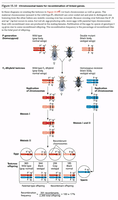
Crossing over during meiosis breaks the physical connection between linked genes, allowing for recombination. The frequency of recombination depends on the distance between genes.
Crossing over: Exchange of genetic material between homologous chromosomes.
Recombination frequency: Percentage of recombinant offspring.
Mapping the Distance Between Genes Using Recombination Data
Linkage Maps
Alfred Sturtevant constructed genetic maps based on recombination frequencies. The farther apart two genes are, the higher the probability of crossover and recombination. Map units (centimorgans) represent 1% recombination frequency.
Linkage map: Ordered list of gene loci based on recombination data.
Map unit: 1% recombination frequency.
Additional info: Genes far apart on the same chromosome can behave as if they are on different chromosomes due to high recombination frequency.
Alterations of Chromosome Number or Structure
Abnormal Chromosome Number
Nondisjunction during meiosis can result in gametes with abnormal chromosome numbers, leading to conditions such as aneuploidy, monosomy, trisomy, and polyploidy.
Nondisjunction: Failure of chromosome pairs to separate properly.
Aneuploidy: Abnormal number of chromosomes.
Polyploidy: More than two complete sets of chromosomes.
Alterations of Chromosome Structure
Chromosome breakage can cause deletions, duplications, inversions, and translocations, leading to genetic disorders.
Deletion: Loss of a chromosome segment.
Duplication: Repetition of a segment.
Inversion: Reversal of a segment.
Translocation: Movement of a segment to another chromosome.
Human Disorders Due to Chromosomal Alterations
Aneuploidy and Syndromes
Some chromosomal alterations result in syndromes such as Down syndrome (trisomy 21), Klinefelter syndrome (XXY), Turner syndrome (X0), and others. Structural changes can cause disorders like cri du chat and certain cancers.
Down syndrome: Three copies of chromosome 21.
Klinefelter syndrome: XXY males.
Turner syndrome: X0 females.
Cri du chat: Deletion in chromosome 5.
Chronic myelogenous leukemia (CML): Caused by translocation.
Exceptions to Standard Mendelian Inheritance
Genomic Imprinting
Genomic imprinting involves the silencing of certain genes depending on which parent passes them on. Most imprinted genes are critical for embryonic development.
Imprinting: Methylation of DNA silences gene expression.
Example: Mouse Igf2 gene, only paternal allele is expressed.
Inheritance of Organelle Genes
Extranuclear genes are found in mitochondria and chloroplasts and are inherited maternally. Defects in mitochondrial genes can cause diseases affecting muscular and nervous systems.
Mitochondrial inheritance: All mitochondria come from the egg.
Example: Mitochondrial myopathy, Leber’s hereditary optic neuropathy.
Additional info: Techniques are being developed to prevent transmission of mitochondrial disorders by replacing affected mitochondria with healthy ones.
