 Indietro
The Chromosomal Basis of Inheritance: Sex-Linked Genes and X Inactivation
Guida di studio - Note intelligenti
 Appunti personalizzati basati sui tuoi materiali, ampliati con definizioni chiave, esempi e contesto.
Sex-Linked Genes and the Chromosomal Basis of Inheritance
The Chromosomal Basis of Sex
Sex determination in humans and many other animals is governed by specific chromosomes known as sex chromosomes. These chromosomes not only determine the biological sex of an individual but also carry genes that can influence various traits.
Sex Chromosomes in Humans: Humans have two types of sex chromosomes: the larger X chromosome and the smaller Y chromosome.
Sex Determination: Individuals with two X chromosomes (XX) are typically female, while those with one X and one Y chromosome (XY) are typically male.
Homologous Regions: Short homologous regions at the ends of the X and Y chromosomes allow them to pair during meiosis in males, behaving like homologous chromosomes.
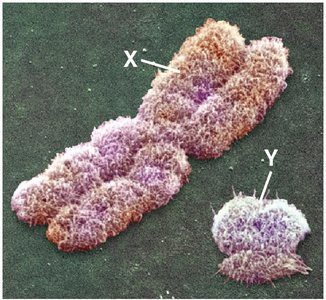
Additional info: The X chromosome contains many more genes than the Y chromosome, which is reflected in their size difference.
Variations in Sex Determination Among Animals
Different animal groups use different systems for sex determination:
X-0 System: Found in some insects; females are XX, males are X (only one X chromosome).
Z-W System: Found in birds, some fishes, and some insects; females are ZW, males are ZZ.
Haplo-Diploid System: Found in bees and ants; females are diploid (from fertilized eggs), males are haploid (from unfertilized eggs).
The SRY Gene and Sex Determination
The SRY gene (sex-determining region of Y) is a critical gene located on the Y chromosome that triggers male development.
Function: If the SRY gene is present, embryonic gonads develop into testes; if absent, they develop into ovaries.
Discovery: Identified in 1990 as essential for testis development in mammals.
Sex-Linked Genes
Genes located on sex chromosomes are called sex-linked genes. They exhibit unique inheritance patterns due to the difference in chromosome composition between males and females.
Y-Linked Genes: Found only on the Y chromosome; passed from father to son.
X-Linked Genes: Found on the X chromosome; the X chromosome carries about 1,100 genes, many unrelated to sex determination.
Inheritance Patterns of X-Linked Genes
Expression of Recessive X-Linked Traits
X-linked recessive traits are more common in males because they have only one X chromosome (hemizygous). Females must inherit two copies of the recessive allele (homozygous) to express the trait, while males need only one.
Carrier Females: Heterozygous females (one normal and one recessive allele) are carriers and can pass the trait to their offspring without showing symptoms themselves.
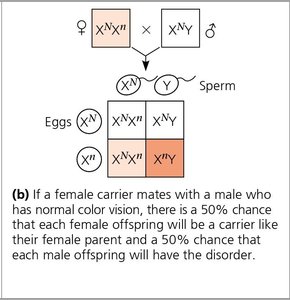
Inheritance Example: A carrier mother has a 50% chance of passing the recessive allele to her sons (who would be affected) and a 50% chance of passing it to her daughters (who would be carriers).
Pedigree and Punnett Square Analysis of X-Linked Inheritance
Inheritance patterns of X-linked traits can be visualized using Punnett squares. These diagrams help predict the probability of offspring inheriting certain traits based on parental genotypes.
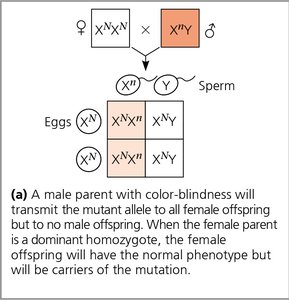
Example (a): A male with color-blindness (XnY) and a homozygous normal female (XNXN) will have all daughters as carriers and all sons with normal vision.
Example (b): A carrier female (XNXn) and a normal male (XNY) have a 50% chance of producing carrier daughters and a 50% chance of producing affected sons.
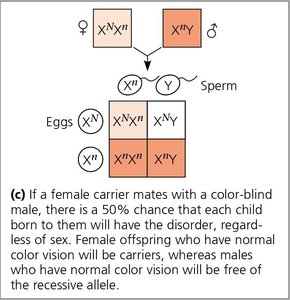
Example (c): A carrier female (XNXn) and a color-blind male (XnY) have a 50% chance of producing affected children, regardless of sex.
Examples of X-Linked Disorders
Color Blindness: Most commonly X-linked; affects the ability to distinguish certain colors.
Duchenne Muscular Dystrophy: Caused by the absence of the dystrophin protein; leads to muscle weakness and loss of coordination.
Hemophilia: Characterized by the absence of proteins required for blood clotting, resulting in prolonged bleeding.
X Inactivation in Female Mammals
Mechanism and Consequences of X Inactivation
In female mammals, one of the two X chromosomes in each cell is randomly inactivated during embryonic development. This process, known as X-chromosome inactivation, ensures dosage compensation between males and females.
Barr Body: The inactivated X chromosome condenses into a structure called a Barr body, which remains inactive except in gamete-forming cells.
XIST Gene: The XIST gene produces an RNA molecule that coats and inactivates one X chromosome in each cell.
Genetic Mosaicism: Heterozygous females for X-linked genes are genetic mosaics, with different cells expressing different alleles. This is visible in calico cats, where patches of fur color result from random X inactivation.
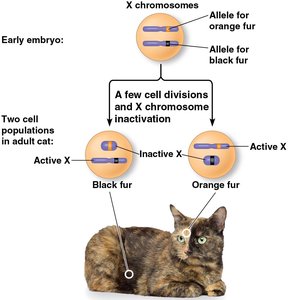
Additional info: X inactivation is a random process, so the proportion of cells expressing each allele can vary, leading to unique patterns in each individual.
Review Questions and Key Concepts
The SRY gene is found on the Y chromosome.
A gene located on either sex chromosome is called a sex-linked gene.
Sex-linked traits can appear in both males and females, but X-linked recessive traits are more common in males.
Y-linked traits are inherited only by males.
Harmful X-linked traits are more numerous than Y-linked ones and are more likely to show up in males.
A heterozygous mother for an X-linked gene has one dominant and one recessive allele.
Males are more likely to be affected by sex-linked disorders because they have only one X chromosome; a single recessive allele will be expressed.
