Indietro
The Chromosomal Basis of Inheritance: Study Notes for General Biology
Guida di studio - Note intelligenti
 Appunti personalizzati basati sui tuoi materiali, ampliati con definizioni chiave, esempi e contesto.
Chapter 15: The Chromosomal Basis of Inheritance
Introduction
This chapter explores the relationship between genes and chromosomes, the physical basis of Mendelian inheritance, and how chromosomal alterations can lead to genetic disorders. It also discusses exceptions to standard Mendelian inheritance, such as genomic imprinting and organelle gene inheritance.
Concept 15.1: Mendelian Inheritance and Chromosome Theory
The Relationship Between Genes and Chromosomes
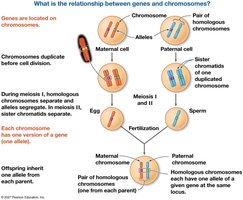
Genes are located on chromosomes, which duplicate before cell division. During meiosis, homologous chromosomes and their alleles segregate, ensuring offspring inherit chromosomes from each parent. Each chromosome carries one version of a gene at a specific locus.
Gene: A segment of DNA that codes for a specific protein or trait.
Chromosome: A structure composed of DNA and proteins that carries genetic information.
Allele: Different versions of a gene found at the same locus.
Homologous chromosomes: Chromosome pairs, one from each parent, with genes at the same loci.
Meiosis: Cell division that reduces chromosome number by half, producing gametes.
Chromosome Theory of Inheritance
Mendel’s hereditary units were theoretical until biologists observed parallels between chromosome behavior and inheritance. Sutton, Boveri, and Morgan provided evidence that chromosomes are the location of Mendel’s heritable factors.
Chromosome theory of inheritance: Genes are located on chromosomes, and their behavior during meiosis accounts for inheritance patterns.
Thomas Hunt Morgan: Provided the first solid evidence associating a specific gene with a specific chromosome.
Morgan’s Experimental Organism: Drosophila melanogaster
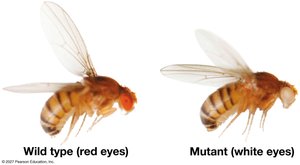
Morgan used fruit flies for genetic studies due to their short generation time, many offspring, and only four pairs of chromosomes. He distinguished between wild type (normal) and mutant phenotypes.
Wild type: The most common phenotype in a population.
Mutant phenotype: Traits alternative to the wild type.
Scientific Inquiry: Correlating Gene Alleles with Chromosome Behavior
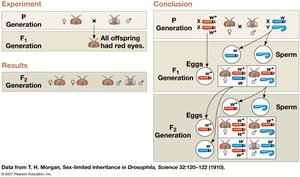
Morgan’s experiments with fruit flies demonstrated that the white-eyed mutant allele is located on the X chromosome, supporting the chromosome theory of inheritance.
Female flies have two X chromosomes (XX), males have one X and one Y (XY).
Sex-linked traits are inherited differently in males and females.
The Chromosomal Basis of Mendel’s Laws
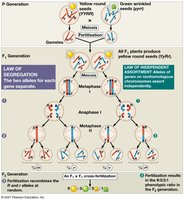
The behavior of chromosomes during meiosis explains Mendel’s laws of segregation and independent assortment.
Law of Segregation: Each parent passes one allele for each gene to offspring.
Law of Independent Assortment: Alleles of different genes assort independently during gamete formation.
Concept 15.2: Sex-Linked Genes and Inheritance Patterns
The Chromosomal Basis of Sex
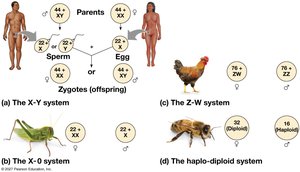
Sex chromosomes determine the sex of an organism. Humans have X and Y chromosomes; other organisms use different systems.
X-Y system: Mammals; XX = female, XY = male.
X-0 system: Insects; XX = female, X0 = male.
Z-W system: Birds; ZW = female, ZZ = male.
Haplo-diploid system: Bees; diploid = female, haploid = male.
Sex-Linked Genes
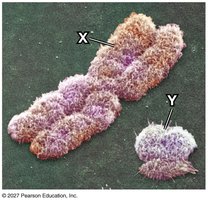
Genes located on sex chromosomes are called sex-linked genes. X-linked genes are found on the X chromosome, Y-linked genes on the Y chromosome.
Human X chromosome contains about 900 genes; Y chromosome about 700 genes.
Y-linked genes are mostly related to sex determination.
Inheritance of X-Linked Genes
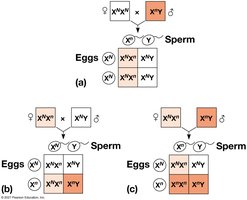
X-linked genes follow specific inheritance patterns. Recessive X-linked traits are more common in males, who only need one copy of the allele to express the trait.
Females need two copies (homozygous) for expression.
Males need only one copy (hemizygous).
Examples: Color blindness, Duchenne muscular dystrophy, hemophilia.
X Inactivation in Female Mammals
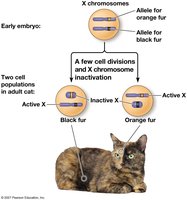
One X chromosome in each cell of female mammals is randomly inactivated, forming a Barr body. This results in mosaicism for X-linked traits.
Barr body: Inactive X chromosome in female cells.
XIST gene: Responsible for X chromosome inactivation.
Concept 15.3: Linked Genes and Genetic Recombination
Linked Genes
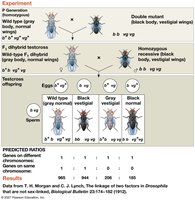
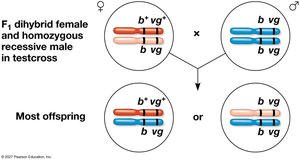
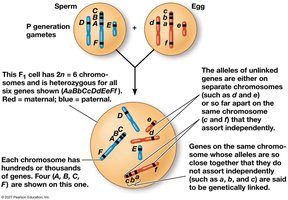
Genes located near each other on the same chromosome tend to be inherited together. Morgan’s experiments with fruit flies showed that linked genes do not assort independently.
Linked genes: Genes located close together on the same chromosome.
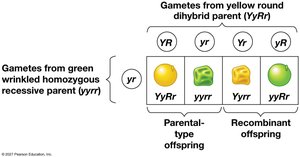
Genetic recombination: Production of offspring with combinations of traits differing from either parent.
Genetic Recombination and Linkage
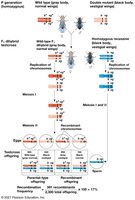
Recombination occurs through independent assortment (unlinked genes) or crossing over (linked genes). A 50% recombination frequency indicates genes are on different chromosomes.
Crossing Over
Crossing over during meiosis breaks the physical connection between linked genes, producing recombinant chromosomes.
Genetic Variation and Natural Selection
Recombinant chromosomes and random fertilization increase genetic variation, which is essential for natural selection.
Mapping the Distance Between Genes Using Recombination Data
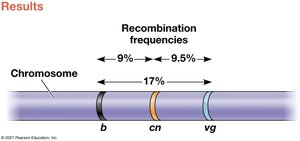
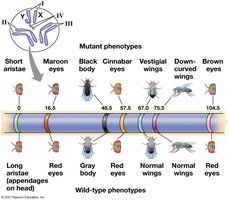
Alfred Sturtevant developed genetic maps based on recombination frequencies. The farther apart two genes are, the higher the probability of crossover.
Linkage map: Genetic map based on recombination frequencies.
Map unit: 1% recombination frequency.
Genes far apart on the same chromosome can behave as if they are on different chromosomes.
Concept 15.4: Chromosomal Alterations and Genetic Disorders
Abnormal Chromosome Number
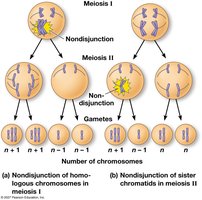
Nondisjunction during meiosis leads to abnormal chromosome numbers, resulting in aneuploidy, monosomy, trisomy, or polyploidy.
Nondisjunction: Failure of homologous chromosomes or sister chromatids to separate properly.
Aneuploidy: Abnormal number of chromosomes.
Monosomy: One copy of a chromosome.
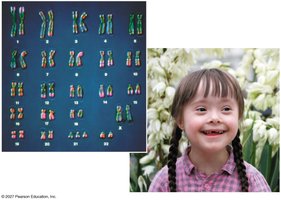
Trisomy: Three copies of a chromosome.
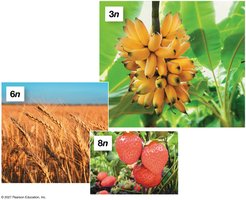
Polyploidy: More than two complete sets of chromosomes; common in plants.
Alterations of Chromosome Structure
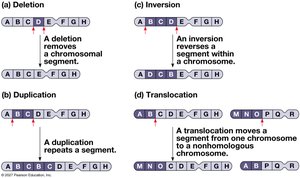
Chromosome breakage can cause deletion, duplication, inversion, or translocation, leading to genetic disorders.
Deletion: Removes a chromosomal fragment.
Duplication: Repeats a segment.
Inversion: Reverses orientation of a segment.
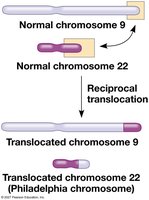
Translocation: Moves a segment to another chromosome.
Human Conditions Due to Chromosomal Alterations
Some chromosomal alterations result in syndromes, such as Down syndrome (trisomy 21), Klinefelter syndrome (XXY), Turner syndrome (X0), and cri du chat syndrome (deletion in chromosome 5). Certain cancers, like chronic myelogenous leukemia, are caused by translocations.
Concept 15.5: Exceptions to Mendelian Inheritance
Genomic Imprinting
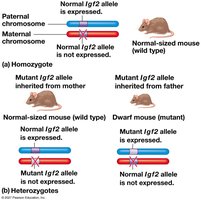
Genomic imprinting is the silencing of certain genes depending on which parent passes them on. The phenotype depends on the parent of origin.
Imprinting involves methylation of cysteine nucleotides.
Most imprinted genes are critical for embryonic development.
Example: Only the paternal allele of the mouse Igf2 gene is expressed.
Inheritance of Organelle Genes
Extranuclear genes are found in mitochondria and chloroplasts. These genes are inherited maternally because the zygote’s cytoplasm comes from the egg.
Defects in mitochondrial genes can cause diseases affecting muscular and nervous systems.
Example: Mitochondrial myopathy, Leber’s hereditary optic neuropathy.

Skills Exercise: Using the Chi-Square Test
Chi-Square Test for Genetic Analysis
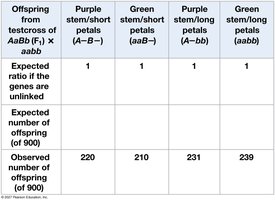
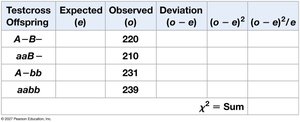
The chi-square test is used to determine whether observed genetic ratios deviate significantly from expected ratios.
Formula:
o: Observed value
e: Expected value
Testcross Offspring | Expected (e) | Observed (o) | Deviation (o-e) | (o-e)^2 | (o-e)^2/e |
|---|---|---|---|---|---|
A–B– | 220 | 220 | 0 | 0 | 0 |
aaB– | 210 | 210 | 0 | 0 | 0 |
A–bb | 231 | 231 | 0 | 0 | 0 |
aabb | 239 | 239 | 0 | 0 | 0 |
Summary of Key Concepts: Linked Genes
Linked Genes and Genetic Mapping
Linked genes are inherited together unless separated by crossing over. Genetic mapping uses recombination frequencies to determine gene order and distance.
Test Your Understanding
Synthesize Your Knowledge
Apply concepts of chromosomal inheritance, linkage, and genetic mapping to solve problems and analyze genetic data.