 Indietro
The Endomembrane System: Structure and Function in Eukaryotic Cells
Guida di studio - Note intelligenti
 Appunti personalizzati basati sui tuoi materiali, ampliati con definizioni chiave, esempi e contesto.
The Endomembrane System
Overview of the Endomembrane System
The endomembrane system is a collection of membrane-bound organelles in eukaryotic cells that regulate protein traffic and perform metabolic functions. It includes the nuclear envelope, endoplasmic reticulum (ER), Golgi apparatus, lysosomes, various vesicles and vacuoles, and the plasma membrane. These organelles are interconnected either by direct physical continuity or by the transfer of membrane segments as vesicles. - Key Point 1: The endomembrane system is essential for synthesis, transport, metabolism, and detoxification within the cell. - Key Point 2: Membranes within the system are dynamic, with their structure and function modified throughout their lifespan.
Endoplasmic Reticulum (ER): Biosynthetic Factory
Structure of the ER
The ER is an extensive network of membranous tubules and sacs called cisternae. It accounts for more than half the total membrane in many eukaryotic cells and is continuous with the nuclear envelope. The ER lumen is the internal compartment separated from the cytosol by the ER membrane. - Key Point 1: The ER consists of two regions: smooth ER (lacking ribosomes) and rough ER (studded with ribosomes). - Key Point 2: The ER membrane is continuous with the nuclear envelope, allowing direct communication between the two. 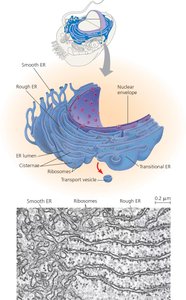
Functions of Smooth ER
The smooth ER is involved in diverse metabolic processes, including lipid synthesis, carbohydrate metabolism, detoxification of drugs and poisons, and storage of calcium ions. - Key Point 1: Smooth ER synthesizes lipids (oils, steroids, phospholipids), including sex hormones and adrenal steroids. - Key Point 2: Detoxifies drugs by adding hydroxyl groups, increasing solubility and excretion. - Key Point 3: Stores calcium ions, crucial for muscle contraction and other cellular responses.
Functions of Rough ER
The rough ER is responsible for the synthesis of secretory proteins and membrane production. Ribosomes attached to the rough ER produce proteins that are threaded into the ER lumen, where they fold and may become glycoproteins. - Key Point 1: Rough ER synthesizes secretory proteins, most of which are glycoproteins. - Key Point 2: Produces membrane proteins and phospholipids, expanding its own membrane and supplying other organelles. - Key Point 3: Proteins and membranes are packaged into transport vesicles for delivery to the Golgi apparatus and other destinations.
Golgi Apparatus: Shipping and Receiving Center
Structure and Function of the Golgi Apparatus
The Golgi apparatus consists of stacks of flattened membranous sacs called cisternae. It receives, modifies, sorts, and ships products from the ER. The Golgi has structural directionality, with a cis face (receiving side) and a trans face (shipping side). - Key Point 1: Vesicles from the ER fuse with the cis face, delivering their contents. - Key Point 2: Products are modified as they move from cis to trans, including glycoprotein carbohydrate processing and phospholipid alteration. - Key Point 3: The Golgi manufactures some macromolecules, such as polysaccharides for plant cell walls. - Key Point 4: The cisternal maturation model proposes that Golgi cisternae move forward, carrying and modifying cargo. - Key Point 5: Products are sorted and tagged for delivery to specific cellular locations. 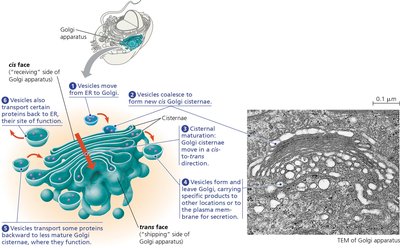
Lysosomes: Digestive Compartments
Structure and Function of Lysosomes
Lysosomes are membranous sacs containing hydrolytic enzymes that digest macromolecules. They function best in acidic environments and are produced by the rough ER and processed in the Golgi apparatus. - Key Point 1: Lysosomes digest food particles via phagocytosis, fusing with food vacuoles and breaking down contents. - Key Point 2: Lysosomes recycle cellular material through autophagy, digesting damaged organelles and releasing their components for reuse. - Key Point 3: Lysosomal storage diseases result from missing enzymes, leading to accumulation of undigested material (e.g., Tay-Sachs disease). 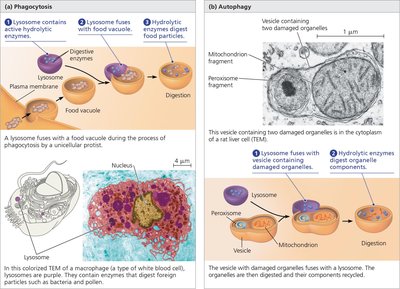
Vacuoles: Diverse Maintenance Compartments
Types and Functions of Vacuoles
Vacuoles are large vesicles derived from the ER and Golgi apparatus, performing various functions depending on cell type. - Key Point 1: Food vacuoles form by phagocytosis and fuse with lysosomes for digestion. - Key Point 2: Contractile vacuoles in protists expel excess water to maintain ion balance. - Key Point 3: Central vacuole in plant cells stores ions, organic compounds, pigments, and contributes to cell growth by absorbing water. - Key Point 4: Vacuoles may store defensive compounds or pigments to attract pollinators. 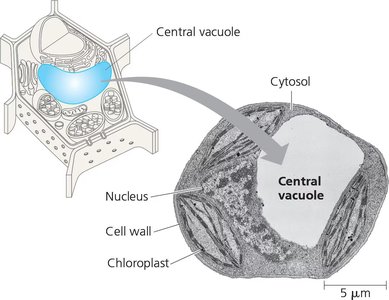
Integration and Review of the Endomembrane System
Relationships Among Organelles
The endomembrane system is a dynamic network, with membrane lipids and proteins moving between organelles via vesicles. As membranes travel from the ER to the Golgi and beyond, their composition and function are modified. - Key Point 1: Transport vesicles integrate the system, carrying proteins and membranes to their destinations. - Key Point 2: The system is essential for compartmentalization, allowing specialized functions within the cell. 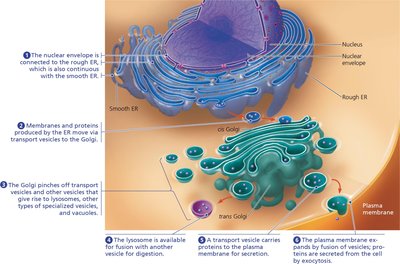
Summary Table: Major Components of the Endomembrane System
Organelle | Main Function | Key Features |
|---|---|---|
Endoplasmic Reticulum (ER) | Synthesis of proteins and lipids; detoxification; calcium storage | Rough ER (ribosomes), Smooth ER (no ribosomes) |
Golgi Apparatus | Modification, sorting, and shipping of proteins and lipids | Cis and trans faces; cisternal maturation |
Lysosomes | Digestion of macromolecules; recycling of cellular material | Hydrolytic enzymes; acidic environment |
Vacuoles | Storage, digestion, water balance, cell growth | Central vacuole in plants; contractile vacuole in protists |
Transport Vesicles | Movement of proteins and membranes between organelles | Bud from ER, Golgi, and other organelles |
Concept Check
Describe the structural and functional distinctions between rough and smooth ER.
Describe how transport vesicles integrate the endomembrane system.
Imagine a protein that functions in the ER but requires modification in the Golgi apparatus before it can achieve that function. Describe the protein’s path through the cell, starting with the mRNA molecule that specifies the protein.
Additional info: The endomembrane system is covered under General Biology topics, specifically "Cell Components" and "The Membrane."
