 Indietro
The Eukaryotic Cell Cycle and Mitosis
Guida di studio - Note intelligenti
 Appunti personalizzati basati sui tuoi materiali, ampliati con definizioni chiave, esempi e contesto.
The Cell Cycle
Overview of the Cell Cycle
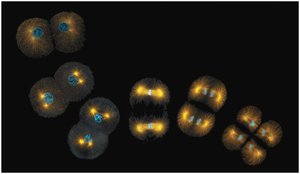
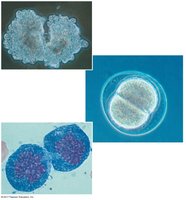
The cell cycle is the series of events that take place in a cell leading to its division and duplication. It is essential for growth, development, and tissue repair in multicellular organisms, and for reproduction in unicellular organisms.
Asexual reproduction: Single-celled organisms reproduce by dividing into two identical cells.
Growth and development: Multicellular organisms grow by increasing cell number through division.
Tissue renewal: Damaged or old cells are replaced by new cells formed through division.
Genetic Material and Chromosomes
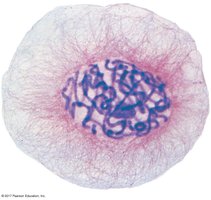
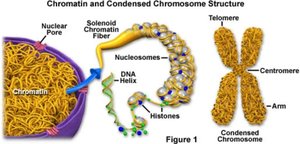
All the DNA in a cell is called its genome. In eukaryotes, DNA is packaged into structures called chromosomes. Chromosomes are made of chromatin, a complex of DNA and proteins that condenses during cell division.
Somatic cells: Non-reproductive cells with two sets of chromosomes.
Gametes: Reproductive cells (sperm and eggs) with half the number of chromosomes.
Chromosome Structure and Replication
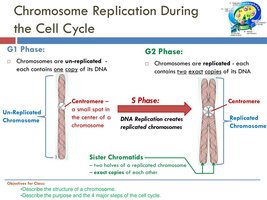
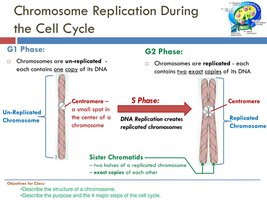
Before a cell divides, its DNA is replicated, and chromosomes condense. Each duplicated chromosome consists of two sister chromatids joined at a region called the centromere. During cell division, sister chromatids separate and are distributed to daughter cells.
Sister chromatids: Identical copies of a chromosome connected by cohesins.
Centromere: The region where sister chromatids are most closely attached.
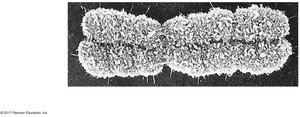
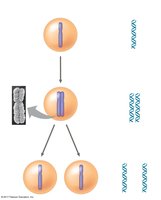
Distribution of Chromosomes During Cell Division
During cell division, the two sister chromatids of each duplicated chromosome separate and move into two nuclei. Once separated, each chromatid is considered a chromosome.
Phases of the Cell Cycle
Major Phases
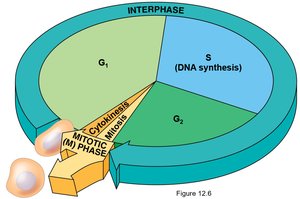
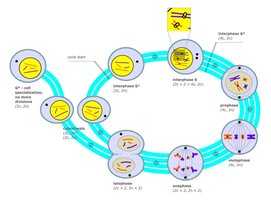
The cell cycle consists of two main phases: interphase and the mitotic (M) phase.
Interphase: Period of cell growth and DNA replication, subdivided into G1 (first gap), S (synthesis), and G2 (second gap) phases.
Mitotic (M) phase: Includes mitosis (division of the nucleus) and cytokinesis (division of the cytoplasm).
Chromosome Replication and the Cell Cycle
Chromosomes are replicated during the S phase of interphase, resulting in two identical sister chromatids for each chromosome. These chromatids are separated during mitosis.
Mitosis: The Process of Nuclear Division
Stages of Mitosis
Mitosis is divided into several stages, each characterized by specific events:
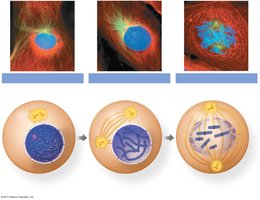
Prophase: Chromosomes condense, spindle apparatus begins to form.
Prometaphase: Nuclear envelope fragments, spindle fibers attach to kinetochores.
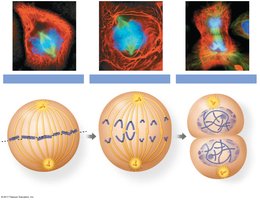
Metaphase: Chromosomes align at the metaphase plate.
Anaphase: Sister chromatids separate and move toward opposite poles.
Telophase: Nuclear envelopes reform around chromosomes at each pole.
Cytokinesis: Division of the cytoplasm, resulting in two daughter cells.
The Mitotic Spindle
The mitotic spindle is a structure made of microtubules that orchestrates the movement of chromosomes during mitosis. In animal cells, spindle formation begins at the centrosomes, which migrate to opposite poles of the cell.
Kinetochore microtubules: Attach to chromosomes at kinetochores and move them during mitosis.
Nonkinetochore microtubules: Overlap at the cell center and help elongate the cell during division.
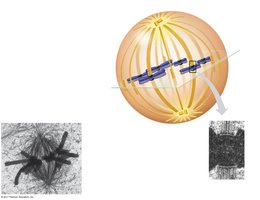
Cytokinesis: Animal vs. Plant Cells
Cytokinesis differs between animal and plant cells:
Animal cells: Form a cleavage furrow that pinches the cell in two.
Plant cells: Form a cell plate that develops into a new cell wall, separating the two daughter cells.
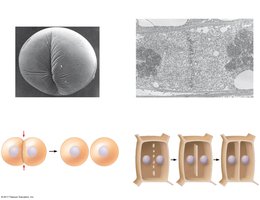
Regulation of the Cell Cycle
Cell Cycle Control System
The cell cycle is regulated by a molecular control system with checkpoints at key stages (G1, G2, and M). These checkpoints ensure that critical processes are completed before the cell proceeds to the next phase.
G1 checkpoint: Determines if the cell will divide or enter a non-dividing state (G0 phase).
G2 checkpoint: Ensures DNA replication is complete before mitosis.
M checkpoint: Ensures all chromosomes are properly attached to the spindle before separation.
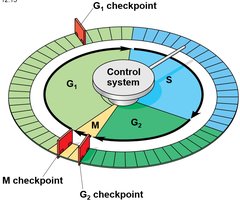
Cyclins and Cyclin-Dependent Kinases (Cdks)
Two types of regulatory proteins, cyclins and cyclin-dependent kinases (Cdks), control the progression of the cell cycle. The activity of Cdks fluctuates with the concentration of their cyclin partners. The maturation-promoting factor (MPF) is a cyclin-Cdk complex that triggers passage through the G2 checkpoint into mitosis.
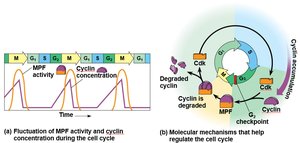
External Signals and Growth Factors
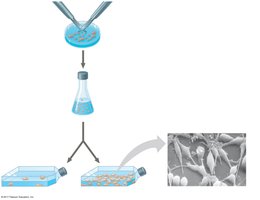
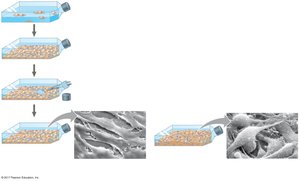
External factors such as growth factors influence cell division. For example, platelet-derived growth factor (PDGF) stimulates fibroblast division. Cells also exhibit anchorage dependence (requiring a surface to divide) and density-dependent inhibition (stopping division when a single layer is formed).
Summary Table: Key Terms in the Cell Cycle
Term | Definition |
|---|---|
Chromosome | Structure of DNA and protein carrying genetic information |
Sister Chromatids | Identical copies of a duplicated chromosome |
Centromere | Region where sister chromatids are joined |
Mitotic Spindle | Microtubule structure that separates chromosomes |
Cytokinesis | Division of the cytoplasm |
Cyclin | Regulatory protein controlling cell cycle progression |
Cdk | Enzyme that, when combined with cyclin, regulates the cell cycle |
Checkpoint | Control point where stop/go signals regulate the cycle |
Key Equations
DNA Replication:
Cell Division:
