 Indietro
The Internal Environment of Animals: Organization and Regulation
Guida di studio - Note intelligenti
 Appunti personalizzati basati sui tuoi materiali, ampliati con definizioni chiave, esempi e contesto.
Animal Form and Function
Introduction to Anatomy and Physiology
Animal biology is structured around the study of form (anatomy) and function (physiology). These two aspects are closely correlated, as the physical structure of an organism often determines its functional capabilities.
Anatomy: The study of the biological form of organisms.
Physiology: The study of the biological functions organisms perform.
Correlation: Form and function are interdependent; for example, long legs in desert animals aid in heat dissipation.
Levels of Organization in Animal Bodies
Animal bodies are organized into hierarchical layers, facilitating specialization and efficient functioning.
Cells: Basic unit of life, specialized for particular activities.
Tissues: Groups of cells with similar appearance and function.
Organs: Functional units composed of different tissue types.
Organ Systems: Groups of organs working together to perform complex functions.
Adaptations for Internal Regulation
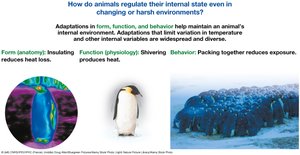
Animals regulate their internal state through adaptations in form, function, and behavior, enabling survival in changing or harsh environments.
Form (Anatomy): Insulating structures reduce heat loss.
Function (Physiology): Shivering generates heat.
Behavior: Packing together reduces exposure and conserves heat.
Animal Tissues
Types of Animal Tissues
Animal tissues are classified into four main categories, each with distinct functions.
Epithelial Tissue: Provides lining for internal and external spaces, acts as a barrier, and controls substance movement.
Connective Tissue: Supports and connects body structures, includes specialized types like blood and bone.
Muscle Tissue: Composed of fibers containing actin and myosin, responsible for contraction and movement. Types include skeletal (voluntary), cardiac (heart), and smooth (involuntary).
Nervous Tissue: Made up of neurons that transmit electrical impulses, processes sensory information, and elicits responses.
Coordination and Control: Endocrine and Nervous Systems
Overview of Coordination Systems
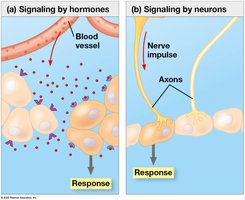
Animals use two major systems for coordination and control in response to stimuli:
Endocrine System: Releases hormones into the bloodstream for slower, longer-lasting responses.
Nervous System: Transmits electrical impulses for immediate, rapid responses.
Endocrine vs. Exocrine Glands
Endocrine Glands: Ductless organs that secrete hormones directly into the circulatory system.
Exocrine Glands: Have ducts that carry secretions to body surfaces or cavities.
Human Endocrine System
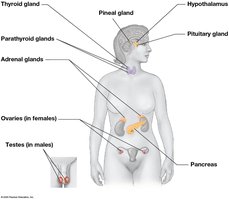
The endocrine system consists of several glands that regulate physiological processes.
Major glands: Hypothalamus, pituitary, thyroid, parathyroid, adrenal, pancreas, ovaries, testes, pineal.
Regulation of Endocrine Signaling
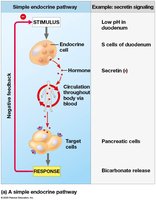
Hormone release is controlled by various stimuli and feedback mechanisms.
Negative Feedback: Dampens stimulus to maintain homeostasis.
Positive Feedback: Reinforces stimulus to amplify response.
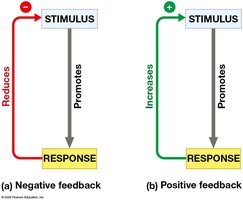
Neuroendocrine Signaling
Hypothalamus: Controls neuroendocrine signaling, often via the pituitary gland.
Posterior Pituitary: Stores and secretes hormones synthesized by the hypothalamus (e.g., oxytocin, ADH).
Anterior Pituitary: Synthesizes and secretes its own hormones, regulating reproduction, growth, metabolism, and stress response.
Hormone Solubility and Action
Protein (Amine) Hormones: Water-soluble, bind to cell-surface receptors, trigger signal transduction (e.g., cAMP as second messenger).
Steroid Hormones: Lipid-soluble, bind to intracellular receptors, alter gene transcription.
Multiple Responses to Hormones
Many hormones, such as epinephrine, elicit multiple responses in different tissues (e.g., increased blood glucose, altered blood flow).
Homeostasis and Regulation
Regulating vs. Conforming
Animals manage their internal environment by either regulating or conforming to external conditions.
Regulators: Use internal mechanisms to maintain stable conditions (e.g., endotherms).
Conformers: Allow internal conditions to change with the environment (e.g., ectotherms).
Homeostasis
Homeostasis is the maintenance of a "steady state" internal balance regardless of external environment.
Set Point: Target value for a physiological variable.
Sensor: Detects deviations from set point.
Response: Returns variable to set point.
Thermoregulation
Thermoregulation is the process by which animals maintain internal temperature within a normal range.
Endotherms: Generate heat by metabolism (birds, mammals).
Ectotherms: Gain heat from external sources (invertebrates, fishes, amphibians, reptiles).
Balancing Heat Loss and Gain
Organisms exchange heat by four physical processes:
Radiation
Evaporation
Convection
Conduction
Circulatory Adaptations for Thermoregulation
Animals alter blood flow to regulate heat exchange.
Vasodilation: Promotes heat loss.
Vasoconstriction: Reduces heat loss.
Countercurrent Exchange
In birds and mammals, countercurrent exchange reduces heat loss by transferring heat between fluids flowing in opposite directions.
Acclimatization
Animals adjust insulation or cellular mechanisms to acclimatize to seasonal temperature changes.
Osmoregulation and Excretion
Osmoregulation
Osmoregulation is the process by which animals control solute concentrations and balance water gain and loss.
Osmolarity: Solute concentration of a solution, determines water movement via osmosis.
Isoosmotic: Equal water movement in both directions.
Hypoosmotic: Lower solute concentration.
Hyperosmotic: Higher solute concentration.
Osmoregulatory Strategies
Osmoconformers: Do not regulate osmolarity, remain isoosmotic with surroundings (some marine animals).
Osmoregulators: Expend energy to control water uptake and loss (e.g., salmon migrating between rivers and ocean).
Osmoregulatory Challenges
Marine Fish: Drink seawater, excrete salt through gills and kidneys.
Freshwater Fish: Drink little water, replenish salts through eating and uptake across gills.
Land Animals: Prevent dehydration via body coverings, drinking, eating moist foods, and metabolic water production.
Nitrogenous Wastes
Ammonia (NH3): Excreted by aquatic organisms, highly toxic.
Urea: Less toxic, excreted by terrestrial and many marine animals.
Uric Acid: Least toxic, excreted by insects, land snails, reptiles, and birds; conserves water.
Excretory Processes
Most excretory systems perform four key functions:
Filtration: Filtering of body fluids.
Reabsorption: Reclaiming valuable solutes.
Secretion: Adding nonessential solutes and wastes.
Excretion: Releasing processed filtrate containing nitrogenous wastes.
Types of Excretory Systems
Flatworms: Protonephridia with flame bulbs produce dilute urine.
Insects: Malpighian tubules remove wastes without filtration, conserve water.
Vertebrates: Kidneys function in osmoregulation and excretion.
Mammalian Kidney: Structure and Function
Nephron Structure
The nephron is the basic unit of the mammalian kidney, responsible for filtration and reabsorption.
Bowman's Capsule/Glomerulus: Initial filtration of blood.
Proximal Tubule: Reabsorption of ions, water, and nutrients; secretion of toxins.
Descending Limb of Loop of Henle: Reabsorption of water via aquaporins; filtrate becomes concentrated.
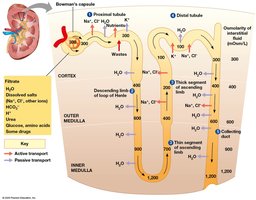
Ascending Limb of Loop of Henle: Salt moves out, filtrate becomes dilute.
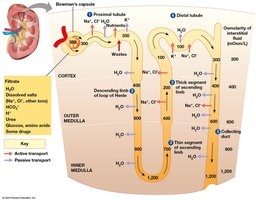
Distal Tubule: Regulates potassium and salt concentrations; contributes to pH regulation.
Collecting Duct: Determines urine concentration; carries filtrate to renal pelvis.
Countercurrent Multiplier System
The loop of Henle and surrounding capillaries act as a countercurrent system, maximizing water conservation.
Adaptations of Vertebrate Kidneys
Desert Mammals: Long loops of Henle, produce hyperosmotic urine.
Birds: Shorter loops, excrete uric acid.
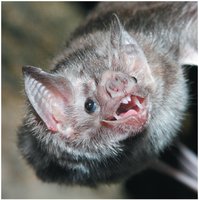
Vampire Bats: Can produce dilute or concentrated urine, aiding in rapid weight reduction and protein digestion.
Homeostatic Regulation of the Kidney
Nervous and Endocrine Regulation
Nervous System: Adjusts blood flow within kidneys.
Antidiuretic Hormone (ADH): Conserves water, triggered by increased blood osmolarity.
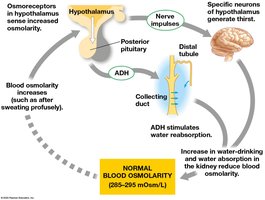
Renin-Angiotensin-Aldosterone System (RAAS)
RAAS: Regulates kidney function, increases water and sodium reabsorption in response to low blood volume and pressure.
Summary Table: Types of Animal Tissues
Type | Main Function | Examples |
|---|---|---|
Epithelial | Barrier, lining, control of substance movement | Skin, lining of gut |
Connective | Support, connection, movement | Bone, blood, cartilage |
Muscle | Contraction, movement | Skeletal, cardiac, smooth muscle |
Nervous | Signal transmission, processing | Brain, spinal cord, nerves |
Summary Table: Forms of Nitrogenous Waste
Waste Type | Toxicity | Water Loss | Typical Animals |
|---|---|---|---|
Ammonia | High | High | Aquatic animals |
Urea | Moderate | Moderate | Mammals, amphibians |
Uric Acid | Low | Low | Birds, reptiles, insects |
Key Equations
Osmosis
Net movement of water:
Feedback Regulation
Negative feedback:
Positive feedback:
Kidney Filtration
Filtration rate:
Reabsorption percentage:
Additional info: Tables and equations were expanded for clarity and completeness. Images were included only when directly relevant to the explanation.
