 Indietro
The Molecular Basis for Inheritance: DNA Structure, Replication, and Repair
Guida di studio - Note intelligenti
 Appunti personalizzati basati sui tuoi materiali, ampliati con definizioni chiave, esempi e contesto.
DNA: Anatomy & Physiology
Historical Discoveries in DNA
The understanding of DNA as the hereditary material has evolved through key experiments and discoveries. These foundational studies established DNA's role in inheritance and paved the way for modern molecular biology.
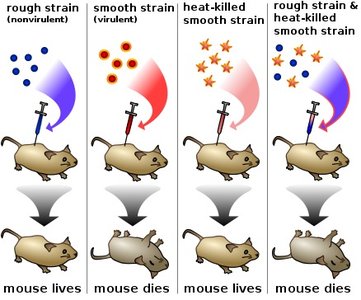
Frederick Griffith & Transformation: Griffith's experiment demonstrated that non-virulent bacteria could be transformed into virulent forms by exposure to heat-killed virulent bacteria, suggesting the presence of a 'transforming principle.'
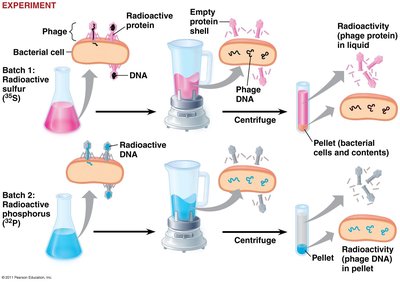
Alfred Hershey & Martha Chase: Their experiment with bacteriophages showed that DNA, not protein, is the hereditary material in viruses. Radioactive labeling of DNA and protein allowed them to track which component entered bacterial cells.
Structure of DNA
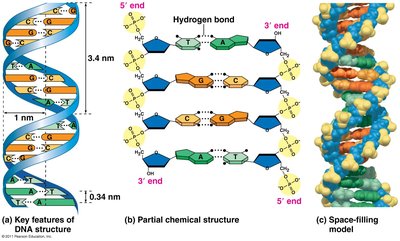
DNA is a double helix composed of two antiparallel strands of nucleotides. Each nucleotide consists of a phosphate group, a deoxyribose sugar, and a nitrogenous base (adenine, thymine, cytosine, or guanine). The structure allows for complementary base pairing, which is essential for replication and information storage.
Key Features: The double helix is stabilized by hydrogen bonds between complementary bases (A-T and G-C). The strands run in opposite directions (5' to 3' and 3' to 5').
Chargaff's Rules: The amount of adenine equals thymine, and the amount of guanine equals cytosine in DNA.
Example: The space-filling model and partial chemical structure illustrate the physical and chemical properties of DNA.
DNA Replication
Semiconservative Replication
DNA replication occurs during the S phase of the cell cycle and is based on the principle of base pairing. The process is semiconservative, meaning each new DNA molecule consists of one parental strand and one newly synthesized strand.
Meselson & Stahl Experiment: Demonstrated semiconservative replication using isotopic labeling and density gradient centrifugation.

Replication Models: Compared conservative, semiconservative, and dispersive models. Only the semiconservative model was supported by experimental evidence.
Mechanism: DNA polymerase synthesizes new strands by adding nucleotides to the 3' end, using the parental strand as a template.
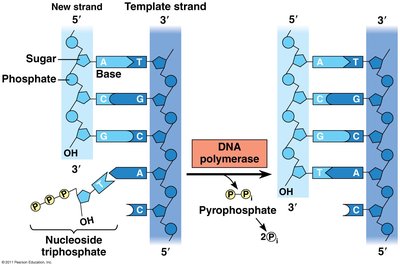
Initiation and Machinery of Replication
Replication begins at specific origins and involves a complex machinery known as the replisome. Multiple enzymes and proteins cooperate to ensure accurate and efficient DNA synthesis.
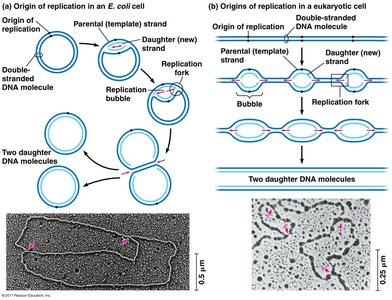
Origins of Replication: In prokaryotes, a single origin; in eukaryotes, multiple origins. Replication bubbles and forks form as DNA unwinds.
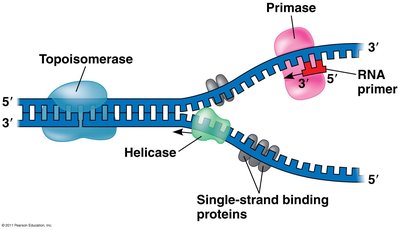
Replication Machinery: Includes helicase (unwinds DNA), primase (synthesizes RNA primer), single-strand binding proteins (stabilize unwound DNA), DNA polymerases (synthesize new DNA), and topoisomerase (relieves supercoiling).
Leading and Lagging Strand Synthesis
DNA replication is continuous on the leading strand and discontinuous on the lagging strand, resulting in the formation of Okazaki fragments.
Leading Strand: Synthesized continuously in the direction of the replication fork.
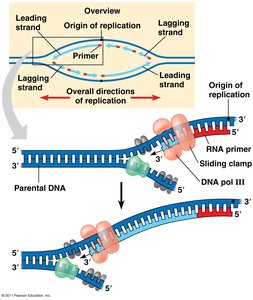
Lagging Strand: Synthesized discontinuously, with short Okazaki fragments joined by DNA ligase. Primase lays down RNA primers, DNA pol I removes primers, and DNA ligase connects fragments.
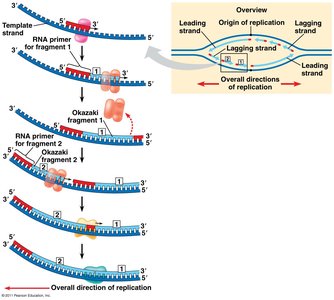
Cooperation at the Molecular Level: The Replisome
The replisome is a multi-protein complex that coordinates the activities of all enzymes involved in DNA replication.
Key Players: Helicase, primase, single-strand binding protein, DNA pol III, DNA pol I, DNA ligase, and topoisomerase.
DNA Repair and Telomeres
DNA Repair Mechanisms
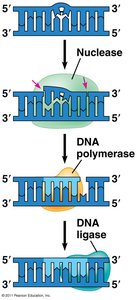
DNA repair is essential for maintaining genetic integrity. Nucleotide excision repair is a major pathway that removes damaged DNA and replaces it with correct nucleotides.
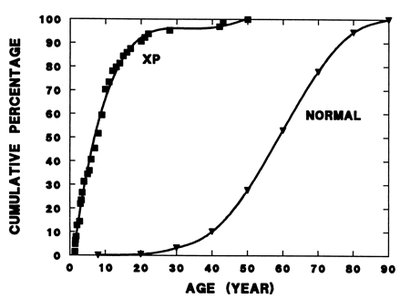
Impaired DNA Repair: Defects in repair mechanisms can lead to diseases such as cancer. The graph below shows the cumulative percentage of individuals with xeroderma pigmentosum (XP) compared to normal individuals.
Nucleotide Excision Repair: Involves three main steps: removal of damaged DNA by nuclease, synthesis of new DNA by polymerase, and sealing by ligase.
Telomeres and Telomerase
Telomeres are repetitive DNA sequences at the ends of chromosomes that protect genetic information. Telomerase is an enzyme that maintains telomere length, which is crucial for cellular longevity and regeneration.
Telomere Function: Telomeres prevent chromosome degradation and fusion. Their length decreases with age and cell division.
Telomerase Activity: High telomerase activity is associated with regenerative capacity, as seen in certain tissues and organisms.
DNA Packing and Chromosome Structure
Chromatid Condensation and Chromosome Formation
During cell division, DNA is packed into chromosomes through condensation, involving loop formation and scaffold twisting. This process ensures efficient segregation of genetic material.
Chromatid Structure: Sister chromatids are joined at the centromere and become visible during mitosis.
Chromosome Duplication: DNA replication and condensation lead to the formation of sister chromatids, which are separated during cell division.
Summary Table: DNA Replication Models
The following table summarizes the three proposed models of DNA replication and their experimental outcomes:
Model | Description | Experimental Outcome |
|---|---|---|
Conservative | Parent DNA remains intact; new molecule is entirely new DNA | Not supported by Meselson-Stahl experiment |
Semiconservative | Each new DNA molecule contains one parental and one new strand | Supported by Meselson-Stahl experiment |
Dispersive | DNA strands are mixtures of old and new segments | Not supported by Meselson-Stahl experiment |
Additional info: The notes expand on brief points by providing full academic explanations, definitions, and relevant examples. All images included are directly relevant to the adjacent content and reinforce key concepts in DNA structure, replication, repair, and chromosome formation.
