 Indietro
The Molecular Basis of Inheritance: DNA Structure, Replication, and Chromosome Organization
Guida di studio - Note intelligenti
 Appunti personalizzati basati sui tuoi materiali, ampliati con definizioni chiave, esempi e contesto.
Chapter 16: The Molecular Basis of Inheritance
DNA as the Genetic Material
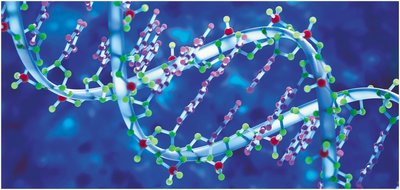
Understanding the molecular basis of inheritance is fundamental to biology. DNA (deoxyribonucleic acid) is the hereditary material in all living organisms, encoding the instructions for life and transmitting genetic information from one generation to the next.
Genes are segments of DNA that code for specific traits.
Chromosomes are composed of DNA and proteins; the DNA component carries genetic information.
Experimental Evidence for DNA as Genetic Material
Griffith’s Transformation Experiment
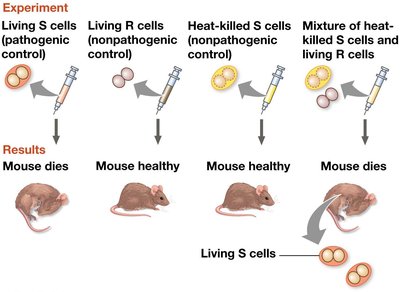
Frederick Griffith demonstrated that a substance from dead pathogenic bacteria could genetically transform living non-pathogenic bacteria, suggesting the presence of a "transforming principle." Later, Avery and colleagues identified this substance as DNA.
S strain: Pathogenic (disease-causing)
R strain: Non-pathogenic (harmless)
Mixing heat-killed S strain with living R strain resulted in the transformation of R to S, causing disease in mice.
Hershey-Chase Experiment
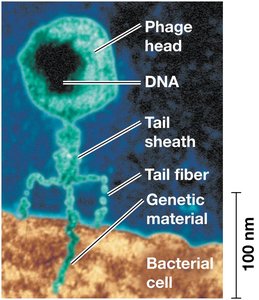
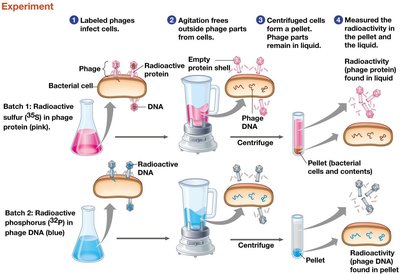
Alfred Hershey and Martha Chase used bacteriophages (viruses that infect bacteria) to show that DNA, not protein, is the genetic material. They labeled viral DNA with radioactive phosphorus and protein with radioactive sulfur, demonstrating that only DNA entered bacterial cells and directed viral replication.
DNA Structure
DNA is a polymer of nucleotides, each consisting of a nitrogenous base, a deoxyribose sugar, and a phosphate group. The four nitrogenous bases are adenine (A), thymine (T), guanine (G), and cytosine (C).
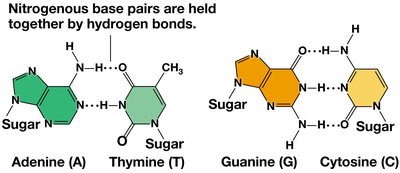
Chargaff’s Rules: In any DNA sample, the amount of A equals T, and the amount of G equals C.
Base composition varies among species, but A = T and G = C always hold.
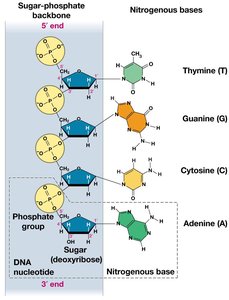
Discovery of the Double Helix
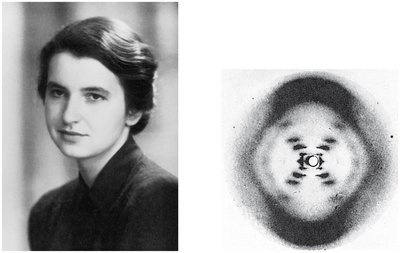
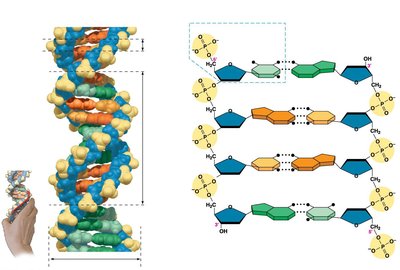
Rosalind Franklin’s X-ray crystallography images revealed DNA’s helical structure and uniform diameter. Watson and Crick used these data to propose the double helix model, where two antiparallel strands are held together by complementary base pairing (A-T and G-C).
DNA Replication
Mechanism of DNA Replication
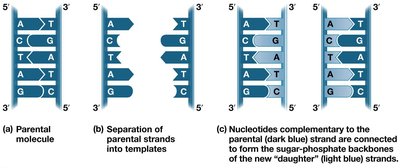
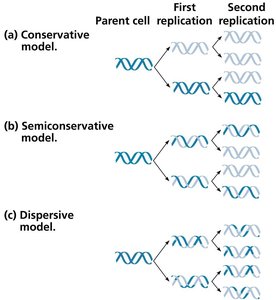
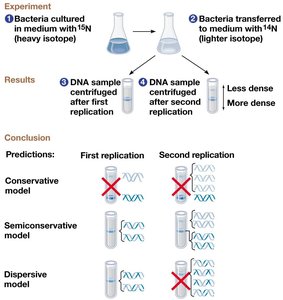
DNA replication is the process by which DNA makes a copy of itself during cell division. It is semiconservative: each new DNA molecule consists of one parental strand and one newly synthesized strand.
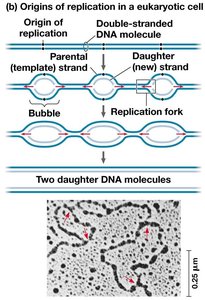
Replication begins at origins of replication, forming replication bubbles.
Replication proceeds in both directions from each origin.
Proteins Involved in DNA Replication
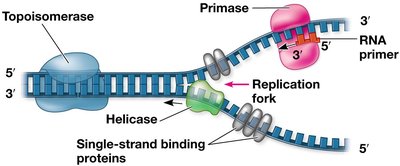
Helicase: Unwinds the DNA double helix at the replication fork.
Single-strand binding proteins: Stabilize unwound DNA strands.
Topoisomerase: Relieves tension ahead of the replication fork by cutting and rejoining DNA strands.
Primase: Synthesizes short RNA primers to provide a starting point for DNA synthesis.
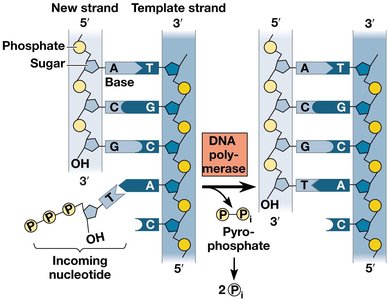
DNA polymerase: Adds nucleotides to the 3′ end of the primer, synthesizing new DNA in the 5′ to 3′ direction.
Leading and Lagging Strand Synthesis
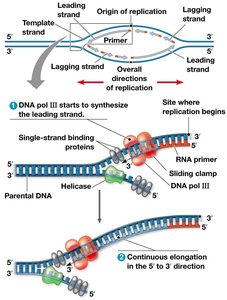
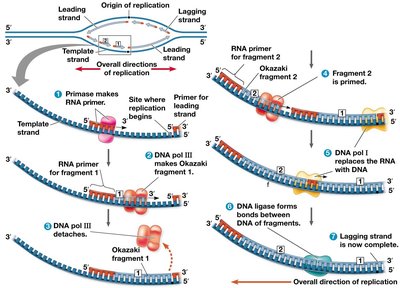
Because DNA polymerase can only add nucleotides to the 3′ end, replication is continuous on the leading strand and discontinuous on the lagging strand.
Leading strand: Synthesized continuously toward the replication fork.
Lagging strand: Synthesized in short segments called Okazaki fragments, each starting with an RNA primer. DNA ligase joins these fragments.
Proofreading and DNA Repair
DNA polymerases proofread newly synthesized DNA, correcting errors. Additional repair mechanisms include mismatch repair and nucleotide excision repair. Unrepaired errors can result in mutations, contributing to genetic variation.
Replicating the Ends: Telomeres and Telomerase
Linear chromosomes have repetitive DNA sequences at their ends called telomeres, which protect genes from being lost during replication. The enzyme telomerase can extend telomeres in certain cells, preventing chromosome shortening.
Chromosome Organization and DNA Packaging
Chromatin Structure
In eukaryotes, DNA is packaged with proteins into chromatin, which condenses to form chromosomes during cell division.
Nucleosome: The basic unit of DNA packaging, consisting of DNA wrapped around histone proteins.
Chromatin undergoes multiple levels of folding, ultimately forming the highly condensed structure of a chromosome.
Histone modifications can regulate gene expression by altering chromatin structure.
Summary Table: Key Features of DNA Structure and Replication
Feature | Description |
|---|---|
Genetic Material | DNA (not protein) carries genetic information |
Structure | Double helix, antiparallel strands, complementary base pairing (A-T, G-C) |
Replication | Semiconservative; each new molecule has one old and one new strand |
Enzymes | Helicase, primase, DNA polymerase, ligase, topoisomerase |
Leading Strand | Synthesized continuously |
Lagging Strand | Synthesized discontinuously as Okazaki fragments |
Proofreading/Repair | Polymerase proofreading, mismatch repair, nucleotide excision repair |
Telomeres | Protect chromosome ends; extended by telomerase |
Chromatin | DNA + proteins (histones); organized into nucleosomes and higher-order structures |
BIG PICTURE: DNA’s structure enables accurate replication, repair, and packaging, ensuring faithful transmission of genetic information.
