 Indietro
The Molecular Diversity of Life: Biomolecules and Their Structure
Guida di studio - Note intelligenti
 Appunti personalizzati basati sui tuoi materiali, ampliati con definizioni chiave, esempi e contesto.
The Molecular Diversity of Life
Biochemicals and Organic Molecules
Biochemicals are organic molecules produced and utilized by living organisms. All biochemicals contain carbon and hydrogen, and often include other elements such as oxygen and nitrogen. The diversity and complexity of biochemicals arise from the versatile bonding properties of carbon, which allows for the formation of a wide variety of molecular structures.
Organic molecules: Compounds containing carbon and hydrogen, often with oxygen, nitrogen, phosphorus, or sulfur.
Biomolecules: Organic molecules essential for life, including proteins, nucleic acids, carbohydrates, and lipids.
Monomers and Polymers
Most biological macromolecules are polymers, constructed from a limited set of common monomers. Monomers can join in different ways or sequences to produce a variety of polymers, contributing to molecular diversity.
Monomer: A small molecule that can join with others to form a polymer.
Polymer: A large molecule composed of repeating monomer units.
Examples: Amino acids (monomers) form proteins (polymers); nucleotides form nucleic acids.

Dehydration Synthesis and Hydrolysis
Biological polymers are formed and broken down by two key reactions: dehydration synthesis and hydrolysis.
Dehydration synthesis: A condensation reaction where two molecules are joined, releasing a water molecule.
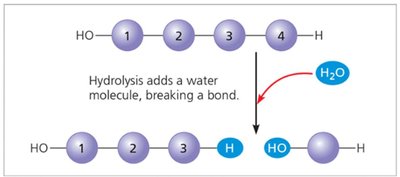
Hydrolysis: A reaction where a water molecule is used to break a bond, splitting a polymer into monomers.
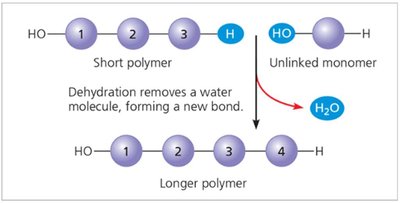
Equation for dehydration synthesis:
Equation for hydrolysis:
Major Classes of Biological Molecules
Proteins
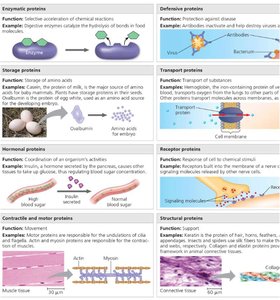
Proteins are polymers made from 20 different amino acids. They perform the most diverse range of functions among biomolecules, including catalysis, defense, transport, storage, signaling, and structural support.
Protein: A biologically functional molecule consisting of one or more polypeptides.
Polypeptide: A linear chain of amino acids joined by peptide bonds.
Most biochemical reactions require enzymes, which are proteins that catalyze reactions under physiological conditions.
Amino Acids: Structure and Properties
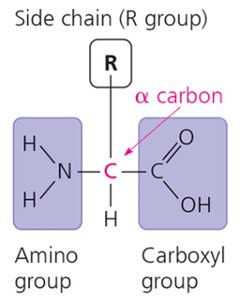
All amino acids have three functional groups attached to a central carbon atom: an amino group (-NH2), a carboxyl group (-COOH), and a unique "R" group (side chain) that determines the identity and properties of the amino acid.
Amino group:
Carboxyl group:
R group: Variable side chain

Peptide Bond Formation
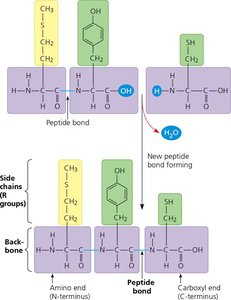
Adjacent amino acids in a polypeptide are joined by a peptide bond, formed through dehydration synthesis between the carboxyl group of one amino acid and the amino group of another.
Levels of Protein Structure
Proteins have four levels of structure, each critical for their function:
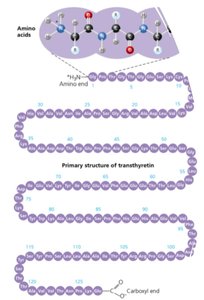
Primary structure: Linear sequence of amino acids.
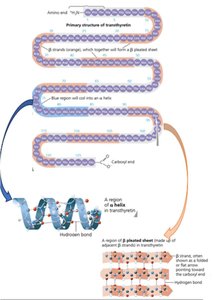
Secondary structure: Local folding (α-helix, β-sheet) due to backbone interactions.
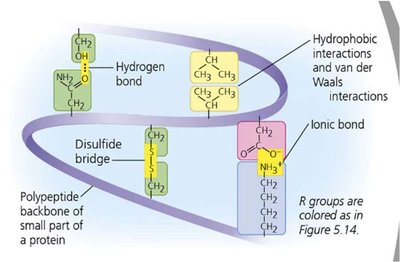
Tertiary structure: Overall 3D shape from R group interactions.
Quaternary structure: Assembly of multiple polypeptides.

Protein Denaturation
Denaturation is the loss of higher-order protein structure (secondary, tertiary, quaternary) without breaking the primary sequence. Denatured proteins usually lose their function.
Nucleic Acids
Nucleic acids are polynucleotides composed of nucleotide monomers. There are two types: DNA and RNA.
DNA (deoxyribonucleic acid): Stores hereditary information.
RNA (ribonucleic acid): Helps express hereditary information.
Carbohydrates
Carbohydrates are sugars or polymers of sugars, made of carbon, hydrogen, and oxygen in a 1:2:1 ratio. They serve as energy sources and structural components.
Monosaccharides: Simple sugars (e.g., glucose, fructose, galactose).
Disaccharides: Double sugars formed by two monosaccharides (e.g., sucrose, lactose, maltose).
Polysaccharides: Polymers of hundreds to thousands of monosaccharides (e.g., starch, glycogen, cellulose).
Lipids
Lipids are hydrophobic organic molecules, not true polymers, and are diverse in structure and function. They include fats, phospholipids, and steroids.
Triacylglycerols (fats): Energy storage molecules formed by linking three fatty acids to a glycerol backbone.
Phospholipids: Major constituents of cell membranes, with two fatty acid tails and a phosphate-containing head.
Steroids: Lipids with a backbone of four fused hydrocarbon rings (e.g., cholesterol, estrogen, testosterone).
Summary Table: Major Biomolecules
Class | Monomer | Polymer | Main Functions |
|---|---|---|---|
Protein | Amino acid | Polypeptide | Catalysis, structure, transport, signaling |
Nucleic Acid | Nucleotide | DNA/RNA | Information storage, expression |
Carbohydrate | Monosaccharide | Polysaccharide | Energy, structure |
Lipid | Fatty acid, glycerol | Triacylglycerol, phospholipid, steroid | Energy storage, membranes, signaling |
Review Questions
Which sugar is most important for making RNA? Ribose
All lipids are poorly water soluble.
Which level of protein structure is most immediately encoded in DNA? Primary
For what is water most important when digesting food? Hydrolysis reactions
