Indietro
The Molecules of Cells: Structure and Function of Biomolecules
Guida di studio - Note intelligenti
 Appunti personalizzati basati sui tuoi materiali, ampliati con definizioni chiave, esempi e contesto.
The Molecules of Cells
Overview
This chapter explores the molecular building blocks of cells, focusing on the structure, function, and diversity of organic compounds essential for life. It covers carbohydrates, lipids, proteins, and nucleic acids, emphasizing their roles in cellular processes and human health.
Introduction to Organic Compounds
Life's Molecular Diversity and Carbon
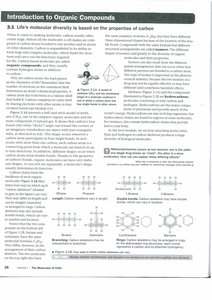
Organic compounds are molecules containing carbon, which forms the backbone of biological molecules due to its ability to create four covalent bonds. This versatility allows for a wide variety of molecular shapes and functions.
Carbon Skeletons: Can be straight, branched, or ring-shaped, enabling structural diversity.
Functional Groups: Specific groups of atoms attached to carbon skeletons determine the chemical properties and reactivity of organic molecules.
Examples: Hydroxyl, carbonyl, carboxyl, amino, phosphate, and methyl groups.
Key Chemical Groups in Biological Molecules
Functional Groups and Their Roles
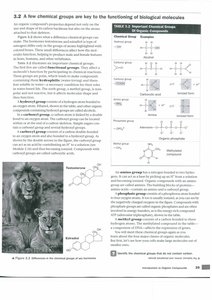
Certain chemical groups are critical for the functioning of biological molecules. These groups influence molecular interactions, solubility, and biological activity.
Hydroxyl Group (-OH): Found in alcohols; increases solubility in water.
Carbonyl Group (C=O): Found in sugars; can be at the end (aldehyde) or within (ketone) a carbon skeleton.
Carboxyl Group (-COOH): Acts as an acid; found in amino acids and fatty acids.
Amino Group (-NH2): Acts as a base; found in amino acids.
Phosphate Group (-PO4): Important in energy transfer (ATP).
Methyl Group (-CH3): Affects gene expression and molecular function.
Group | Structure | Function |
|---|---|---|
Hydroxyl | -OH | Alcohols, increases solubility |
Carbonyl | C=O | Sugars, aldehydes, ketones |
Carboxyl | -COOH | Amino acids, fatty acids |
Amino | -NH2 | Amino acids |
Phosphate | -PO4 | ATP, nucleic acids |
Methyl | -CH3 | Gene expression |
Macromolecules: Building and Breaking Polymers
Polymer Formation and Diversity
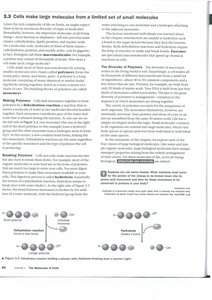
Cells construct large molecules (macromolecules) from smaller units (monomers) through dehydration reactions, and break them down via hydrolysis. The diversity of polymers arises from the arrangement of monomers.
Dehydration Reaction: Removes water to join monomers.
Hydrolysis: Adds water to break polymers into monomers.
Polymer Diversity: Sequence and type of monomers determine function.
Carbohydrates
Monosaccharides: The Simplest Carbohydrates
Carbohydrates are organic molecules composed of carbon, hydrogen, and oxygen. Monosaccharides are the simplest form, serving as energy sources and building blocks for more complex carbohydrates.
Examples: Glucose, fructose, galactose.
Structure: Can exist as linear chains or rings.
Formula:
Disaccharides: Linking Two Monosaccharides
Disaccharides are formed by joining two monosaccharides via a dehydration reaction. Common examples include sucrose, lactose, and maltose.
Formation: Glycosidic bond between two sugar units.
Examples: Sucrose (glucose + fructose), lactose (glucose + galactose).
Polysaccharides: Long Chains of Sugar Units
Polysaccharides are complex carbohydrates consisting of many monosaccharide units. They serve as energy storage and structural components in cells.
Starch: Energy storage in plants.
Glycogen: Energy storage in animals.
Cellulose: Structural component in plant cell walls.
Lipids
Fats: Energy-Storage Molecules
Lipids are hydrophobic molecules, including fats, phospholipids, and steroids. Fats are primarily used for energy storage and insulation.
Structure: Glycerol backbone with three fatty acids (triglyceride).
Saturated vs. Unsaturated: Saturated fats have no double bonds; unsaturated fats have one or more double bonds.
Health Risks of Trans Fats
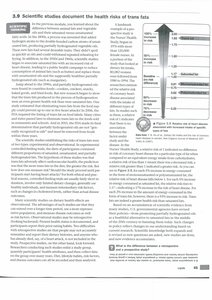
Trans fats are artificially created by hydrogenating unsaturated fats. They are associated with increased health risks, including heart disease.
Trans Fats: Raise LDL cholesterol and lower HDL cholesterol.
Health Impact: Linked to cardiovascular disease.
Phospholipids and Steroids: Structure and Function
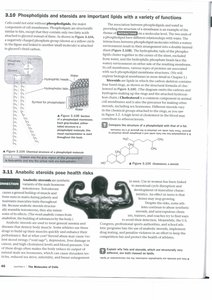
Phospholipids form cell membranes, while steroids serve as signaling molecules and structural components.
Phospholipids: Two fatty acids, glycerol, and a phosphate group; form bilayers in membranes.
Steroids: Four fused carbon rings; include cholesterol and hormones.
Proteins
Functions and Structures of Proteins
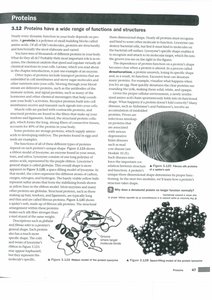
Proteins are polymers of amino acids with diverse functions, including catalysis, structure, transport, and signaling. Their function depends on their three-dimensional shape.
Enzymes: Catalyze biochemical reactions.
Structural Proteins: Provide support (e.g., collagen).
Transport Proteins: Move substances across membranes.
Signaling Proteins: Hormones and receptors.
Amino Acids and Peptide Bonds
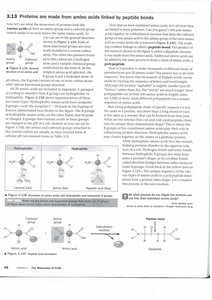
Proteins are made from amino acids linked by peptide bonds. Each amino acid has a central carbon, an amino group, a carboxyl group, and a unique side chain (R group).
Peptide Bond: Formed by dehydration reaction between amino and carboxyl groups.
Primary Structure: Sequence of amino acids.
Levels of Protein Structure
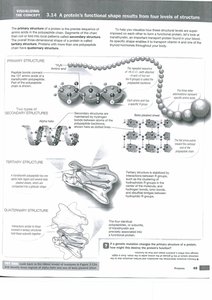
Protein function is determined by four levels of structure: primary, secondary, tertiary, and quaternary.
Primary: Amino acid sequence.
Secondary: Alpha helices and beta sheets formed by hydrogen bonding.
Tertiary: Three-dimensional folding due to interactions among side chains.
Quaternary: Association of multiple polypeptide chains.
Nucleic Acids
DNA and RNA: Information-Rich Polymers
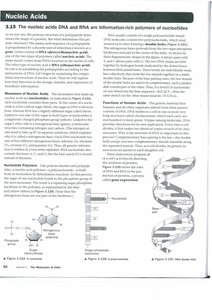
Nucleic acids are polymers of nucleotides, which store and transmit genetic information. DNA and RNA differ in structure and function.
DNA: Double helix; stores genetic information.
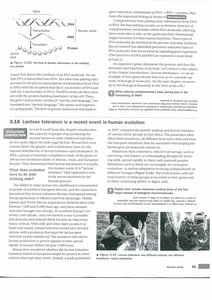
RNA: Single-stranded; involved in protein synthesis.
Nucleotide Structure: Sugar, phosphate, and nitrogenous base.
Lactose Tolerance and Human Evolution
Genetic Adaptation to Diet
Lactose tolerance is a recent evolutionary adaptation in humans, allowing adults to digest lactose due to the continued expression of the lactase enzyme. This trait is linked to the domestication of dairy animals and cultural dietary practices.
Lactase Persistence: Genetic mutation enables continued production of lactase.
Evolutionary Significance: Provides a nutritional advantage in populations with dairy consumption.
Review and Testing Your Knowledge
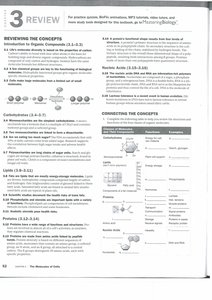
Summary Table: Biomolecules and Their Functions
Biomolecule | Monomer | Polymer | Main Function |
|---|---|---|---|
Carbohydrates | Monosaccharide | Polysaccharide | Energy, structure |
Lipids | Fatty acid, glycerol | Triglyceride, phospholipid | Energy storage, membranes |
Proteins | Amino acid | Polypeptide | Catalysis, structure, transport |
Nucleic Acids | Nucleotide | DNA, RNA | Information storage |
Practice Questions
What is the role of carbon in organic molecules?
Describe the structure and function of carbohydrates, lipids, proteins, and nucleic acids.
Explain the significance of functional groups in biological molecules.
How do dehydration and hydrolysis reactions affect polymers?
Discuss the health implications of trans fats and lactose tolerance.