 Indietro
Chap 27
Guida di studio - Note intelligenti
 Appunti personalizzati basati sui tuoi materiali, ampliati con definizioni chiave, esempi e contesto.
Introduction to Animal Diversity
This section explores the evolutionary history, classification, and major adaptations of animals, focusing on their origins, body plans, and the transition from aquatic to terrestrial life. It covers the main animal phyla, the Cambrian explosion, and the rise of vertebrates, providing a comprehensive overview suitable for General Biology students.
What Is an Animal?
Multicellularity: Animals are composed of multiple cells.
Heterotrophy: Animals obtain energy by consuming other organisms.
Sexual Reproduction: Most animals reproduce sexually, producing genetically diverse offspring.
Lack of Cell Walls: Animal cells do not have rigid cell walls, unlike plants and fungi.
Motility: Animals are capable of movement at some stage of their life cycle.
Response to Stimuli: Animals have nerve and muscle tissues (or contractile tissues) that allow rapid response to environmental changes.
Origins and Early Evolution of Animals
Evolutionary Origins
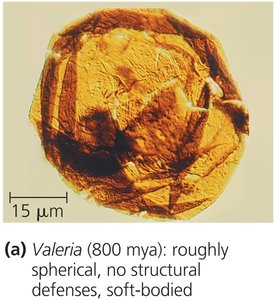
Animals likely evolved from single-celled eukaryotes similar to modern choanoflagellates over 700 million years ago. Fossil and molecular evidence, including steroid traces in sediments, suggest animals arose by 770 million years ago. The earliest animal fossils are from the Ediacaran biota (about 560 million years ago).
Early-Diverging Animal Groups
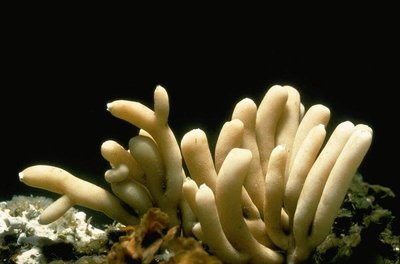
Sponges (Phylum Porifera): Simple filter feeders lacking true tissues. Water flows through their porous bodies, allowing them to capture food particles.
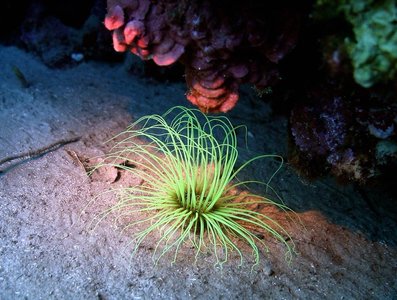
Cnidarians (Phylum Cnidaria): Eumetazoans with true tissues, including hydrozoans, jellies, and sea anemones. They have a sac-like body with a central gastrovascular cavity and tentacles for capturing prey.
Phylogenetic Relationships
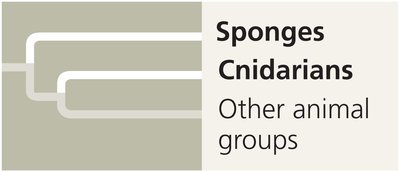
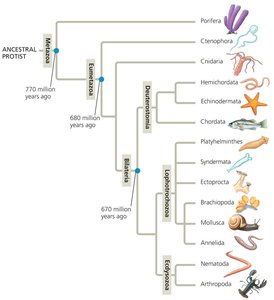
Sponges and cnidarians diverged early from other animal groups, as shown in simple phylogenetic trees.
The Cambrian Explosion and Animal Diversification
The Cambrian Explosion
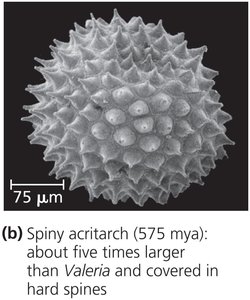
The Cambrian explosion (535–525 million years ago) marks a period of rapid diversification, with the sudden appearance of large forms of many present-day animal phyla. Fossils from this period include the first hard, mineralized skeletons and the earliest bilaterians—animals with bilateral symmetry and a complete digestive tract.
Animal Body Plans
Symmetry
Radial Symmetry: Body parts arranged around a central axis (e.g., cnidarians). Any slice through the central axis produces mirror images.
Bilateral Symmetry: Body has distinct left and right sides, with only one plane producing mirror images. Bilateral animals have dorsal (top), ventral (bottom), anterior (front), and posterior (back) sides, and often a concentration of sensory organs at the anterior end (cephalization).
The type of symmetry often reflects the animal's lifestyle: radial animals are usually sessile or planktonic, while bilateral animals are typically active movers.
Tissues and Germ Layers
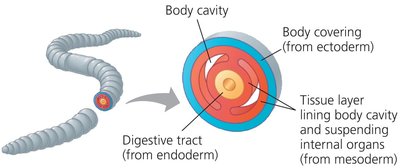
Tissues: Collections of specialized cells acting as functional units. True tissues arise from germ layers during embryonic development.
Germ Layers:
Ectoderm: Forms the outer covering and nervous system.
Endoderm: Forms the digestive tract and internal organ linings.
Mesoderm: Forms muscles and most other organs (present in all bilaterians).
Body Cavities
Most bilaterians possess a coelom, a fluid- or air-filled body cavity between the digestive tract and the outer body wall. Functions include cushioning organs, acting as a hydrostatic skeleton, and allowing independent movement of internal organs.
Major Animal Phyla and Their Characteristics
Invertebrate Diversity
Annelida: Segmented worms, primarily aquatic or terrestrial (e.g., earthworms).
Nematoda: Roundworms with a tough cuticle, many of which are parasitic.
Arthropoda: The largest animal phylum, with segmented exoskeletons and jointed appendages (e.g., insects, crabs, spiders).
Animal Phylogeny
Most animal phyla were established by 500 million years ago. The major clades of bilaterians are Lophotrochozoa, Ecdysozoa, and Deuterostomia. Most animals are invertebrates; only Chordata includes vertebrates.
Vertebrate Evolution and Diversity
Chordate Characteristics
Notochord: Flexible rod for support.
Dorsal, hollow nerve cord: Develops into the brain and spinal cord.
Pharyngeal slits: Used for feeding, respiration, or head structures.
Muscular post-anal tail: Extends beyond the anus.
Early chordates include lancelets and tunicates. Vertebrates have a backbone, skull, and well-defined head.
Major Vertebrate Groups
Jawless Vertebrates (Cyclostomes): Hagfishes and lampreys.
Jawed Vertebrates (Gnathostomes): Include sharks, rays, and bony fishes.
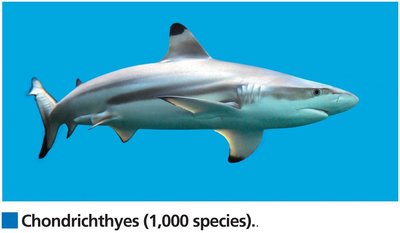
Chondrichthyes: Cartilaginous fishes such as sharks and rays.
Ray-finned Fishes: The largest group of vertebrates, with bony skeletons and fins supported by rays.
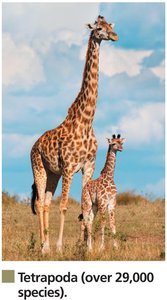
Tetrapods: Vertebrates with limbs and digits, including amphibians, reptiles, and mammals.
Transition to Land: Tetrapods and Amniotes
The Origin of Tetrapods
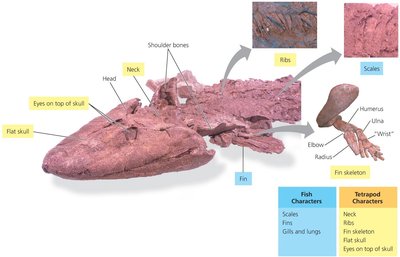
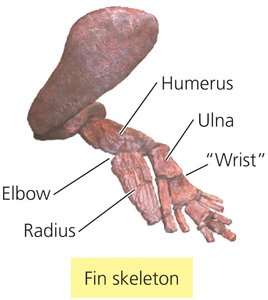
Tiktaalik is a 375-million-year-old fossil showing both fish and tetrapod features, representing a transitional form in the evolution of vertebrates from water to land. Its fins had bones similar to tetrapod limbs, and it had ribs, a neck, and lungs.
Amphibians
Include salamanders, frogs, and caecilians.
Many have aquatic larvae and terrestrial adults.
Restricted to moist habitats due to their skin and eggs.
Amniotes
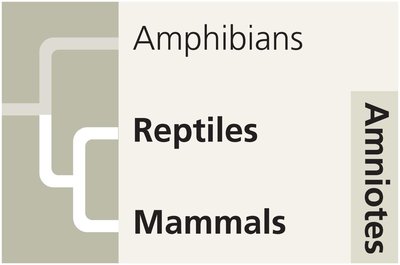
Amniotes are tetrapods with adaptations for life on land, including the amniotic egg (with amnion, chorion, yolk sac, and allantois membranes) and rib cage ventilation. They include reptiles (with birds) and mammals.
Reptiles and Mammals
Reptiles
Early reptiles appeared about 310 million years ago.
Modern reptiles include tuataras, lizards, snakes, turtles, crocodilians, and birds.
Most are ectothermic (regulate temperature using external sources), except birds, which are endothermic.
Birds evolved flight, aiding in predator avoidance, hunting, and migration.
Mammals
Named for mammary glands that produce milk.
Adaptations include hair, fat layers, kidneys, endothermy, large brains, and specialized teeth.
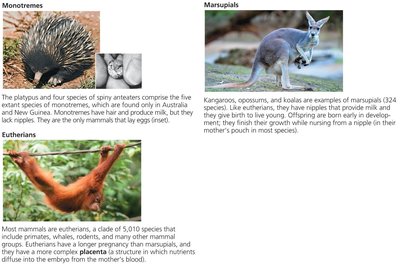
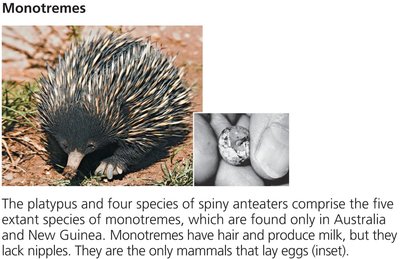
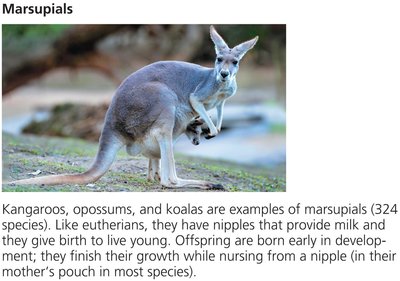
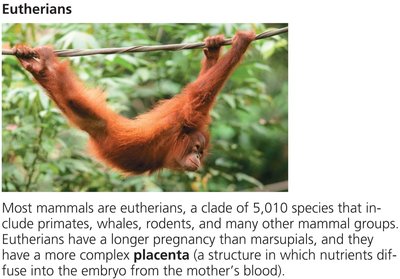
Three main lineages: monotremes (egg-laying), marsupials (pouched), and eutherians (placental mammals).
Primates and Human Evolution
Primates
Include lemurs, tarsiers, monkeys, and apes (including humans).
Adaptations for arboreal life: grasping hands/feet, opposable thumbs, large brains, forward-facing eyes.
Apes have larger brains and more flexible behavior than other primates.
Humans
Distinguished by upright posture, bipedal locomotion, large brains, language, symbolic thought, and tool use.
Summary Table: Major Animal Groups
Group | Key Features | Examples |
|---|---|---|
Sponges | No true tissues, filter feeders | Sponges |
Cnidarians | Radial symmetry, gastrovascular cavity, tentacles | Jellies, sea anemones |
Bilaterians | Bilateral symmetry, three germ layers, coelom | Worms, arthropods, vertebrates |
Chordates | Notochord, dorsal nerve cord, pharyngeal slits, tail | Lancelets, tunicates, vertebrates |
Vertebrates | Backbone, skull, complex organs | Fish, amphibians, reptiles, mammals |
Mammals | Hair, mammary glands, endothermy | Monotremes, marsupials, eutherians |
Additional info: This guide integrates foundational concepts from animal evolution, body plans, and major animal groups, providing context for the diversity and adaptations observed in the animal kingdom.
