 Indietro
The Structure and Function of Cellular Membranes
Guida di studio - Note intelligenti
 Appunti personalizzati basati sui tuoi materiali, ampliati con definizioni chiave, esempi e contesto.
The Membrane
Overview of Plasma Membrane Structure and Function
The plasma membrane is a selectively permeable barrier that regulates the movement of substances into and out of the cell. It is primarily composed of a phospholipid bilayer with embedded proteins, carbohydrates, and cholesterol, each contributing to membrane structure and function.
Selective Permeability: The membrane allows some substances to cross more easily than others, maintaining the internal environment of the cell.
Amphipathic Nature: Phospholipids have both hydrophilic (water-attracting) heads and hydrophobic (water-repelling) tails, forming a bilayer that separates the cell from its environment.
Fluid Mosaic Model: The membrane is described as a mosaic of proteins floating in or on the fluid lipid bilayer.
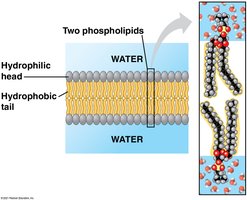
Fluid Mosaic Model
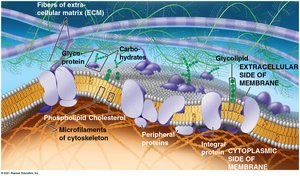
The fluid mosaic model describes the dynamic arrangement of phospholipids and proteins in biological membranes. Proteins are interspersed within the lipid bilayer, allowing for flexibility and the movement of components within the membrane.
Protein Distribution: Membrane proteins are not randomly distributed; they often form functional groups.
Membrane Fluidity: Lipids and some proteins can move laterally within the layer, contributing to membrane flexibility.
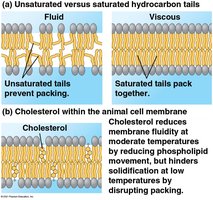
Membrane Fluidity and Composition
Membrane fluidity is influenced by the types of fatty acids in phospholipids and the presence of cholesterol. The balance between saturated and unsaturated fatty acids determines how tightly the lipids pack together, affecting the membrane's state (fluid or viscous).
Unsaturated Fatty Acids: Increase fluidity by preventing tight packing of phospholipids.
Saturated Fatty Acids: Decrease fluidity by allowing phospholipids to pack closely together.
Cholesterol: Acts as a fluidity buffer, restraining movement at high temperatures and preventing tight packing at low temperatures.
Membrane Proteins and Their Functions
Membrane proteins are essential for various cellular processes, including transport, communication, and cell recognition. They are classified as peripheral (surface-bound) or integral (embedded within the bilayer), with transmembrane proteins spanning the entire membrane.
Peripheral Proteins: Loosely attached to the membrane surface.
Integral Proteins: Penetrate the hydrophobic core; transmembrane proteins span the membrane.
Functions: Transport, enzymatic activity, signal transduction, cell-cell recognition, intercellular joining, and attachment to the cytoskeleton and extracellular matrix.
Role of Membrane Carbohydrates
Carbohydrates attached to lipids (glycolipids) or proteins (glycoproteins) on the extracellular surface of the membrane play a key role in cell-cell recognition and communication.
Cell Recognition: Glycoproteins and glycolipids serve as identification markers for cellular interactions.
Synthesis and Sidedness of Membranes
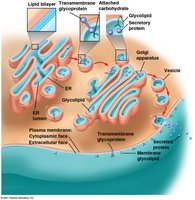
Membranes have distinct inside and outside faces, with asymmetrical distribution of proteins, lipids, and carbohydrates. This sidedness is established during membrane synthesis in the endoplasmic reticulum and Golgi apparatus.
Membrane Transport
Selective Permeability
The plasma membrane's selective permeability allows it to control the exchange of materials. Small, nonpolar molecules (e.g., O2, CO2) pass easily, while ions and polar molecules require transport proteins.
Lipid Bilayer: Permits rapid passage of hydrophobic molecules; impedes hydrophilic molecules.
Transport Proteins: Facilitate movement of specific substances across the membrane.
Passive Transport: Diffusion and Osmosis
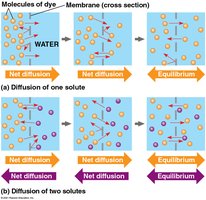
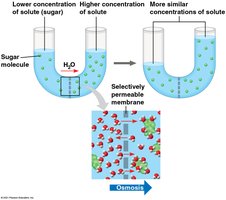
Passive transport involves the movement of substances down their concentration gradients without energy input. Diffusion and osmosis are key examples.
Diffusion: Movement of molecules from high to low concentration until equilibrium is reached.
Osmosis: Diffusion of water across a selectively permeable membrane toward higher solute concentration.
Tonicity and Water Balance
Tonicity describes the ability of a surrounding solution to cause a cell to gain or lose water. It is determined by the concentration of non-penetrating solutes.
Isotonic: Solute concentration is equal inside and outside the cell; no net water movement.
Hypertonic: Higher solute concentration outside the cell; cell loses water and shrivels.
Hypotonic: Lower solute concentration outside the cell; cell gains water and may burst (animal cells) or become turgid (plant cells).
Facilitated Diffusion
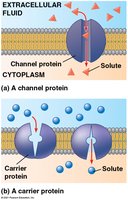
Facilitated diffusion is a type of passive transport aided by proteins. Channel proteins provide corridors for specific molecules or ions, while carrier proteins change shape to move substances across the membrane.
Channel Proteins: Form hydrophilic channels for ions or water (e.g., aquaporins).
Carrier Proteins: Bind and transport specific molecules by changing shape.
Active Transport
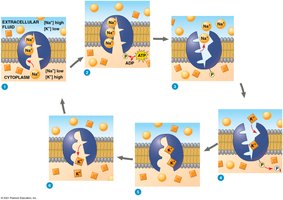
Active transport moves substances against their concentration gradients using energy, typically from ATP. All active transport proteins are carrier proteins.
Sodium-Potassium Pump: Maintains high K+ and low Na+ inside animal cells by pumping Na+ out and K+ in, using ATP.
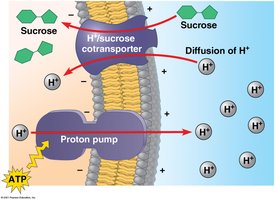
Proton Pump: Main electrogenic pump in plants, fungi, and bacteria; moves H+ out of the cell to generate a proton gradient.
Membrane Potential and Electrochemical Gradients
Membrane potential is the voltage across a membrane, created by differences in ion distribution. The electrochemical gradient drives ion movement, combining chemical and electrical forces.
Electrogenic Pumps: Generate voltage across membranes (e.g., sodium-potassium pump in animals, proton pump in plants).
Cotransport: The downhill movement of one solute drives the uphill transport of another (e.g., H+/sucrose cotransporter in plants).
Bulk Transport: Exocytosis and Endocytosis
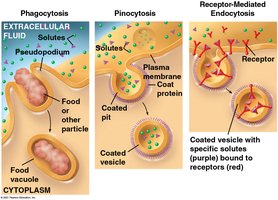
Large molecules cross the membrane via vesicles in processes called exocytosis and endocytosis.
Exocytosis: Vesicles fuse with the plasma membrane to release contents outside the cell (e.g., secretion of insulin).
Endocytosis: The cell takes in macromolecules by forming vesicles from the plasma membrane. Types include phagocytosis (cell eating), pinocytosis (cell drinking), and receptor-mediated endocytosis (specific uptake of molecules).
Summary Table: Types of Membrane Transport
Transport Type | Energy Required? | Direction | Example |
|---|---|---|---|
Simple Diffusion | No | Down gradient | O2, CO2 |
Facilitated Diffusion | No | Down gradient | Glucose, ions via channels |
Active Transport | Yes (ATP) | Against gradient | Na+/K+ pump |
Bulk Transport | Yes (ATP) | In or out | Exocytosis, endocytosis |
