Indietro
The Structure and Function of Large Biological Molecules
Guida di studio - Note intelligenti
 Appunti personalizzati basati sui tuoi materiali, ampliati con definizioni chiave, esempi e contesto.
Chapter 5: The Structure and Function of Large Biological Molecules
Introduction
Large biological molecules, also known as macromolecules, are essential for life. They include carbohydrates, lipids, proteins, and nucleic acids. Each class of macromolecule has unique structures and functions that are fundamental to cellular processes and the overall functioning of living organisms.
Macromolecules: Polymers and Monomers
Polymers and Monomers
Most macromolecules are polymers, which are long molecules made up of repeating units called monomers. Carbohydrates, proteins, and nucleic acids are all polymers, while lipids are not true polymers.
Polymer: A long molecule consisting of many similar or identical building blocks linked by covalent bonds.
Monomer: The repeating unit that serves as the building block of a polymer.
Synthesis and Breakdown of Polymers
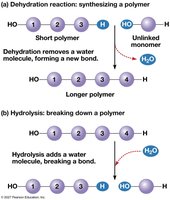
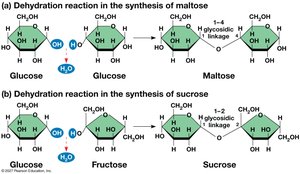
Dehydration Reaction: Monomers are joined together by covalent bonds through the loss of a water molecule.
Hydrolysis: Polymers are broken down into monomers by the addition of water, essentially the reverse of dehydration.
Enzymes: Specialized macromolecules that speed up chemical reactions, including those that build or break down polymers.
Carbohydrates
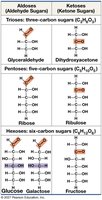
Monosaccharides and Classification
Carbohydrates serve as fuel and building material. The simplest carbohydrates are monosaccharides, or simple sugars. Carbohydrate macromolecules are polysaccharides, polymers composed of many sugar building blocks.
Glucose: Linear and Ring Forms
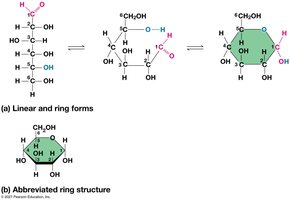
Glucose, a common monosaccharide, can exist in both linear and ring forms. In aqueous solutions, glucose forms a ring structure, which is the predominant form in cells.
Disaccharides
Disaccharides are formed when two monosaccharides are joined by a dehydration reaction, creating a glycosidic linkage. Common examples include maltose and sucrose.
Polysaccharides: Storage and Structural Roles
Polysaccharides are polymers of sugars and serve various storage and structural functions. The architecture and function of a polysaccharide are determined by its sugar monomers and the positions of its glycosidic linkages.
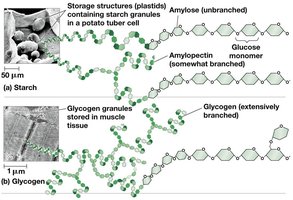
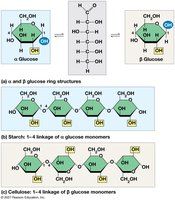
Starch: Storage polysaccharide in plants, composed of glucose monomers.
Glycogen: Storage polysaccharide in animals, highly branched.
Cellulose: Structural polysaccharide in plant cell walls, composed of β-glucose monomers.
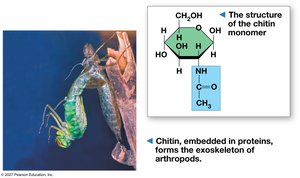
Chitin: Structural polysaccharide in the exoskeleton of arthropods and fungal cell walls.
Lipids
Overview of Lipids
Lipids are a diverse group of hydrophobic molecules that do not form true polymers. They consist mostly of hydrocarbon regions and include fats, phospholipids, and steroids.
Fats (Triacylglycerols)
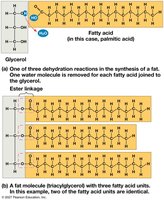
Fats are constructed from glycerol and fatty acids. Their main function is energy storage. Fats can be saturated (solid at room temperature) or unsaturated (liquid at room temperature).
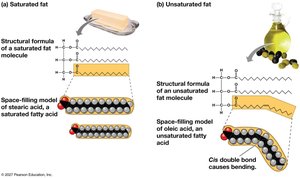
Saturated fats: No double bonds between carbon atoms; typically found in animal fats.
Unsaturated fats: One or more double bonds; typically found in plant and fish fats.
Trans fats: Created by hydrogenation; associated with negative health effects.
Adipose tissue: Stores fat in animals, cushions organs, and insulates the body.
Phospholipids
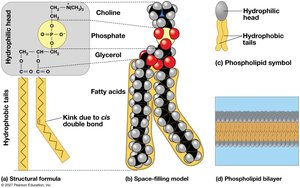
Phospholipids are major components of cell membranes. They have hydrophilic heads and hydrophobic tails, causing them to self-assemble into bilayers in aqueous environments.
Steroids
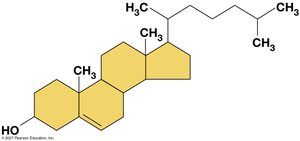
Steroids are lipids with a carbon skeleton consisting of four fused rings. Cholesterol is an important steroid found in animal cell membranes and is a precursor for other steroids.
Proteins
Functions of Proteins
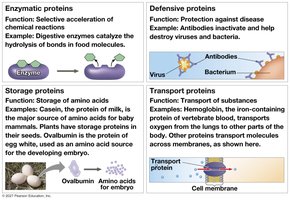
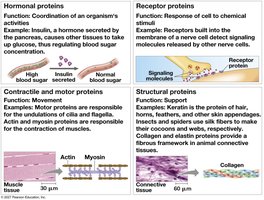
Proteins are the most structurally sophisticated molecules known and account for more than 50% of the dry mass of most cells. They perform a wide range of functions, including catalysis, defense, storage, transport, communication, movement, and structural support.
Amino Acids and Polypeptides
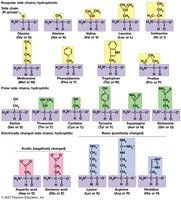
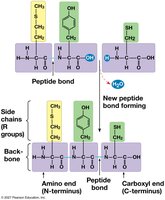
Proteins are polymers of amino acids. Each amino acid has an amino group, a carboxyl group, and a unique side chain (R group). Amino acids are linked by peptide bonds to form polypeptides.
 s
Polypeptide: A polymer of amino acids.
Peptide bond: Covalent bond linking amino acids.
Levels of Protein Structure
The structure of a protein determines its function. There are four levels of protein structure:
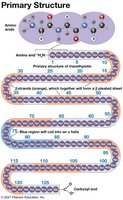
Primary structure: Unique sequence of amino acids.
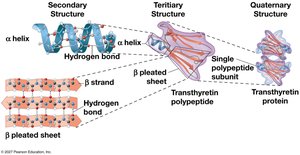
Secondary structure: Coils and folds (α-helix and β-pleated sheet) due to hydrogen bonding.
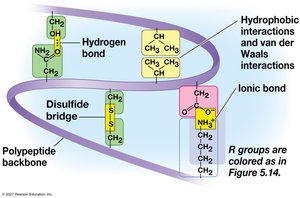
Tertiary structure: Overall 3D shape due to interactions among R groups.
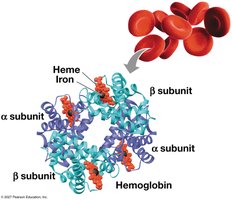
Quaternary structure: Association of multiple polypeptide chains.
Protein Structure and Disease
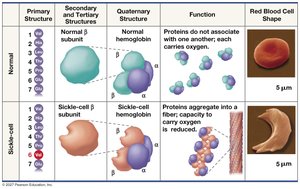
Even a single amino acid substitution can affect protein structure and function, as seen in sickle-cell disease.
Denaturation
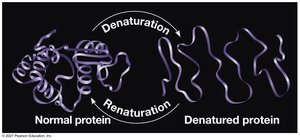
Physical and chemical conditions can affect protein structure. Denaturation is the loss of a protein’s native structure, often resulting in loss of function.
Nucleic Acids
DNA and RNA
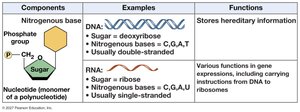
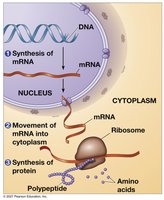
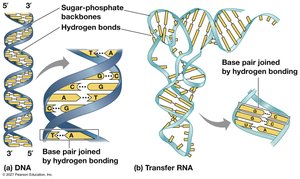
Nucleic acids store, transmit, and help express hereditary information. The two types are DNA (deoxyribonucleic acid) and RNA (ribonucleic acid). Genes are made of DNA, which is composed of nucleotide monomers.
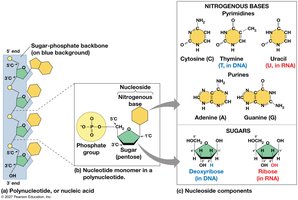
Nucleotide: Consists of a nitrogenous base, a pentose sugar, and a phosphate group.
Phosphodiester linkage: Bonds nucleotides together, forming the sugar-phosphate backbone.
Genomics and Proteomics
Bioinformatics, Genomics, and Proteomics
Modern biology uses computational tools to analyze large data sets. Genomics is the study of whole sets of genes, while proteomics is the study of large sets of proteins, including their sequences and functions.
Summary Tables
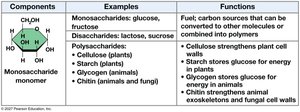
Carbohydrates: Components, Examples, and Functions
Components | Examples | Functions |
|---|---|---|
Monosaccharide monomer | Monosaccharides: glucose, fructose Disaccharides: lactose, sucrose Polysaccharides: cellulose (plants), starch (plants), glycogen (animals), chitin (animals and fungi) | Fuel; carbon sources that can be converted to other molecules or combined into polymers Cellulose strengthens plant cell walls Starch stores glucose for energy in plants Glycogen stores glucose for energy in animals Chitin strengthens animal exoskeletons and fungal cell walls |
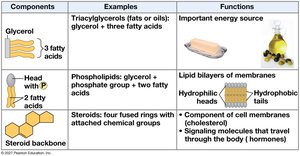
Lipids: Components, Examples, and Functions
Components | Examples | Functions |
|---|---|---|
Glycerol Fatty acids Steroid backbone | Triacylglycerols (fats or oils): glycerol + three fatty acids Phospholipids: glycerol + phosphate group + two fatty acids Steroids: four fused rings with attached chemical groups | Important energy source Lipid bilayers of membranes Component of cell membranes (cholesterol) Signaling molecules (hormones) |
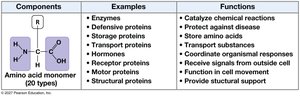
Proteins: Components, Examples, and Functions
Components | Examples | Functions |
|---|---|---|
Amino acid monomer (20 types) | Enzymes Defensive proteins Storage proteins Transport proteins Hormones Receptor proteins Motor proteins Structural proteins | Catalyze chemical reactions Protect against disease Store amino acids Transport substances Coordinate organismal responses Receive signals from outside cell Function in cell movement Provide structural support |
 d
Nucleic Acids: Components, Examples, and Functions
Components | Examples | Functions |
|---|---|---|
Nucleotide (monomer of a polynucleotide) | DNA: sugar = deoxyribose, nitrogenous bases = C, G, A, T, usually double-stranded RNA: sugar = ribose, nitrogenous bases = C, G, A, U, usually single-stranded | Stores hereditary information Various functions in gene expression, including carrying instructions from DNA to ribosomes |