Indietro
The Structure and Function of Large Biological Molecules (Chapter 5) – Study Notes
Guida di studio - Note intelligenti
 Appunti personalizzati basati sui tuoi materiali, ampliati con definizioni chiave, esempi e contesto.
The Structure and Function of Large Biological Molecules
Introduction to Macromolecules
Large biological molecules, or macromolecules, are essential for life and include carbohydrates, lipids, proteins, and nucleic acids. These molecules are polymers, built from smaller units called monomers, and their structure determines their function in living organisms.
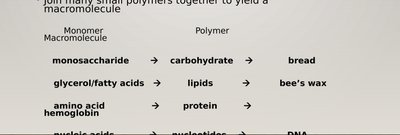
Monomers and Polymers
Monomers are the building blocks of polymers.
Polymers are long molecules consisting of many similar or identical building blocks linked by covalent bonds.
Examples:
Monosaccharide → Carbohydrate (e.g., bread)
Glycerol & Fatty Acids → Lipids (e.g., bee’s wax)
Amino Acid → Protein (e.g., hemoglobin)
Nucleotides → Nucleic Acids (e.g., DNA)
Monomer | Polymer | Example |
|---|---|---|
Monosaccharide | Carbohydrate | Bread |
Glycerol/Fatty acids | Lipids | Bee's wax |
Amino acid | Protein | Hemoglobin |
Nucleotides | Nucleic acids | DNA |
Polymerization: Dehydration and Hydrolysis Reactions
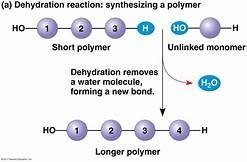
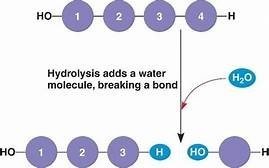
Polymers are synthesized and broken down by specific chemical reactions:
Dehydration Reaction: Joins monomers by removing a water molecule, forming a new bond.
Hydrolysis: Breaks bonds between monomers by adding a water molecule.
Carbohydrates
Monosaccharides
Monosaccharides are the simplest carbohydrates, serving as fuel and building material.
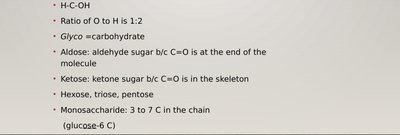
General formula: (CH2O)n
Ratio of O to H is 1:2
Aldose: Aldehyde sugar (C=O at the end)
Ketose: Ketone sugar (C=O in the skeleton)
Classified by number of carbons: hexose (6C), triose (3C), pentose (5C)
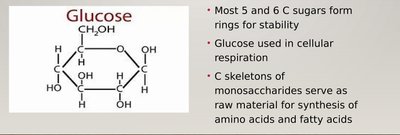
Most 5 and 6 carbon sugars form rings for stability
Disaccharides and Polysaccharides
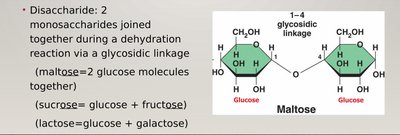
Disaccharide: Two monosaccharides joined by a glycosidic linkage (e.g., maltose = 2 glucose, sucrose = glucose + fructose, lactose = glucose + galactose)
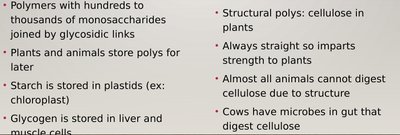
Polysaccharides: Polymers with hundreds to thousands of monosaccharides joined by glycosidic links
Storage polysaccharides: Starch (plants), Glycogen (animals)
Structural polysaccharides: Cellulose (plants)
Cellulose is straight and imparts strength; most animals cannot digest it, but some (e.g., cows) have microbes that can
Lipids
Fats, Oils, and Phospholipids
Lipids are hydrophobic molecules important for energy storage, insulation, and membrane structure.
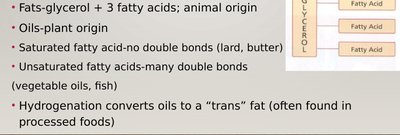
Fats: Glycerol + 3 fatty acids (animal origin)
Oils: Plant origin
Saturated fatty acids: No double bonds (solid at room temp, e.g., lard, butter)
Unsaturated fatty acids: Many double bonds (liquid at room temp, e.g., vegetable oils, fish)
Hydrogenation: Converts oils to trans fats (found in processed foods)
Phospholipids and Steroids
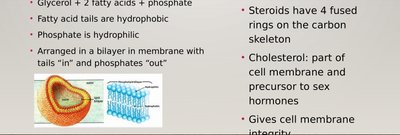
Phospholipids: Glycerol + 2 fatty acids + phosphate group
Fatty acid tails are hydrophobic; phosphate head is hydrophilic
Form bilayers in cell membranes
Steroids: Four fused rings on the carbon skeleton (e.g., cholesterol, precursor to sex hormones)
Proteins
Functions of Proteins
Proteins are the most diverse macromolecules, performing a wide range of functions in the body.
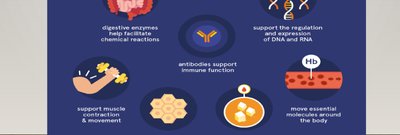
Enzymes (catalysts), storage, hormonal, motor, defensive, transport, receptor, and structural proteins
Examples: Digestive enzymes, antibodies, muscle contraction, hormones, hemoglobin
Amino Acids and Peptide Bonds
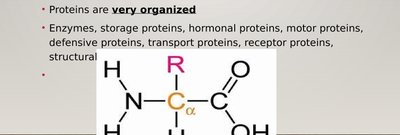
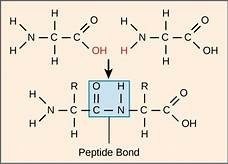
Amino acids are the monomers of proteins, each with a central carbon, amino group, carboxyl group, hydrogen, and R group (side chain)
Peptide bonds link amino acids to form polypeptides
One end of a polypeptide has a free amino group, the other a free carboxyl group
Protein Structure and Folding
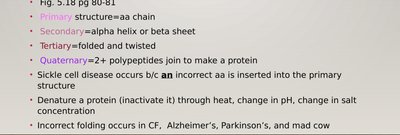
Primary structure: Sequence of amino acids
Secondary structure: Alpha helix or beta sheet
Tertiary structure: Folded and twisted 3D shape
Quaternary structure: Two or more polypeptides join to make a protein
Protein function depends on correct folding; misfolding can cause diseases (e.g., sickle cell, Alzheimer's, Parkinson's)
Denaturation (loss of structure and function) can occur due to heat, pH changes, or salt concentration
Nucleic Acids
Structure and Function
Nucleic acids store and transmit hereditary information. The two types are DNA and RNA.
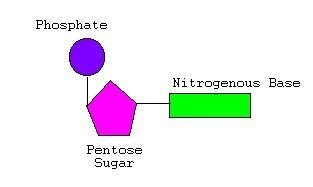
Monomer: Nucleotide (composed of a phosphate group, pentose sugar, and nitrogenous base)
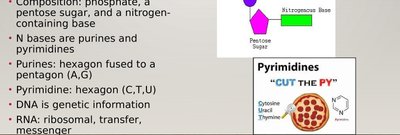
Nitrogenous bases: Purines (adenine, guanine), Pyrimidines (cytosine, thymine, uracil)
DNA: Genetic information; RNA: Ribosomal, transfer, messenger roles
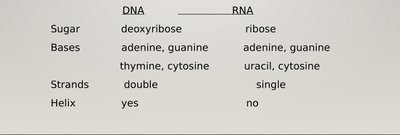
DNA vs. RNA
DNA | RNA | |
|---|---|---|
Sugar | Deoxyribose | Ribose |
Bases | Adenine, Guanine, Thymine, Cytosine | Adenine, Guanine, Uracil, Cytosine |
Strands | Double | Single |
Helix | Yes | No |
Summary Table: Major Macromolecules
Type | Monomer | Examples | Function |
|---|---|---|---|
Proteins | Amino acids | Enzymes, muscle proteins | Catalysis, structure, transport |
Carbohydrates | Glucose | Starch, glycogen, cellulose | Energy storage, plant cell walls |
Lipids | Glycerol, fatty acids | Fats, oils, phospholipids | Energy storage, membrane structure |
Nucleic Acids | Nucleotides | DNA, RNA | Genetic information, protein synthesis |