 Indietro
The Structure and Function of Large Biological Molecules
Guida di studio - Note intelligenti
 Appunti personalizzati basati sui tuoi materiali, ampliati con definizioni chiave, esempi e contesto.
Chapter 5: The Structure and Function of Large Biological Molecules
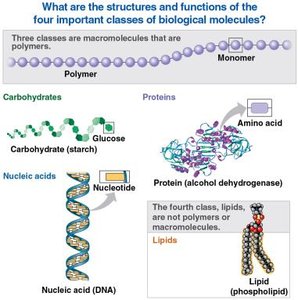
Introduction to Macromolecules
Large biological molecules, or macromolecules, are essential for life and include carbohydrates, proteins, nucleic acids, and lipids. Most macromolecules are polymers, long chains of repeating units called monomers, except for lipids, which are not true polymers.
Polymer: A long molecule consisting of many similar or identical building blocks linked by covalent bonds.
Monomer: The repeating units that serve as the building blocks of a polymer.
Enzymes: Specialized macromolecules that speed up chemical reactions, including the synthesis and breakdown of polymers.
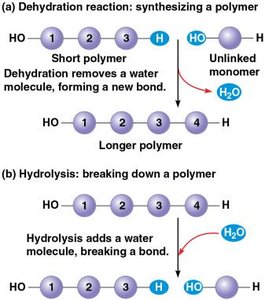
Synthesis and Breakdown of Polymers
Polymers are assembled and disassembled by specific chemical reactions:
Dehydration Reaction: Two monomers are covalently bonded with the loss of a water molecule, forming a polymer.
Hydrolysis: Polymers are broken down into monomers by the addition of water, reversing the dehydration reaction.
Carbohydrates
Monosaccharides: Simple Sugars
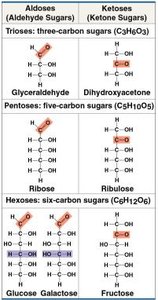
Carbohydrates include sugars and their polymers. The simplest carbohydrates are monosaccharides, which generally have molecular formulas that are multiples of CH2O. Glucose (C6H12O6) is the most common monosaccharide.
Classification: Based on the location of the carbonyl group (aldose or ketose) and the number of carbons in the skeleton (triose, pentose, hexose).
Structure and Function of Monosaccharides
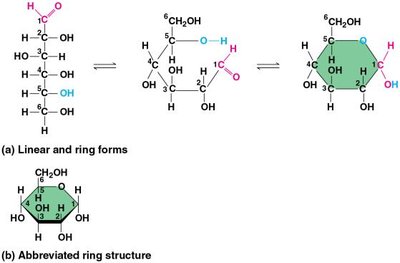
Monosaccharides can exist as linear chains or ring forms in aqueous solutions. They serve as major fuel for cells and as raw material for building other molecules.
Disaccharides and Glycosidic Linkages
Disaccharides are formed when two monosaccharides are joined by a dehydration reaction, creating a covalent bond called a glycosidic linkage. Common disaccharides include maltose and sucrose.
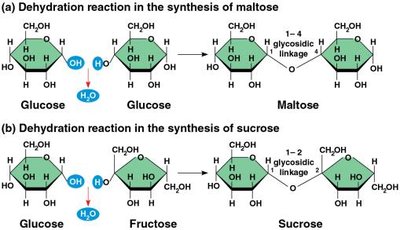
Polysaccharides: Storage and Structural Roles
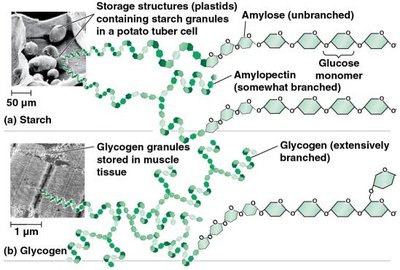
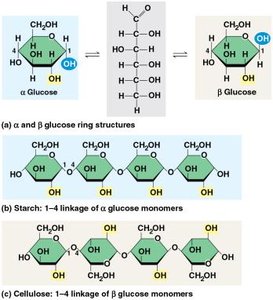
Polysaccharides are polymers of sugars with storage or structural functions. Their properties depend on the types of monomers and the positions of glycosidic linkages.
Starch: A storage polysaccharide in plants, composed of glucose monomers. Exists as amylose (unbranched) and amylopectin (branched).
Glycogen: A storage polysaccharide in animals, highly branched and stored in liver and muscle cells.
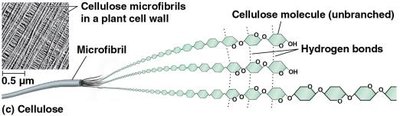
Cellulose: A structural polysaccharide in plant cell walls, composed of β-glucose monomers. Its straight, unbranched chains allow hydrogen bonding between molecules, forming strong fibers.
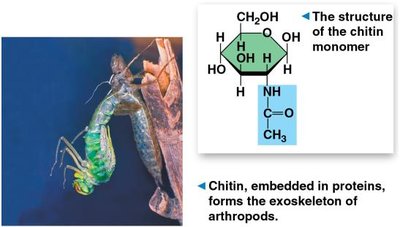
Chitin: A structural polysaccharide found in the exoskeleton of arthropods and in fungal cell walls.
Lipids
Overview of Lipids
Lipids are a diverse group of hydrophobic molecules that do not form true polymers. They consist mainly of hydrocarbons and include fats, phospholipids, and steroids.
Fats: Structure and Function
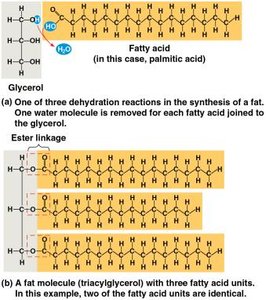
Fats are constructed from glycerol and fatty acids. Three fatty acids are joined to glycerol by ester linkages, forming a triacylglycerol (triglyceride).
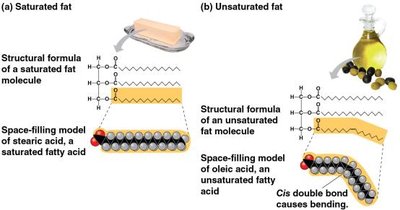
Saturated Fatty Acids: No double bonds; solid at room temperature (e.g., animal fats).
Unsaturated Fatty Acids: One or more double bonds; liquid at room temperature (e.g., plant and fish oils).
Phospholipids
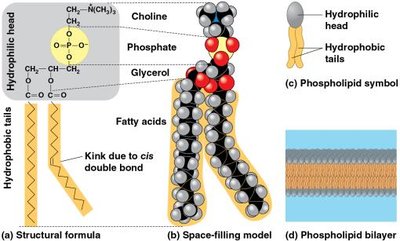
Phospholipids consist of two fatty acids and a phosphate group attached to glycerol. The hydrophobic tails and hydrophilic head allow phospholipids to form bilayers, which are the basis of cell membranes.
Steroids
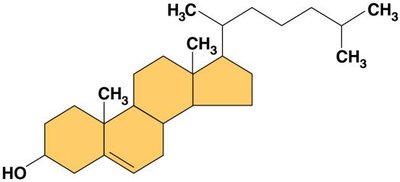
Steroids are lipids with a carbon skeleton consisting of four fused rings. Cholesterol is an important steroid in animal cell membranes and a precursor for other steroids.
Proteins
Functions of Proteins
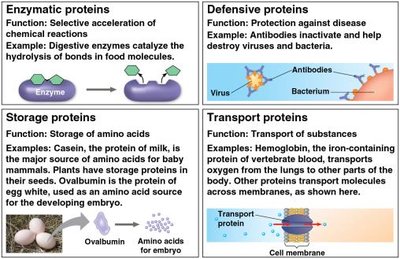
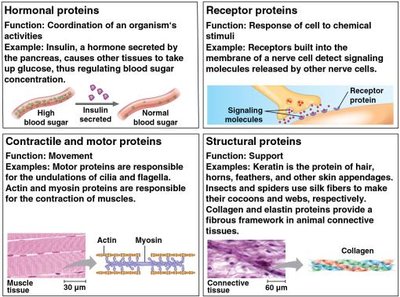
Proteins are the most diverse macromolecules, accounting for more than 50% of the dry mass of most cells. They perform a wide range of functions, including catalysis, defense, storage, transport, communication, movement, and structural support.
Amino Acids and Polypeptides
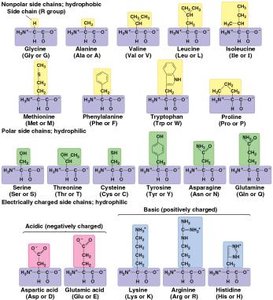
Proteins are polymers of amino acids, linked by peptide bonds. Each amino acid has an amino group, a carboxyl group, and a unique side chain (R group) that determines its properties.
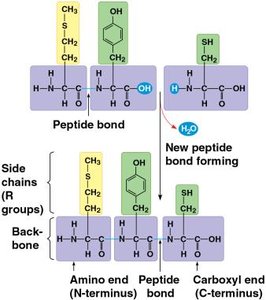
Levels of Protein Structure
The structure of a protein determines its function and is organized into four levels:
Primary Structure: Unique sequence of amino acids.
Secondary Structure: Coils (α helix) and folds (β pleated sheet) due to hydrogen bonding.
Tertiary Structure: Overall 3D shape due to interactions among R groups.
Quaternary Structure: Association of multiple polypeptide chains.
Protein Structure and Disease
A change in primary structure can affect protein function. For example, sickle-cell disease results from a single amino acid substitution in hemoglobin, causing abnormal cell shape and function.
Protein Denaturation
Physical and chemical conditions (pH, temperature, salt concentration) can cause proteins to lose their native structure, a process called denaturation. Denatured proteins are usually biologically inactive.
Nucleic Acids
Roles of Nucleic Acids
Nucleic acids store, transmit, and help express hereditary information. The two types are DNA (deoxyribonucleic acid) and RNA (ribonucleic acid).
DNA: Contains genetic instructions for development and function; directs its own replication and synthesis of mRNA.
RNA: Functions in protein synthesis and gene regulation.
Structure of Nucleic Acids
Nucleic acids are polymers called polynucleotides, made of nucleotide monomers. Each nucleotide consists of a nitrogenous base, a pentose sugar, and one or more phosphate groups.
Pyrimidines: Cytosine, thymine, uracil (single ring).
Purines: Adenine, guanine (double ring).
Phosphodiester Linkage: Bonds nucleotides together, forming a sugar-phosphate backbone.
DNA and RNA Structure
DNA consists of two antiparallel polynucleotide strands forming a double helix, with complementary base pairing (A with T, G with C). RNA is usually single-stranded and can form complex structures through internal base pairing.
Summary Table: Comparison of Biological Macromolecules
Class | Monomer | Polymer | Bond Type | Function |
|---|---|---|---|---|
Carbohydrates | Monosaccharide | Polysaccharide | Glycosidic linkage | Energy storage, structure |
Proteins | Amino acid | Polypeptide | Peptide bond | Catalysis, structure, transport, etc. |
Nucleic Acids | Nucleotide | Polynucleotide | Phosphodiester bond | Genetic information storage and transfer |
Lipids | Fatty acids, glycerol | Not true polymers | Ester linkage | Energy storage, membranes, signaling |
