 Indietro
The Structure and Function of Large Biological Molecules
Guida di studio - Note intelligenti
 Appunti personalizzati basati sui tuoi materiali, ampliati con definizioni chiave, esempi e contesto.
Biological Molecules: Structure and Function
Overview of Biological Macromolecules
Large biological molecules, or macromolecules, are essential for life and are primarily composed of carbon, hydrogen, oxygen, nitrogen, and sometimes phosphorus and sulfur. Their diversity and complexity arise from the unique bonding properties of carbon, which can form four covalent bonds, allowing for a wide variety of molecular structures.
Macromolecules are giant molecules built from smaller repeating units called monomers.
Polymers are long chains of monomers linked together; examples include carbohydrates, proteins, and nucleic acids.
Lipids are not true polymers but share similar assembly and breakdown chemistry.
Key chemical reactions:
Dehydration synthesis (condensation): Joins monomers by removing a water molecule.
Hydrolysis: Breaks polymers into monomers by adding water.

Additional info: The diversity of macromolecules is due to the variety of monomers and the ways they can be arranged and bonded.
The Four Classes of Biological Molecules
Carbohydrates
Carbohydrates are organic molecules composed of carbon, hydrogen, and oxygen, typically in a 1:2:1 ratio (CH2O)n. They serve as energy sources, energy storage, and structural components in cells.
Monosaccharides: Simple sugars (e.g., glucose, fructose, galactose) that are the monomers of carbohydrates.
Disaccharides: Composed of two monosaccharides joined by a glycosidic linkage (e.g., sucrose, lactose).
Polysaccharides: Long chains of monosaccharides; serve as energy storage (starch, glycogen) or structural support (cellulose, chitin).
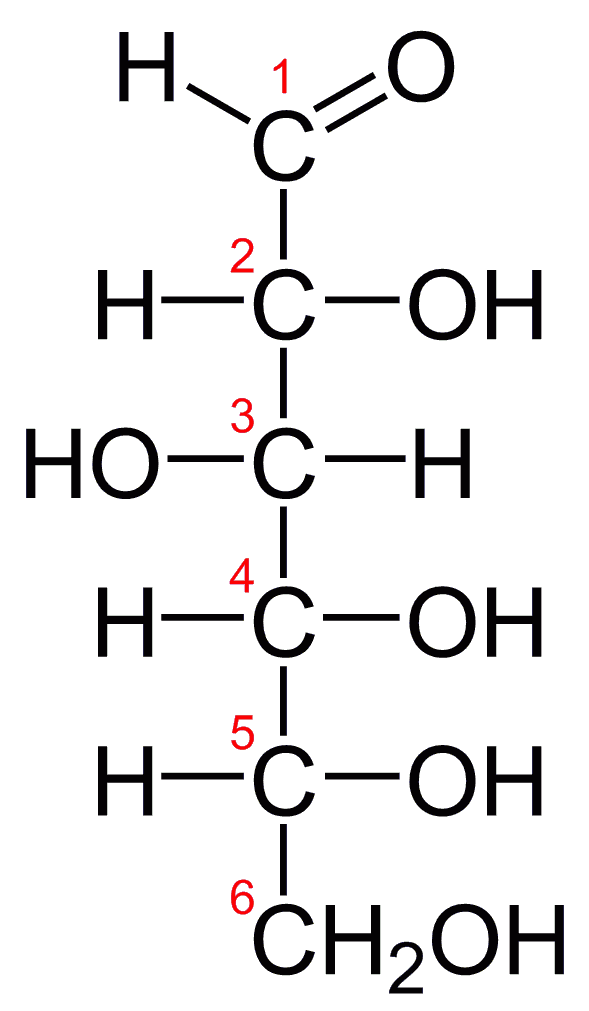
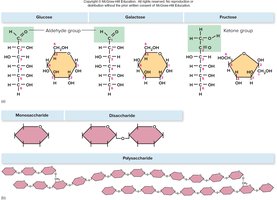
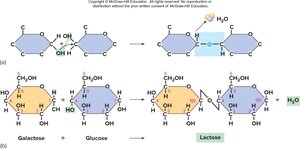
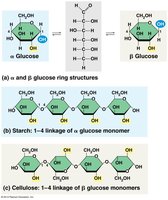
Glycosidic linkage: A covalent bond formed between two monosaccharides by a dehydration reaction. The specific carbons involved and their orientation determine the properties of the resulting disaccharide or polysaccharide.
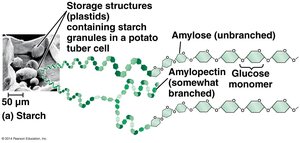
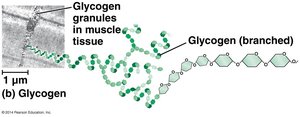
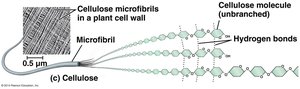
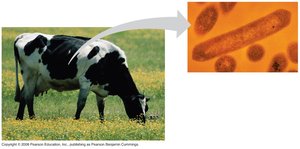
Starch vs. Cellulose: Both are polymers of glucose, but differ in the type of glycosidic linkage. Starch has α(1→4) linkages, while cellulose has β(1→4) linkages, making cellulose indigestible to most animals without microbial help.
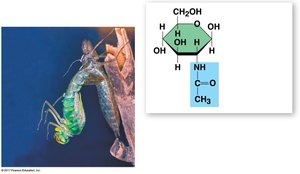
Chitin: A structural polysaccharide found in the exoskeletons of arthropods and cell walls of fungi.
Lipids
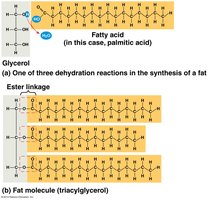
Lipids are hydrophobic molecules that include fats, phospholipids, and steroids. They are not true polymers but are assembled from smaller molecules through dehydration reactions.
Fats (triglycerides): Composed of glycerol and three fatty acids. Serve as long-term energy storage, insulation, and cushioning.
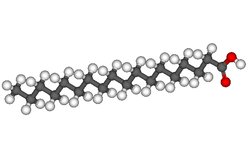
Saturated fats: No double bonds; solid at room temperature; mostly animal fats.
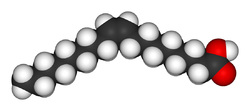
Unsaturated fats: One or more double bonds (cis configuration); liquid at room temperature; found in plants and fish.
Phospholipids: Glycerol, two fatty acids, and a phosphate group; form the basis of cell membranes.
Steroids: Four fused carbon rings; include cholesterol and hormones.
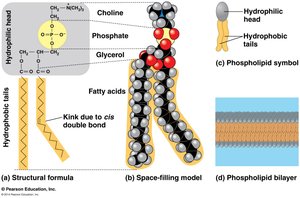
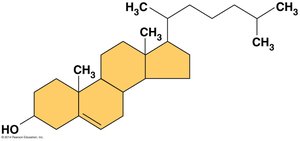
Health note: Diets high in saturated fats are linked to cardiovascular disease. Essential fatty acids (e.g., omega-3) must be obtained from the diet.
Proteins
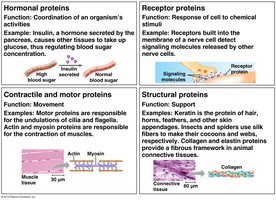
Proteins are polymers of amino acids and perform a vast array of functions in cells, including catalysis, structure, transport, signaling, and defense. The function of a protein is determined by its specific three-dimensional shape, which is built through four levels of structure.
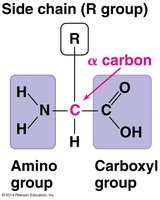
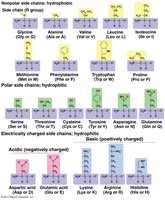
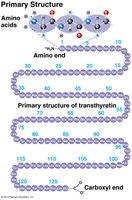
Monomer: Amino acid (20 types, each with a unique R group).
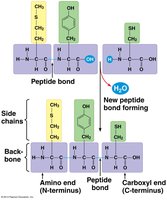
Peptide bond: Covalent bond linking amino acids via dehydration synthesis.
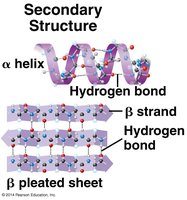
Levels of structure:
Primary: Amino acid sequence
Secondary: Local folding (α-helix, β-sheet)
Tertiary: Overall 3D shape
Quaternary: Association of multiple polypeptides
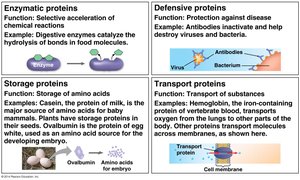
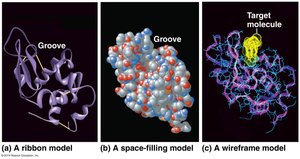
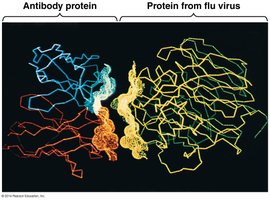
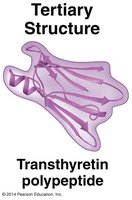
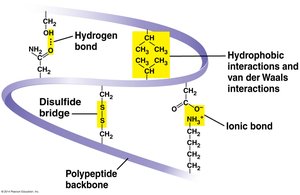
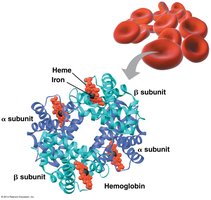
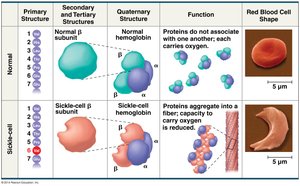
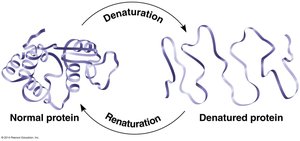
Denaturation: Loss of protein structure (and function) due to heat, pH, salt, or chemicals. Some proteins can refold if normal conditions are restored.
Nucleic Acids
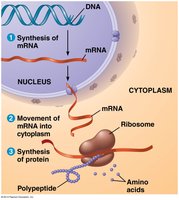
Nucleic acids store and transmit hereditary information. The two main types are DNA (deoxyribonucleic acid) and RNA (ribonucleic acid). DNA encodes genetic information, which is transcribed into RNA and then translated into proteins.
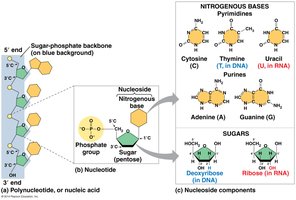
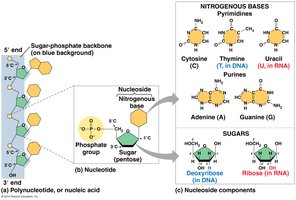
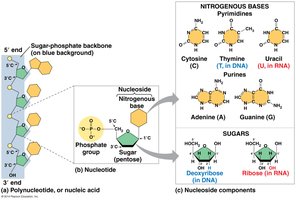
Monomer: Nucleotide (composed of a phosphate group, a five-carbon sugar, and a nitrogenous base).
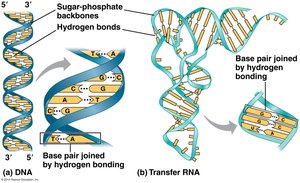
DNA: Double-stranded, forms a double helix, contains A, T, G, C bases.
RNA: Single-stranded, contains A, U, G, C bases.
Phosphodiester bond: Links nucleotides between the 3' OH of one sugar and the 5' phosphate of the next.
Other important nucleotides: ATP (energy carrier), NAD+/NADH and NADP+/NADPH (coenzymes in metabolism).
Bioinformatics, genomics, and proteomics are fields that study the sequences and functions of nucleic acids and proteins.
Key Takeaways
All four macromolecule classes are built by condensation (dehydration synthesis) and broken down by hydrolysis.
Carbohydrates and lipids are both composed of C, H, and O, but differ in linkage types and functions.
Protein function depends on precise 3D structure, which can be disrupted by denaturation.
Nucleic acids store and transmit genetic information, linking DNA, RNA, and protein synthesis.
