 Indietro
The Structure and Function of Large Biological Molecules
Guida di studio - Note intelligenti
 Appunti personalizzati basati sui tuoi materiali, ampliati con definizioni chiave, esempi e contesto.
Macromolecules and Monomers
Overview of Biological Macromolecules
Biological macromolecules are essential for life, forming the structural and functional basis of cells. There are four major classes:
Carbohydrates
Proteins
Lipids
Nucleic acids
Enzymes, a type of protein, catalyze the synthesis and breakdown of these molecules. 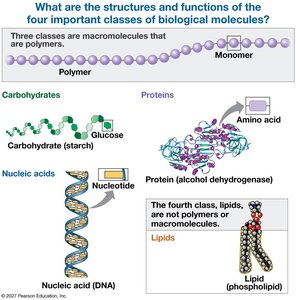
Polymers and Monomers
Carbohydrates, proteins, and nucleic acids are polymers, constructed from repeating units called monomers.
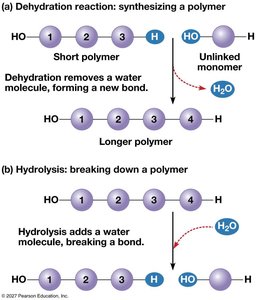
Dehydration (condensation) reaction: Joins monomers by removing a water molecule.
Hydrolysis: Breaks polymers apart by adding water.
Enzymes: Speed up both dehydration and hydrolysis reactions.
Carbohydrates
Definition and Roles
Carbohydrates are organic compounds composed of carbon, hydrogen, and oxygen, typically in a 2:1 ratio of hydrogen to oxygen. They include sugars and polymers of sugars.
Energy storage: Starch (plants), glycogen (animals)
Structural support: Cellulose (plant cell walls), chitin (arthropod exoskeletons, fungal cell walls)
Other roles: Components of coenzymes (ATP, FAD, NAD), immune system, fertilization, pathogen defense, blood clotting, and development
Classification of Monosaccharides
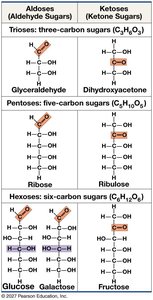
Monosaccharides are classified by the number of carbon atoms and the type of carbonyl group (aldose or ketose).
Triose: Three-carbon sugars
Pentose: Five-carbon sugars
Hexose: Six-carbon sugars (e.g., glucose, galactose, fructose)
Linear and Ring Forms of Glucose
Glucose can exist in both linear and ring forms, with the ring form predominating in aqueous solutions. 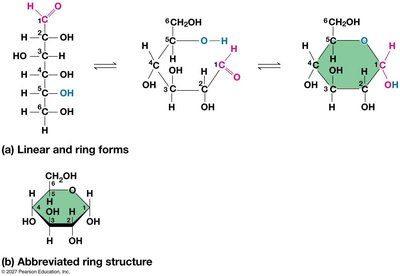
Disaccharide Synthesis
Disaccharides are formed by joining two monosaccharides via a glycosidic linkage, releasing water.
Maltose: Glucose + Glucose
Sucrose: Glucose + Fructose
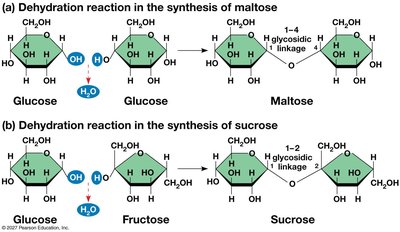
Polysaccharides: Starch and Glycogen
Polysaccharides are polymers whose function depends on the sugar monomer and the position of glycosidic linkages.
Starch: Plant storage polysaccharide; mixture of amylose (unbranched) and amylopectin (branched)
Glycogen: Animal storage polysaccharide; highly branched
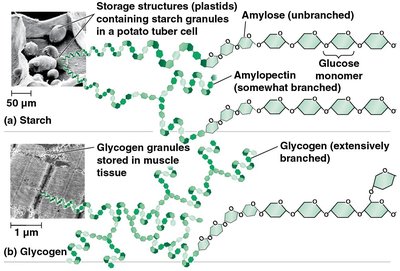
Cellulose: Structural Polysaccharide
Cellulose is a structural polymer of β-glucose monomers found in plant cell walls.
Starch: α configuration, helical
Cellulose: β configuration, straight and unbranched
Hydroxyl groups on parallel cellulose molecules hydrogen-bond, adding strength
Humans lack enzymes to hydrolyze β linkages; cellulose is 'insoluble fiber'
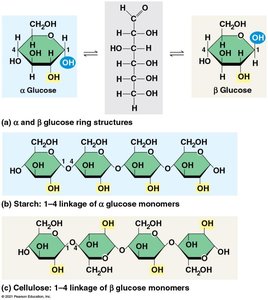
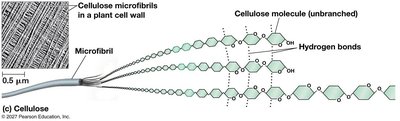
Chitin: Structural Polysaccharide
Chitin is a structural polysaccharide found in arthropod exoskeletons and fungal cell walls. 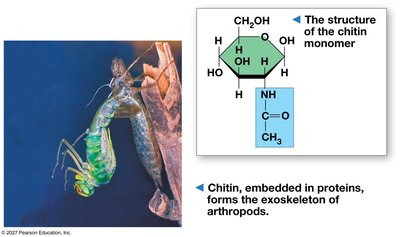
Lipids
Definition and Types
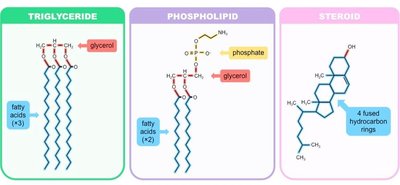
Lipids are large biological molecules that are not true polymers. Their defining feature is insolubility in water due to a high proportion of nonpolar C-C and C-H bonds. The three main types are:
Fats: Energy storage
Phospholipids: Membrane formation
Steroids: Four fused rings
Fats: Structure and Synthesis
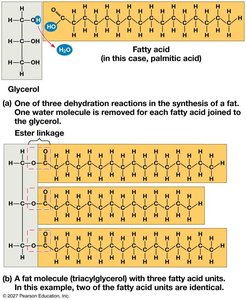
Fats are composed of glycerol and fatty acids, joined by ester linkages through dehydration reactions.
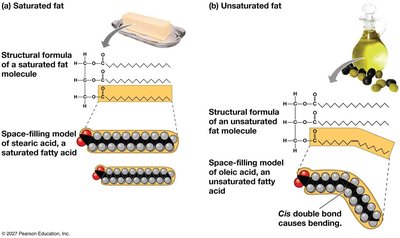
Saturated fatty acids: No double bonds, solid at room temperature
Unsaturated fatty acids: One or more double bonds, liquid at room temperature
Phospholipids: Membrane Formation
Phospholipids are amphipathic, with a hydrophilic head and hydrophobic tails. In water, they self-assemble into bilayers, forming cell membranes. 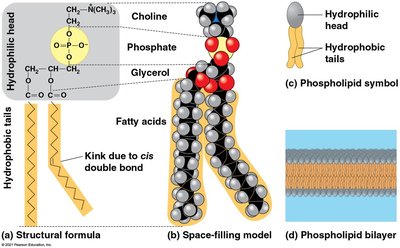
Steroids: Structure and Function
Steroids are characterized by a carbon skeleton of four fused rings. Cholesterol is a key steroid in animal cell membranes and a precursor for other steroids. 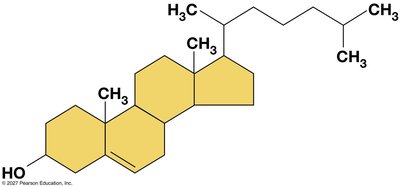
Proteins
Definition and Functions
Proteins are the most abundant substance in the body after water and serve as vital building blocks for growth, maintenance, and repair. They are contained in every cell and perform a wide variety of functions.
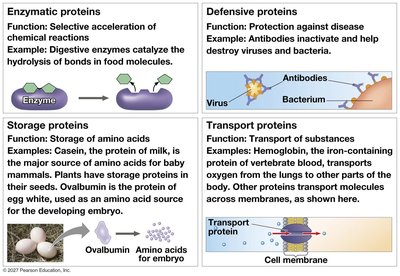
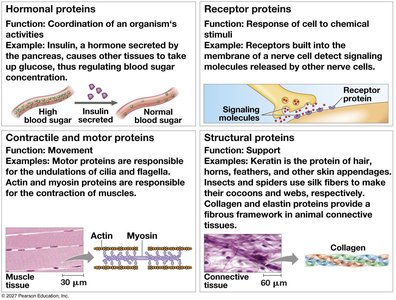
Protein Functions
Enzymatic: Catalyze chemical reactions
Defensive: Protection against disease
Storage: Store amino acids
Transport: Move substances
Hormonal: Coordinate activities
Receptor: Respond to stimuli
Contractile and motor: Movement
Structural: Support
Amino Acids: Building Blocks of Proteins
All proteins are made from 20 amino acids, each with a central carbon atom bonded to a hydrogen, an amino group, a carboxyl group, and a distinctive R-group (side chain). 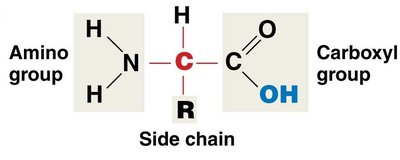
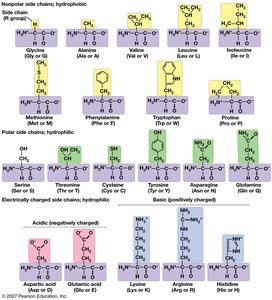
Polypeptide Formation
Amino acids join via peptide bonds to form polypeptides. 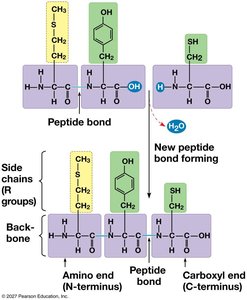
Protein Structure and Function
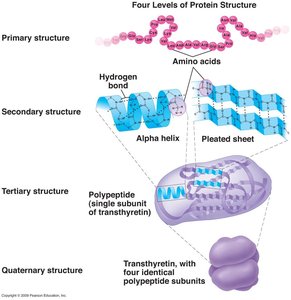
Protein function depends on its three-dimensional structure, which is hierarchical:
Primary: Linear sequence of amino acids
Secondary: Local folding (alpha helix, beta sheet) from hydrogen bonds
Tertiary: Overall 3-D shape from R-group interactions
Quaternary: Assembly of multiple polypeptide subunits
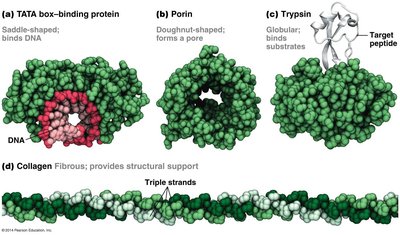
Nucleic Acids
Definition and Structure
Nucleic acids store, transmit, and help express hereditary information. Their monomers are nucleotides, each consisting of a phosphate group, a 5-carbon sugar, and a nitrogenous base.
Nitrogenous Bases
Purines: Adenine (A), Guanine (G) – double-ring structure
Pyrimidines: Cytosine (C), Uracil (U, RNA only), Thymine (T, DNA only) – single-ring structure
Nucleotide Polymerization
Nucleotides join via phosphodiester linkages between the phosphate group on the 5' carbon of one nucleotide and the -OH group on the 3' carbon of the next, through a dehydration reaction.
DNA vs. RNA
DNA: Double-stranded; A–T, G–C base pairing
RNA: Usually single-stranded; U replaces T
Genomics and Proteomics
Large-Scale Molecular Biology
Genomics: Study and comparison of genes and genomes
Proteomics: Study of proteins and their sequences
Bioinformatics: Use of computational tools to analyze large biological data sets
These approaches are used across medicine, evolution, conservation, and ecology, connecting molecular information with organismal and ecological questions.
Summary Tables
Monomers and Functions of Macromolecules
Macromolecule | Monomer | Main Function |
|---|---|---|
Carbohydrates | Monosaccharides | Energy storage, structural support |
Proteins | Amino acids | Enzymatic, structural, transport, etc. |
Lipids | Fatty acids, glycerol (not true polymers) | Energy storage, membrane structure, signaling |
Nucleic acids | Nucleotides | Information storage and transmission |
Types of Lipids
Type | Structure | Function |
|---|---|---|
Fats | Glycerol + 3 fatty acids | Energy storage |
Phospholipids | Glycerol + 2 fatty acids + phosphate group | Membrane formation |
Steroids | Four fused rings | Signaling, membrane structure |
Levels of Protein Structure
Level | Description |
|---|---|
Primary | Sequence of amino acids |
Secondary | Local folding (alpha helix, beta sheet) |
Tertiary | 3-D shape from R-group interactions |
Quaternary | Assembly of multiple polypeptides |
Key Equations
Dehydration Reaction (Polymer Formation)
Hydrolysis Reaction (Polymer Breakdown)
Phosphodiester Linkage (Nucleic Acid Formation)
Additional info:
Small differences in monomer structure and linkage can lead to major differences in function (e.g., starch vs. cellulose).
Humans can digest starch but not cellulose due to enzyme specificity.
Modern biology increasingly connects molecular information with organismal and ecological questions.
