 Indietro
The Structure and Function of Large Biological Molecules
Guida di studio - Note intelligenti
 Appunti personalizzati basati sui tuoi materiali, ampliati con definizioni chiave, esempi e contesto.
Large Biological Molecules
Polymers and Monomers
Large biological molecules, also known as macromolecules, are essential for life and are constructed from smaller subunits called monomers. The properties and functions of a polymer depend on the type and number of monomers it contains.
Polymer: A large molecule made from repeating monomer units.
Monomer: A small molecule that serves as a subunit for polymers.
Dehydration synthesis: A chemical reaction in which water is removed to join two monomers together.
Carbohydrates, proteins, and nucleic acids are all polymers.
Genomics & Proteomics
Genomics and proteomics are fields that study the structure, function, and interactions of genes and proteins, respectively. These disciplines help us understand how biological molecules contribute to cellular processes and organismal traits.
Genomics: Study of genomes, the complete set of DNA in an organism.
Proteomics: Study of the proteome, the entire set of proteins produced by an organism.
Carbohydrates
Structure and Function
Carbohydrates are polymers with multiple functions, including serving as fuel, energy storage, and structural support. Their basic building blocks are monosaccharides.
Monomer: Monosaccharide (simple sugar)
Polymer: Polysaccharide, disaccharide
Functions: Fuel, energy storage, structural support
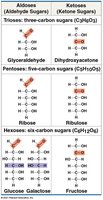
Types of Carbohydrates
Monosaccharides: Simple sugars (e.g., glucose, fructose)
Disaccharides: Formed by joining two monosaccharides via a dehydration reaction, resulting in a glycosidic linkage (e.g., sucrose)
Polysaccharides: Long chains of monosaccharides (e.g., starch, glycogen, cellulose, chitin)
Structural Forms of Sugars
Sugars can exist in linear or ring forms. The ring form is more common in biological systems.
Storage Polysaccharides
Starch: Storage polysaccharide in plants, composed of glucose monomers (common form: amylose)
Glycogen: Storage polysaccharide in animals, stored mainly in liver and muscle cells; hydrolysis releases glucose when needed
Structural Polysaccharides
Cellulose: Major component of plant cell walls; polymer of glucose with β glycosidic linkages
Chitin: Found in the exoskeleton of arthropods and cell walls of fungi; provides structural support
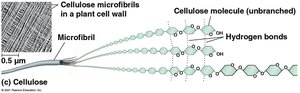
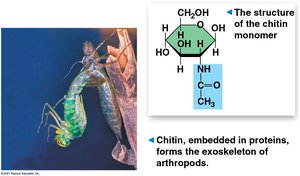
Lipids
General Properties
Lipids are a diverse group of hydrophobic molecules that do not form polymers. Their unifying feature is their poor mixing with water, due to their hydrocarbon regions.
Types of lipids: Fats, phospholipids, steroids
Lipids consist mostly of hydrocarbon regions
Fats
Fats are constructed from glycerol and fatty acids. Glycerol is a three-carbon alcohol, and fatty acids are long hydrocarbon chains with a carboxyl group.
Triacylglycerol (triglyceride): Formed by joining three fatty acids to glycerol via ester linkages
Fats separate from water because water molecules hydrogen-bond to each other and exclude the fats
Saturated vs. Unsaturated Fatty Acids
Saturated fatty acids: Maximum number of hydrogen atoms, no double bonds; solid at room temperature (most animal fats)
Unsaturated fatty acids: One or more double bonds; liquid at room temperature (plant and fish fats)
Trans Fats and Health
Hydrogenation: Process of converting unsaturated fats to saturated fats by adding hydrogen
Hydrogenation creates trans fats, which may contribute more to cardiovascular disease than saturated fats
A diet rich in saturated fats may contribute to cardiovascular disease through plaque deposits
Functions of Fats
Energy storage: Fats are the major energy storage molecules in animals
Adipose tissue stores long-term food reserves, cushions organs, and insulates the body
Additional info:
Phospholipids and steroids are also important lipids, but their structure and function are covered in more detail in later sections.
