 Indietro
The Urinary System: Structure, Function, and Homeostasis
Guida di studio - Note intelligenti
 Appunti personalizzati basati sui tuoi materiali, ampliati con definizioni chiave, esempi e contesto.
The Urinary System
Functions of Urinary Systems
The urinary system is an organ system responsible for excreting wastes and maintaining cellular homeostasis. It produces urine, a watery fluid containing waste products filtered from the blood or interstitial fluid. Urine contains nitrogenous wastes, ions, and other water-soluble nutrients in excess of the body's needs. The urinary system also regulates water content, pH, and ion concentrations in body fluids.
Excretion of cellular wastes: Removes metabolic byproducts, especially nitrogenous wastes.
Homeostasis: Maintains water balance, pH, and ion concentrations.
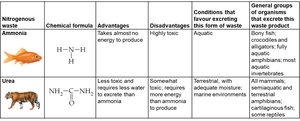
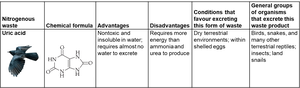
Types of nitrogenous wastes: Ammonia, urea, and uric acid, depending on the animal's habitat and physiology.
Comparison of Nitrogenous Wastes
Animals excrete different nitrogenous wastes based on their environment and evolutionary adaptations.
Nitrogenous Waste | Chemical Formula | Advantages | Disadvantages | Conditions Favoring Excretion | Organisms |
|---|---|---|---|---|---|
Ammonia | NH3 | Takes almost no energy to produce | Highly toxic | Aquatic | Bony fish, aquatic amphibians, most aquatic invertebrates |
Urea | NH2CONH2 | Less toxic, requires less water to excrete | Requires more energy than ammonia to produce | Terrestrial, moderate moisture, marine environments | Mammals, terrestrial amphibians, cartilaginous fish |
Uric acid | C5H4N4O3 | Nontoxic, insoluble in water, requires almost no water to excrete | Requires more energy to produce | Dry terrestrial environments | Birds, reptiles, insects, land snails |
Invertebrate Urinary Systems
Urinary Structures in Invertebrates
Invertebrates have diverse urinary systems adapted to their environments. Sponges and cnidarians lack urinary systems and rely on diffusion and active transport. More complex invertebrates regulate water balance and waste composition using specialized structures.
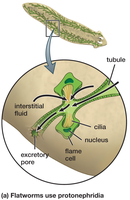
Protonephridia: Flatworms use tubules capped by ciliated flame cells to filter interstitial fluid and excrete wastes.
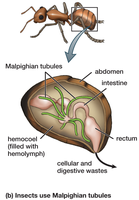
Malpighian tubules: Insects produce urine from hemolymph, with tubules extending from the intestine.
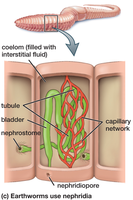
Nephridia: Earthworms and mollusks use tubular structures to filter coelomic fluid, reabsorb nutrients, and excrete urine through nephridiopores.
Structures of the Mammalian Urinary System
Anatomy and Function
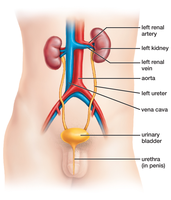
The mammalian urinary system consists of paired kidneys and ureters, a single bladder, and a urethra. These organs filter blood, maintain homeostasis, and excrete wastes.
Kidneys: Fist-sized organs at waist level, filter blood and produce urine.
Ureters: Muscular tubes that propel urine to the bladder.
Bladder: Stores urine until excretion.
Urethra: Conducts urine out of the body.
Kidney Structure
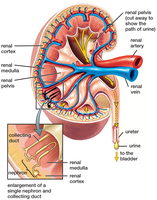
The kidney has three main regions: the renal cortex (outer layer, where urine is formed), the renal medulla (middle layer), and the renal pelvis (collects urine and conducts it to the ureter).
Nephron Structure and Function
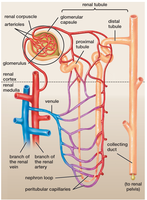
Each kidney contains about 1 million nephrons, the functional units that filter blood and produce urine. Nephrons have two major parts:
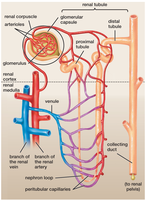
Renal corpuscle: Includes the glomerulus (capillary network) and glomerular capsule (collects filtrate).
Renal tubule: Converts filtrate to urine through reabsorption and secretion.
Renal Tubule Segments
Proximal tubule: Returns water and essential molecules to the blood.
Nephron loop (Loop of Henle): Maintains high salt concentration in the medulla.
Distal tubule: Final conversion of filtrate to urine, additional removal of substances.
Collecting Duct
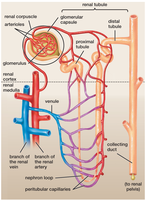
The distal tubule empties urine into a collecting duct, which conducts urine from the cortex through the medulla to the renal pelvis.
Urine Formation
Processes of Urine Formation
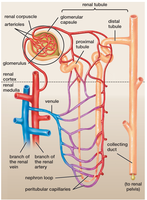
Urine is produced in nephrons through three main processes: filtration, reabsorption, and secretion. These processes involve movement of substances between nephron structures and surrounding interstitial fluid.
Filtration: Blood pressure forces fluid and small molecules through glomerular capillaries into the glomerular capsule.
Reabsorption: Returns important substances to the blood via diffusion or active transport.
Secretion: Moves wastes and excess ions from blood into the renal tubule.
Vertebrate Urinary Systems & Homeostasis
Homeostatic Functions
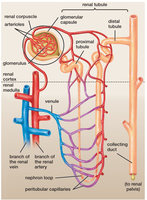
Vertebrate urinary systems maintain cellular homeostasis by regulating water and ion content, blood pH, blood pressure, and oxygen levels. The kidneys play a central role in these processes.
Osmoregulation: Maintains blood osmolarity within strict limits.
Urine concentration: Adjusted in the distal tubule and collecting duct, regulated by antidiuretic hormone (ADH).
Blood pH regulation: Reabsorbs bicarbonate and secretes hydrogen ions.
Blood pressure regulation: Releases renin, catalyzes angiotensin formation, stimulates aldosterone and ADH release.
Blood oxygen regulation: Releases erythropoietin in response to low oxygen.
Adaptations in Mammals and Fish
Mammals: Nephrons with long loops allow water conservation in dry environments.
Fish: Freshwater fish face hypotonic environments; saltwater fish face hypertonic environments and excrete excess salt.
Summary Table: Nitrogenous Waste Excretion
Nitrogenous Waste | Chemical Formula | Advantages | Disadvantages | Conditions Favoring Excretion | Organisms |
|---|---|---|---|---|---|
Ammonia | NH3 | Takes almost no energy to produce | Highly toxic | Aquatic | Bony fish, aquatic amphibians, most aquatic invertebrates |
Urea | NH2CONH2 | Less toxic, requires less water to excrete | Requires more energy than ammonia to produce | Terrestrial, moderate moisture, marine environments | Mammals, terrestrial amphibians, cartilaginous fish |
Uric acid | C5H4N4O3 | Nontoxic, insoluble in water, requires almost no water to excrete | Requires more energy to produce | Dry terrestrial environments | Birds, reptiles, insects, land snails |
Key Equations
Filtration rate:
Osmolarity:
Additional info:
Hormonal regulation of urine concentration is essential for water balance and blood pressure control.
Kidney adaptations reflect environmental challenges, such as water scarcity or salt abundance.
