 Indietro
The Working Cell: Membrane Transport, Osmosis, and Enzyme Function
Guida di studio - Note intelligenti
 Appunti personalizzati basati sui tuoi materiali, ampliati con definizioni chiave, esempi e contesto.
Membrane Structure and Function
Fluid Mosaic Model
The fluid mosaic model describes the structure of cell membranes as a flexible layer made of lipid molecules interspersed with proteins. This model explains how membranes are dynamic and allow for the movement of molecules and proteins within the lipid bilayer.
Phospholipid bilayer: Provides a semi-permeable barrier.
Proteins: Embedded within the membrane, serve as channels, carriers, or receptors.
Cholesterol: Maintains membrane fluidity.
Selective Permeability
Cell membranes exhibit selective permeability, allowing some substances to cross more easily than others. This is essential for maintaining cellular homeostasis.
Small, nonpolar molecules: Pass freely.
Ions and large polar molecules: Require transport proteins.
Transport Across Membranes
Diffusion and Dynamic Equilibrium
Diffusion is the movement of molecules from an area of higher concentration to an area of lower concentration, driven by kinetic energy. When molecules are evenly distributed, dynamic equilibrium is reached.
Concentration gradient: The difference in concentration across a space.
Net movement: Always down the concentration gradient in passive transport.
Passive Transport
Passive transport does not require energy and includes diffusion, osmosis, and facilitated diffusion.
Facilitated diffusion: Uses transport proteins to move substances across the membrane.
Aquaporin: A channel protein specifically for water.
Osmosis
Osmosis is the diffusion of water across a selectively permeable membrane. Water moves from areas of low solute concentration to high solute concentration.
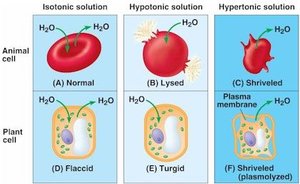
Isotonic solution: Equal solute concentration inside and outside the cell; no net water movement.
Hypotonic solution: Lower solute concentration outside; water moves into the cell.
Hypertonic solution: Higher solute concentration outside; water moves out of the cell.
Tonicity affects cell health:
Animal cells: Can burst (lyse) in hypotonic solutions or shrivel in hypertonic solutions.
Plant cells: Become turgid in hypotonic solutions (healthy), flaccid in isotonic, and plasmolyzed in hypertonic.
Active Transport
Active transport moves substances against their concentration gradient, requiring energy (usually from ATP).
Process: Solute binds to transport protein → ATP provides energy → protein changes shape and releases solute → protein returns to original shape.
Bulk Transport: Exocytosis and Endocytosis
Cells move large molecules or particles via exocytosis (export) and endocytosis (import).
Exocytosis: Vesicles fuse with the membrane to release contents outside.
Endocytosis: Membrane engulfs material to bring it inside.
Phagocytosis: Cell engulfs large particles using pseudopodia.
Receptor-mediated endocytosis: Specific molecules are taken in after binding to receptors.
Energy and Enzyme Function
Kinetic and Potential Energy
Kinetic energy is energy of motion; potential energy is stored energy. Cells use both forms in metabolic processes.
Exergonic and Endergonic Reactions
Exergonic reactions release energy; endergonic reactions absorb energy.
Example: ATP hydrolysis is exergonic.
ATP: The Energy Currency
ATP (adenosine triphosphate) stores and releases energy for cellular work. Hydrolysis of ATP produces ADP and inorganic phosphate:
Enzymes and Activation Energy
Enzymes are biological catalysts that speed up chemical reactions by lowering activation energy. The induced fit model describes how enzymes change shape to fit substrates.
Competitive inhibition: Inhibitor binds to active site, blocking substrate.
Non-competitive inhibition: Inhibitor binds elsewhere, changing enzyme shape.
Summary Table: Effects of Tonicity on Cells
The following table summarizes the effects of isotonic, hypotonic, and hypertonic solutions on animal and plant cells:
Solution Type | Animal Cell | Plant Cell |
|---|---|---|
Isotonic | Normal | Flaccid |
Hypotonic | Lysed (burst) | Turgid (firm) |
Hypertonic | Shriveled | Plasmolyzed (shrivelled) |
Key point: Plant cells thrive in hypotonic solutions (turgid), while animal cells can burst. Hypertonic solutions cause cells to lose water and shrink.
