 Indietro
Transcription and Gene Expression: From DNA to mRNA
Guida di studio - Note intelligenti
 Appunti personalizzati basati sui tuoi materiali, ampliati con definizioni chiave, esempi e contesto.
Transcription and the Central Dogma of Molecular Biology
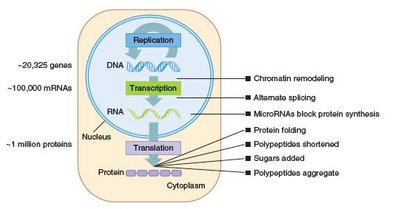
Overview of the Central Dogma
The Central Dogma of Molecular Biology describes the flow of genetic information within a biological system. It explains how information stored in DNA is transcribed into messenger RNA (mRNA), which is then translated into proteins. Proteins are responsible for most cellular functions and structures.
DNA stores genetic instructions.
Transcription is the process of copying DNA information into mRNA.
Translation is the process where mRNA is decoded to build proteins.
Proteins perform essential cellular activities and provide structure.
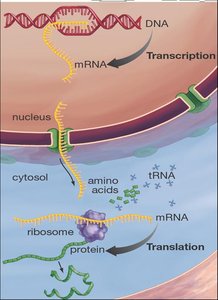
Genetic Information Flow
Genetic information is stored in the sequence of DNA bases.
This information is transcribed into a sequence of RNA bases.
The RNA sequence is then translated into a sequence of amino acids to form proteins.
Example: The sequence of nucleotides in a gene determines the sequence of amino acids in a protein, which in turn determines the protein's function.
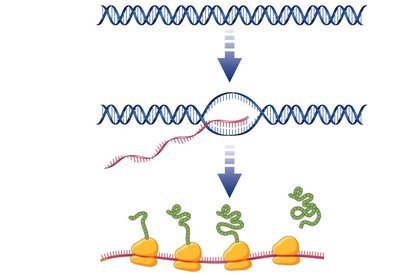
Gene Structure and Expression
Genes and Chromosomes
A gene is a segment of DNA that contains the instructions for making a specific protein or functional RNA. Genes are located on chromosomes, and each chromosome contains many genes.
All cells in an organism contain the same DNA and genes.
Different cell types express different sets of genes, leading to cellular diversity.
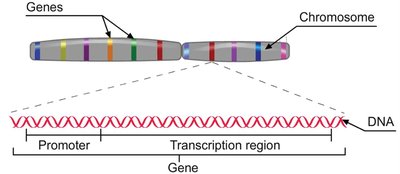
Cellular Differentiation and Gene Expression
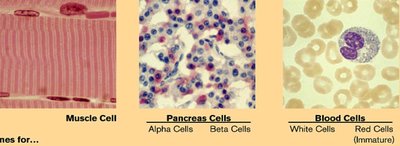
Although all cells in a multicellular organism have the same DNA, they can become specialized by expressing different genes. This process is called cellular differentiation.
Muscle cells, pancreas cells, and blood cells have the same DNA but express different genes to perform specialized functions.
Gene expression is regulated so that only the necessary proteins are produced in each cell type.
Mechanism of Transcription
Initiation of Transcription
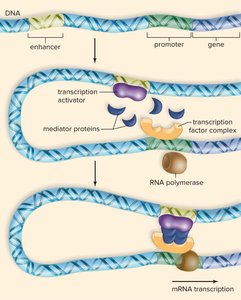
Transcription begins at specific DNA sequences called promoters. Transcription factors are proteins that bind to the promoter and help recruit RNA polymerase, the enzyme that synthesizes RNA.
The promoter determines where transcription starts and which DNA strand is used as the template.
Transcription factors regulate when, where, and how much a gene is transcribed.
Transcription Process
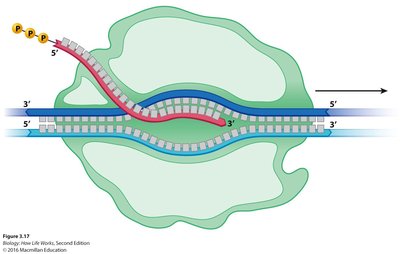
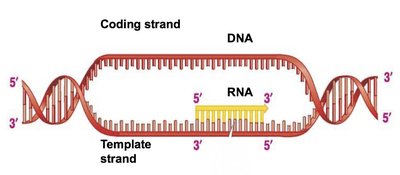
During transcription, RNA polymerase reads the template DNA strand in the 3' to 5' direction and synthesizes a complementary RNA strand in the 5' to 3' direction.
The template strand is the DNA strand used to synthesize RNA.
The coding strand has the same sequence as the RNA (except RNA has uracil (U) instead of thymine (T)).
New nucleotides are added to the 3' end of the growing RNA molecule.
Directionality and Polarity
The structure and polarity of DNA and RNA are crucial for information transfer. DNA and RNA strands have directionality, labeled 5' (five prime) and 3' (three prime) ends, which determines the direction of synthesis.
RNA is synthesized in the 5' to 3' direction.
The template DNA strand is read in the 3' to 5' direction.
Regulation of Transcription
Promoters and Transcription Factors
The promoter region of a gene contains specific sequences that are recognized by transcription factors. These proteins help position RNA polymerase at the correct site to begin transcription.
Different genes have different promoter sequences, allowing for specific regulation.
Transcription factors can activate or repress gene expression.
Termination and mRNA Processing
Transcription ends at terminator sequences. The newly made pre-mRNA undergoes several modifications before it becomes mature mRNA:
5' Cap: A modified guanine nucleotide is added to the 5' end, stabilizing the mRNA and aiding in export and translation.
Poly(A) Tail: A string of adenine nucleotides is added to the 3' end, further stabilizing the mRNA and promoting translation.
Splicing: Non-coding regions (introns) are removed, and coding regions (exons) are joined together. Alternative splicing can produce different proteins from the same gene.
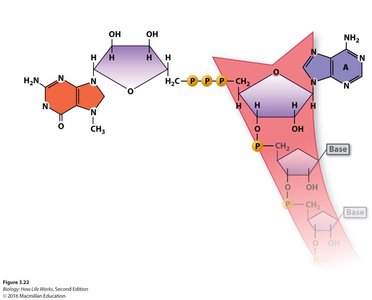
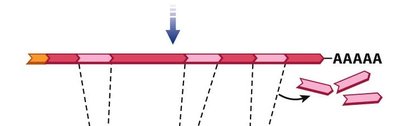
Summary Table: Key Steps in Transcription and mRNA Processing
Step | Description |
|---|---|
Initiation | Transcription factors bind to promoter; RNA polymerase recruited |
Elongation | RNA polymerase synthesizes RNA strand complementary to DNA template |
Termination | Transcription ends at terminator sequence |
5' Capping | Modified guanine added to 5' end of mRNA |
Polyadenylation | Poly(A) tail added to 3' end of mRNA |
Splicing | Introns removed, exons joined; alternative splicing possible |
Key Concepts and Review Questions
How is DNA used to transcribe mRNA?
Where does transcription start and end?
What is the enzyme catalyzing transcription, and in which direction does it synthesize RNA?
How is transcription regulated?
What happens to mRNA after transcription is complete?
