 Indietro
Transcription and Gene Expression: Structure, Function, and Regulation
Guida di studio - Note intelligenti
 Appunti personalizzati basati sui tuoi materiali, ampliati con definizioni chiave, esempi e contesto.
Transcription and the Central Dogma
Overview of the Central Dogma
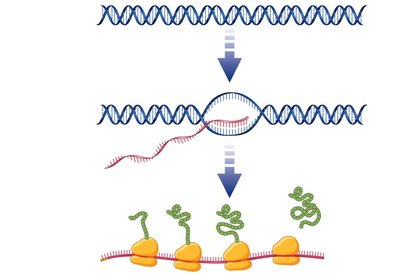
The central dogma of molecular biology describes the flow of genetic information within a biological system. It states that information stored in DNA is transcribed into messenger RNA (mRNA), which is then translated into protein. This process is fundamental to all living organisms and underlies cellular function and differentiation.
DNA stores genetic instructions for cellular activities.
Transcription is the process of copying DNA into mRNA.
Translation is the process of converting mRNA into a protein sequence.
Proteins provide structure and carry out essential cellular functions.
Example: The gene for insulin is transcribed and translated to produce the insulin protein, which regulates blood sugar. 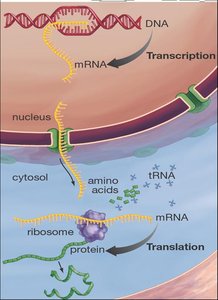
Gene Structure and Chromosomes
Genes, Promoters, and Chromosomal Organization
Genes are segments of DNA that encode instructions for making proteins. Each gene contains a promoter region, which is the site where transcription begins, and a transcription region that is copied into RNA. Chromosomes are long DNA molecules containing many genes.
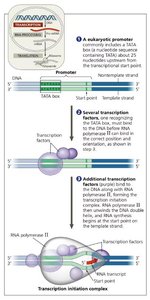
Promoter: DNA sequence where transcription factors and RNA polymerase bind to initiate transcription.
Transcription region: Portion of the gene that is transcribed into RNA.
Chromosome: Structure containing many genes, each with its own promoter and transcription region.
Example: The promoter region determines when and where a gene is expressed. 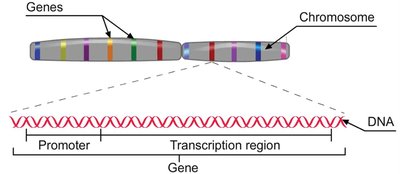
Cellular Differentiation and Gene Expression
Cell Types and Differential Gene Expression
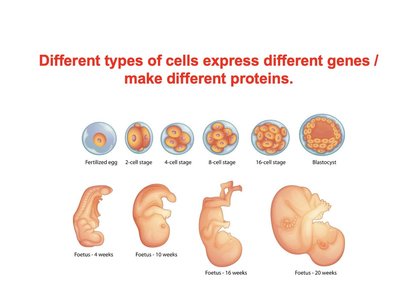
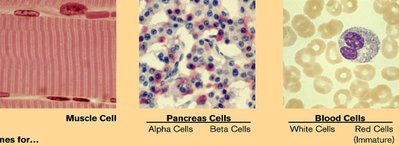
Although all cells in an organism contain the same DNA, they express different sets of genes, resulting in different cell types and functions. This process is called cellular differentiation.
Cellular differentiation: Process by which cells become specialized by expressing specific genes.
Gene expression: Conversion of genetic instructions into functional products (proteins).
Examples of cell types: Muscle cells, pancreas cells, blood cells, etc.
Example: Muscle cells express genes for contractile proteins, while pancreas cells express genes for insulin. 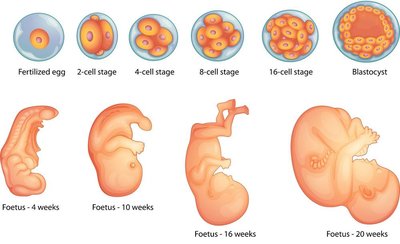
Regulation of Gene Expression
Transcriptional Regulation
The initiation of transcription is the most common point of regulation for gene expression. Transcription factors are proteins that bind to promoter sequences and regulate the activity of RNA polymerase.
Transcription factors: Proteins that bind to specific DNA sequences (promoters) to regulate transcription.
Promoter sequence: Determines which transcription factors bind and when transcription occurs.
Regulation: Controls when, where, and how much a gene is transcribed.
Example: The presence of specific transcription factors in liver cells allows expression of liver-specific genes. 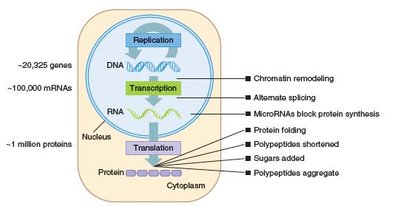
Mechanism of Transcription
Steps of Transcription
Transcription occurs in three main steps: initiation, elongation, and termination.
Initiation: RNA polymerase binds to the promoter with the help of transcription factors.
Elongation: RNA polymerase synthesizes the RNA strand by adding nucleotides complementary to the DNA template.
Termination: Transcription ends when RNA polymerase reaches a terminator sequence.
Example: The gene for hemoglobin is transcribed in red blood cell precursors. 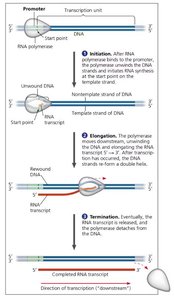
Transcription: Template and Coding Strands
Directionality and Complementarity
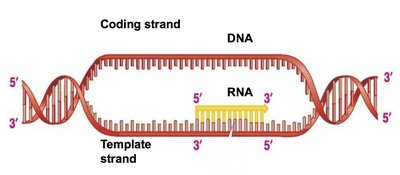
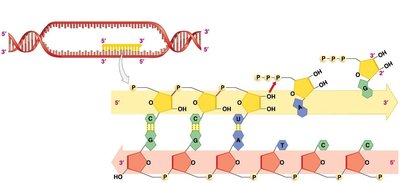
During transcription, the template strand of DNA is read by RNA polymerase in the 3' to 5' direction, and the mRNA is synthesized in the 5' to 3' direction. The coding strand has the same sequence as the mRNA (except T is replaced by U).
Template strand: DNA strand used as a template for mRNA synthesis.
Coding strand: DNA strand with the same sequence as mRNA (except for U/T).
Directionality: mRNA is synthesized 5' to 3'.
Example: The sequence of mRNA is determined by the template strand of DNA. 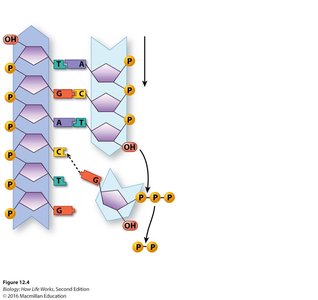
mRNA Processing in Eukaryotes
Post-Transcriptional Modifications
In eukaryotes, mRNA undergoes several modifications before it is translated. These include addition of a 5' cap, a poly(A) tail, and splicing to remove introns.
5' cap: Added during transcription; stabilizes mRNA and helps export from nucleus.
Poly(A) tail: Added during processing; stabilizes mRNA and promotes translation.
Splicing: Removal of introns and joining of exons; allows for alternative splicing.
Example: Alternative splicing can produce multiple proteins from a single gene.
Summary Table: Key Concepts in Transcription and Gene Expression
Concept | Description | Example |
|---|---|---|
Central Dogma | DNA → mRNA → Protein | Insulin gene expression |
Gene | Segment of DNA encoding a protein | Hemoglobin gene |
Promoter | DNA sequence where transcription starts | TATA box in eukaryotes |
Transcription Factor | Protein regulating transcription | Liver-specific factors |
Template Strand | DNA strand used for mRNA synthesis | Antiparallel to mRNA |
mRNA Processing | 5' cap, poly(A) tail, splicing | Alternative splicing in tropomyosin gene |
Important Equations and Concepts
Directionality of Transcription
DNA template strand is read 3' → 5'
mRNA is synthesized 5' → 3'
Phosphodiester Bond Formation
RNA polymerase catalyzes the formation of phosphodiester bonds between nucleotides.
Additional info:
Alternative splicing allows for the production of multiple protein isoforms from a single gene, increasing protein diversity.
Transcription can be regulated at multiple levels, including chromatin remodeling, transcription factor binding, and mRNA processing.
