 Indietro
Transcription and RNA Processing in Bacteria and Eukaryotes
Guida di studio - Note intelligenti
 Appunti personalizzati basati sui tuoi materiali, ampliati con definizioni chiave, esempi e contesto.
Transcription: Overview and Key Events
Introduction to Transcription
Transcription is the process by which the information encoded in a DNA sequence is copied into a complementary RNA molecule. This process is fundamental to gene expression in both prokaryotic (bacterial) and eukaryotic cells, but the mechanisms and regulatory elements involved differ between these domains of life.
Mechanism of Transcription
Stages of Transcription
Initiation: RNA polymerase binds to the promoter region of DNA, unwinds the DNA, and begins RNA synthesis.
Elongation: RNA polymerase moves along the DNA template strand, synthesizing RNA in the 5' to 3' direction by adding ribonucleotides to the 3' end of the growing RNA chain.
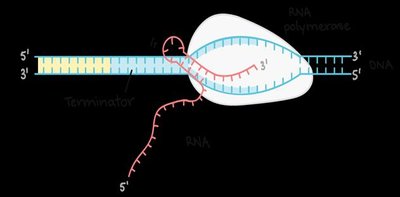
Termination: Transcription ends when RNA polymerase encounters a terminator sequence (in bacteria) or a polyadenylation signal (in eukaryotes), releasing the newly synthesized RNA.
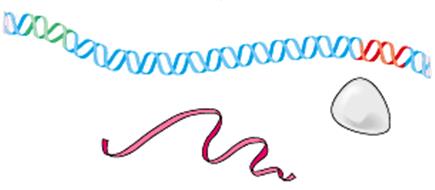
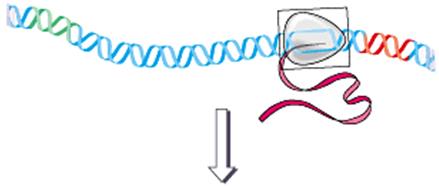
Transcription Initiation in Eukaryotes
In eukaryotes, transcription initiation is a multi-step process involving several proteins:
Transcription factors recognize and bind to specific DNA sequences in the promoter region, such as the TATA box.
These factors help position RNA polymerase II at the correct site and orientation for transcription to begin.
The transcription initiation complex is formed, which unwinds the DNA and starts RNA synthesis.
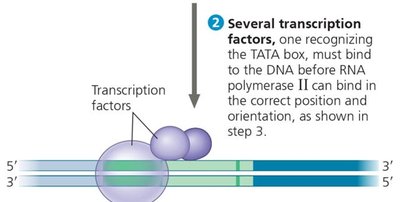
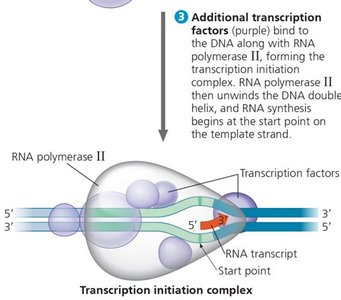
Promoter Elements and Consensus Sequences
Promoters are DNA sequences upstream of the transcription start site that direct the binding of RNA polymerase and transcription factors. Both prokaryotic and eukaryotic promoters contain conserved consensus sequences:
Eukaryotic promoters often include a GC-rich box, CAAT box, and TATA box (located about 25 nucleotides upstream of the start site).
Bacterial promoters contain a -35 consensus sequence and a -10 consensus sequence (Pribnow box).

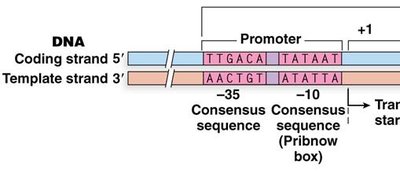
Directionality and Terminology
The 5' end of a gene is upstream of the transcription start site, while the 3' end is downstream of the termination site.
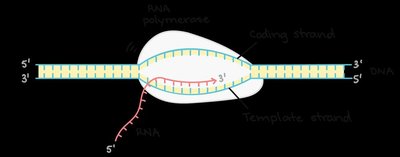
The coding strand (non-template) has the same sequence as the RNA (except T is replaced by U), while the template strand is used by RNA polymerase to synthesize RNA.
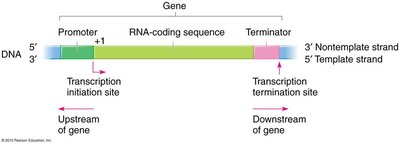
Transcription Elongation and Termination
Elongation
During elongation, RNA polymerase synthesizes RNA by adding nucleotides to the 3' end of the growing RNA chain, using the DNA template strand as a guide. The process is always in the 5' to 3' direction.
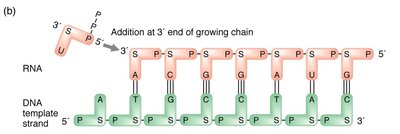
Termination
In bacteria, transcription ends at a terminator sequence, often forming a hairpin structure in the RNA that causes RNA polymerase to detach.
In eukaryotes, transcription ends after the polyadenylation signal is transcribed, and the RNA is cleaved downstream of this site.
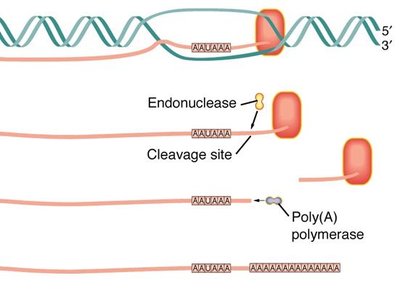
Comparison of Transcription in Bacteria and Eukaryotes
Key Differences
Feature | Bacteria | Eukaryotes |
|---|---|---|
RNA Polymerase | One type | Three types (I, II, III) |
Promoter Recognition | RNA polymerase binds directly | Transcription factors required |
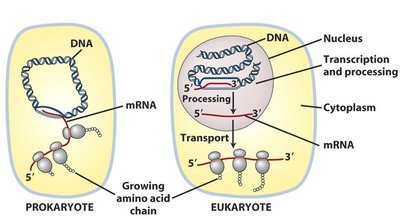
Location | Cytoplasm | Nucleus |
RNA Processing | Minimal/none | 5' capping, splicing, 3' polyadenylation |
Coupling with Translation | Yes | No |
RNA Processing in Eukaryotes
Post-Transcriptional Modifications
5' Capping: Addition of a modified guanine nucleotide to the 5' end of the mRNA, which protects the RNA and aids in ribosome binding.
Splicing: Removal of non-coding introns and joining of exons by the spliceosome, a complex of small nuclear RNAs (snRNAs) and proteins (snRNPs).
3' Polyadenylation: Addition of a poly(A) tail to the 3' end, enhancing mRNA stability and export from the nucleus.
Splicing Mechanism
Spliceosome recognizes conserved sequences at exon-intron boundaries.
snRNAs base pair with intron sequences, guiding the spliceosome to the correct site.
Splicing removes introns and ligates exons, producing mature mRNA.
Template and Coding Strands
Determining the Template Strand
The template strand is the DNA strand that RNA polymerase reads to synthesize RNA; it is complementary and antiparallel to the RNA product.
The coding strand has the same sequence as the RNA (except T is replaced by U).
The location of the promoter determines which strand is used as the template for a given gene.
Cis- and Trans-Acting Elements
Definitions and Examples
Cis-regulatory elements (CREs): DNA sequences (such as promoters and enhancers) located on the same DNA molecule as the gene they regulate.
Trans-regulatory elements: Usually proteins (such as transcription factors) that can regulate genes distant from the gene from which they were transcribed.
Summary Table: Key Features of Transcription
Feature | Bacteria | Eukaryotes |
|---|---|---|
RNA Polymerase | One | Three (I, II, III) |
Promoter Elements | -35 and -10 boxes | TATA box, CAAT box, GC-rich box |
Initiation | Polymerase binds directly | Requires transcription factors |
RNA Processing | None | 5' cap, splicing, poly(A) tail |
Location | Cytoplasm | Nucleus |
Key Equations and Concepts
Direction of RNA synthesis:
Base pairing during transcription:
Applications and Examples
Mutational analysis of promoter regions can reveal the importance of specific cis-regulatory elements in gene expression.
mRNA-based vaccines require intact 5' caps and poly(A) tails for stability and efficient translation in eukaryotic cells.
