 Indietro
Transcription and Translation: Gene Expression in Bacteria and Eukaryotes
Guida di studio - Note intelligenti
 Appunti personalizzati basati sui tuoi materiali, ampliati con definizioni chiave, esempi e contesto.
Transcription: The Synthesis of RNA from DNA
Overview of Transcription
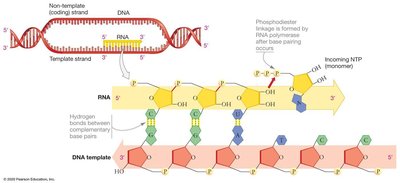
Transcription is the process by which RNA is synthesized from a DNA template. This is a fundamental step in gene expression, allowing genetic information stored in DNA to be converted into a functional RNA molecule.
RNA polymerases perform template-directed synthesis in the 5′ → 3′ direction.
Unlike DNA polymerases, RNA polymerases do not require a primer to begin transcription.
Bacteria have one RNA polymerase; eukaryotes have at least three distinct types.
Initiation of Transcription in Bacteria
Transcription initiation is the first phase, requiring specific proteins and DNA sequences.
RNA polymerase cannot initiate transcription on its own; sigma protein must bind first.
The RNA polymerase and sigma form a holoenzyme.
Sigma recognizes promoters, which are DNA sequences where transcription begins.
Promoters in bacteria are typically 40–50 base pairs long, containing a −10 box (TATAAT) and a −35 box (TTGACA).

Events Inside the Holoenzyme
Transcription begins when the sigma part of the holoenzyme binds to the −35 and −10 boxes, determining the template strand and direction of RNA polymerase movement.

Elongation and Termination in Bacteria
During elongation, RNA polymerase reads the DNA template and adds nucleotides to the 3’ end of the RNA. Termination occurs when a transcription-termination signal is transcribed, forming a hairpin structure that causes RNA polymerase to separate from the RNA transcript.

Transcription in Eukaryotes
Differences from Bacterial Transcription
Eukaryotic transcription is more complex, involving multiple RNA polymerases, larger and more diverse promoters (including the TATA box), and general transcription factors. Termination involves a poly(A) signal, and transcription occurs in the nucleus, separated from translation.
RNA Processing in Eukaryotes
Unlike bacteria, eukaryotes produce an immature primary transcript (pre-mRNA) that must undergo processing before translation.
Processing includes splicing, addition of a 5′ cap, and a poly(A) tail.
Splicing removes introns (noncoding regions) and joins exons (coding regions).


Adding Caps and Tails to Transcripts
Pre-mRNAs are processed by the addition of a 5′ cap and a poly(A) tail, which protect the RNA and are necessary for translation.
The 5′ cap is a modified guanine nucleotide.
The poly(A) tail consists of 100–250 adenine nucleotides.
Mature mRNAs contain untranslated regions (UTRs) at both ends.

Translation: Converting mRNA to Protein
Introduction to Translation
Translation is the process by which the sequence of mRNA bases is converted to an amino acid sequence, forming a polypeptide. This process involves ribosomes, mRNA, and tRNAs.
Coupling of Transcription and Translation in Bacteria
In bacteria, translation can begin before transcription is complete, allowing for rapid protein synthesis. Multiple ribosomes can attach to a single mRNA, forming a polyribosome.

Separation of Transcription and Translation in Eukaryotes
In eukaryotes, transcription and translation are separated in space and time. Transcription and RNA processing occur in the nucleus, while translation occurs in the cytoplasm.
Structure and Function of Transfer RNA (tRNA)
tRNAs are adapter molecules that bring amino acids to the ribosome during translation. Each tRNA has an amino acid binding site at the 3′ end and an anticodon loop that base-pairs with the mRNA codon.

Aminoacyl-tRNA Synthetases
Aminoacyl-tRNA synthetases are enzymes that attach the correct amino acid to its corresponding tRNA, a process requiring ATP. There are 20 synthetases, one for each amino acid.

Wobble Pairing
Although there are 61 codons, most cells have about 40 tRNAs. Wobble pairing allows one tRNA to recognize multiple codons due to nonstandard base pairing at the third position of the anticodon.
Ribosome Structure and Function in Translation
Ribosome Subunits and tRNA Binding Sites
Ribosomes consist of a small subunit (holds mRNA) and a large subunit (forms peptide bonds). Three tRNA binding sites exist: A site (acceptor), P site (peptidyl), and E site (exit).

Translation Process: Initiation, Elongation, and Termination
Translation occurs in three phases:
Initiation: Begins near the AUG start codon. In bacteria, the small ribosomal subunit binds to the Shine–Dalgarno sequence, and the initiator tRNA (carrying f-Met) binds to the start codon.
Elongation: Aminoacyl tRNAs enter the A site, peptide bonds form, and the ribosome moves along the mRNA.
Termination: Occurs when a stop codon is encountered; a release factor enters the A site, and the polypeptide is released.
Comparison of Gene Expression in Bacteria and Eukaryotes
Table: Transcription, RNA Processing, and Translation
The following table summarizes the differences between bacteria and eukaryotes in gene expression:
Process | Bacteria | Eukaryotes |
|---|---|---|
Transcription | One RNA polymerase; promoter contains -35 and -10 boxes; sigma proteins | Three RNA polymerases; variable promoters with TATA box; general transcription factors |
RNA Processing | Rare | Extensive: 5′ cap, splicing, 3′ poly(A) tail |
Translation | Initiation and termination less complex; elongation similar to eukaryotes | Initiation and termination more complex; elongation similar to bacteria |
Post-Translational Modification
Polypeptide Folding and Chemical Modifications
Proteins undergo folding and chemical modifications after translation to become functional. Molecular chaperones assist in folding, and enzymes may add sugars, lipids, or phosphate groups to alter activity.
Linking Genotypes to Phenotypes
Genetic Information Flow
An organism’s genotype is determined by the sequence of bases in its DNA, while its phenotype is a product of the proteins it produces. Differences in genotype can lead to differences in phenotype due to variations in protein structure and function.
Central Dogma: DNA → RNA → Protein
Alleles of the same gene differ in DNA sequence, resulting in different proteins and phenotypes.
