 Indietro
Transport Across Biological Membranes: Structure, Mechanisms, and Cellular Implications
Guida di studio - Note intelligenti
 Appunti personalizzati basati sui tuoi materiali, ampliati con definizioni chiave, esempi e contesto.
Transport Across Membranes
Introduction to Biological Membranes
Biological membranes are essential structures that define the boundaries of cells and organelles, controlling the movement of substances in and out. They are primarily composed of lipid bilayers, which provide both a barrier and a matrix for proteins involved in transport.
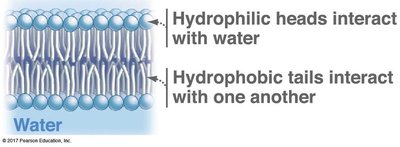
Lipid Bilayer: Composed of phospholipids with hydrophilic (water-attracting) heads and hydrophobic (water-repelling) tails.
Selective Permeability: Membranes allow some molecules to pass more easily than others, maintaining cellular homeostasis.
Membrane Permeability and Fluidity
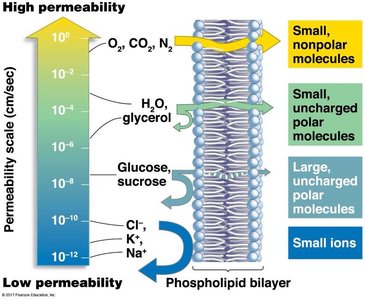
The permeability of the membrane depends on the chemical nature of the molecules and the fluidity of the lipid bilayer. Small, nonpolar molecules cross easily, while ions and large molecules require assistance.
High Permeability: Small, nonpolar molecules (e.g., O2, CO2, N2).
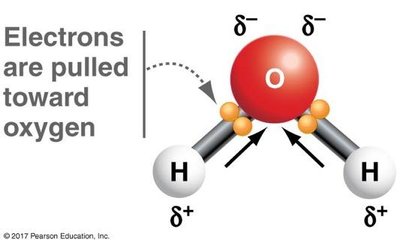
Moderate Permeability: Small, uncharged polar molecules (e.g., H2O, glycerol).
Low Permeability: Large, uncharged polar molecules (e.g., glucose, sucrose) and ions (e.g., Cl-, K+, Na+).
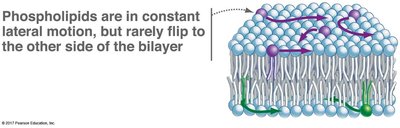
Phospholipids are in constant lateral motion, contributing to membrane fluidity, but rarely flip-flop between layers.
Higher temperatures increase membrane fluidity, which in turn increases permeability.
Diffusion Across Membranes
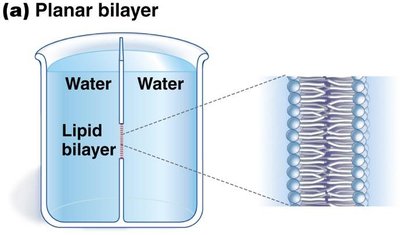
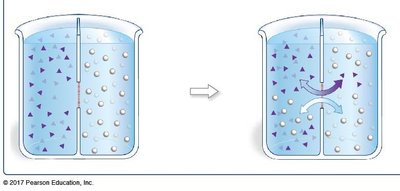
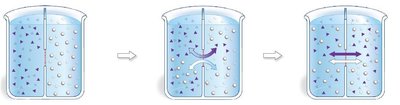
Diffusion is the spontaneous movement of molecules from regions of high concentration to regions of low concentration. It is a passive process that does not require energy input.
Concentration Gradient: The difference in solute concentration across a space or membrane drives diffusion.
Equilibrium: Achieved when molecules are evenly distributed, but movement continues randomly.
The rate of diffusion can be described by Fick's Law:
F: Rate of diffusion
k: Diffusion constant (depends on solute, membrane, temperature)
A: Surface area for diffusion
Δc: Change in concentration
d: Distance for diffusion (e.g., membrane thickness)
Diffusion of Charged Particles
Charged particles (ions) rarely cross the phospholipid bilayer unaided. Their movement is influenced by both concentration gradients and electrical gradients, together forming the electrochemical gradient.
Electrochemical Gradient: The combined effect of concentration and electrical gradients on ion movement.
Electrochemical Equilibrium: Achieved when the forces of the concentration and electrical gradients are balanced.
Consequences of Cell Size and Shape
As cells increase in size, their surface area-to-volume ratio decreases, which limits the rate at which substances can diffuse into and out of the cell. Cells adapt by increasing surface complexity or subdividing internal volume.
Surface Area (SA): for a cube
Volume (V): for a cube
SA:V Ratio: Decreases as cell size increases, reducing diffusion efficiency.
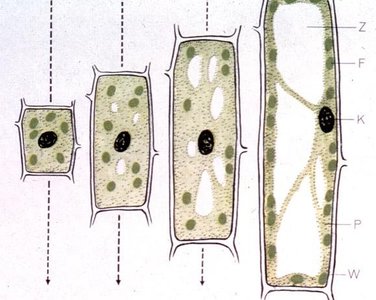
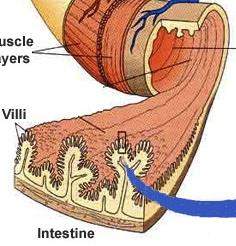
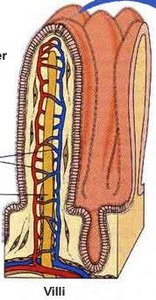
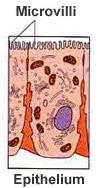
Adaptations: Cells may become long and thin, flat, or develop structures like villi and microvilli to increase surface area for diffusion.
Osmosis: Diffusion of Water
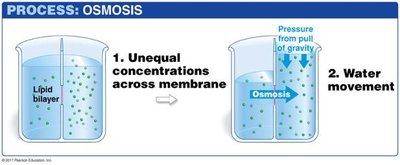
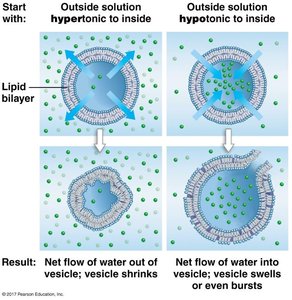
Osmosis is the diffusion of water across a selectively permeable membrane. Water moves from regions of high free water concentration (low solute) to regions of low free water concentration (high solute).
Semi-permeable Membrane: Allows water but not solute to cross.
Free Water: Only unbound water molecules can cross the membrane.
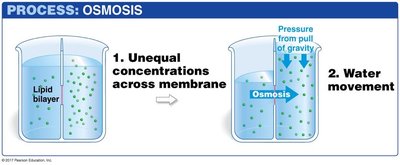
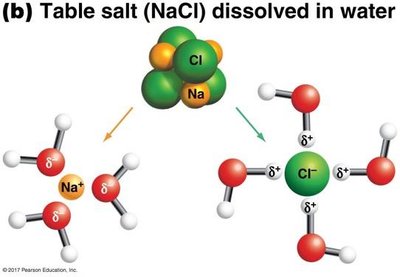
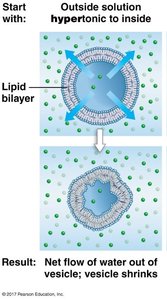
During osmosis, water moves to balance solute concentrations, causing changes in cell or vesicle volume.
Passive Transport
Passive transport is the movement of substances across the membrane without energy input, driven by concentration or electrochemical gradients.
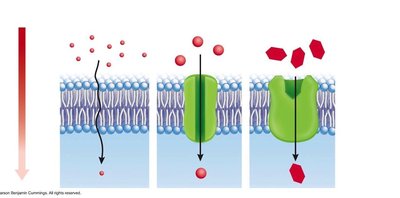
Simple Diffusion: Movement directly through the lipid bilayer.
Facilitated Diffusion: Movement via membrane proteins (channels or carriers).
Channel Proteins
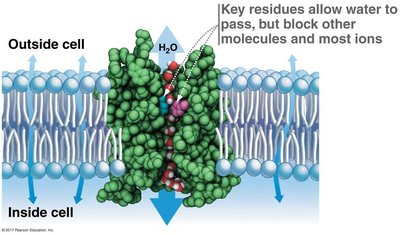
Aquaporins: Allow water to cross membranes rapidly, excluding other molecules and ions.
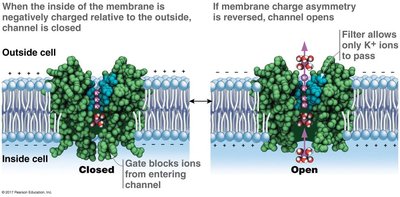
Gated Channels: Open or close in response to signals (e.g., voltage-gated K+ channels).
Carrier Proteins
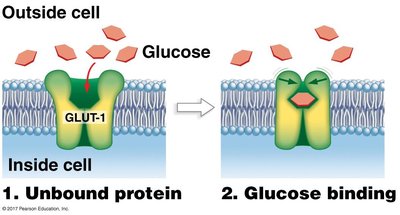
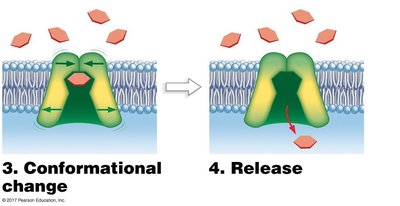
Undergo conformational changes to transport specific molecules (e.g., glucose) across the membrane.
Active Transport
Active transport moves substances against their concentration or electrochemical gradients, requiring energy (usually from ATP).
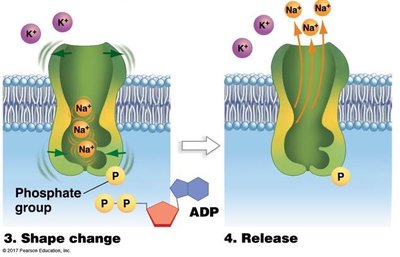
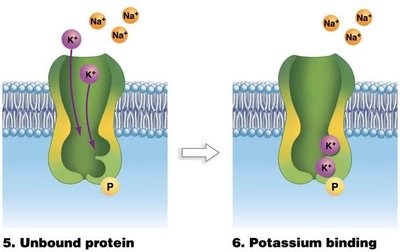
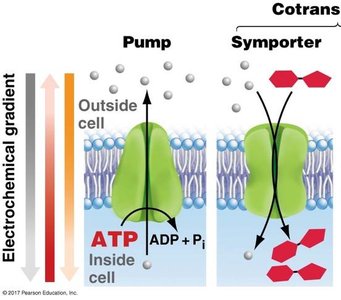
Pumps: Membrane proteins that use ATP to transport ions or molecules (e.g., sodium-potassium pump).
Proton Pump (H+-ATPase): Moves protons to create pH and electrochemical gradients.
Sodium-Potassium Pump (Na+/K+-ATPase): Exchanges Na+ and K+ across the membrane, maintaining cellular gradients.
Secondary Active Transport (Cotransport)
Secondary active transport uses the energy stored in electrochemical gradients (established by primary active transport) to move other substances against their gradients. ATP is not directly used for the transport step.
Symporters: Move two substances in the same direction.
Antiporters: Move substances in opposite directions.
Summary Table: Types of Membrane Transport
Transport Type | Energy Required? | Direction | Example |
|---|---|---|---|
Simple Diffusion | No | Down gradient | O2, CO2 |
Facilitated Diffusion (Channel) | No | Down gradient | Aquaporin (H2O) |
Facilitated Diffusion (Carrier) | No | Down gradient | GLUT-1 (glucose) |
Primary Active Transport | Yes (ATP) | Against gradient | Na+/K+-ATPase |
Secondary Active Transport (Cotransport) | Indirect (gradient) | Against gradient | Symporter, Antiporter |
