 Indietro
Transport Across Membranes and Plant Structure & Function
Guida di studio - Note intelligenti
 Appunti personalizzati basati sui tuoi materiali, ampliati con definizioni chiave, esempi e contesto.
Transport of Substances Across Membranes
Membrane Structure and Properties
Biological membranes are primarily composed of lipid bilayers, which provide a selectively permeable barrier for cells. The arrangement of hydrophilic heads and hydrophobic tails of phospholipids allows for dynamic movement and selective transport of substances.
Lipid bilayer: Two layers of phospholipids with hydrophilic heads facing outward and hydrophobic tails inward.
Selective permeability: Small, uncharged molecules cross easily; ions and large molecules require assistance from membrane proteins.
Fluidity: Phospholipids move laterally within the membrane; higher temperatures increase fluidity.
Diffusion and Rate of Diffusion
Diffusion is the passive movement of molecules from regions of high concentration to low concentration. It is a fundamental process for the movement of substances across membranes.
Passive process: No energy input required.
Equilibrium: Achieved when molecules are evenly distributed, but movement continues randomly.
Rate of diffusion equation:
Where: F = rate of diffusion k = diffusion constant A = surface area = concentration difference d = distance (e.g., membrane thickness)
Electrochemical Gradients
For charged particles, diffusion is influenced by both concentration and electrical gradients, forming an electrochemical gradient. Equilibrium is reached when both gradients are balanced.
Consequences of Size and Shape
As organisms increase in size, their surface area to volume ratio decreases, which impacts the efficiency of diffusion.
Surface area:
Volume:
Lower SA:V ratio reduces diffusion rate per unit volume.
Adaptations include subdivision into smaller units, increased surface complexity, and elongated or flattened shapes.
Osmosis
Osmosis is the diffusion of water across a semi-permeable membrane. Water moves from areas of high water potential to low water potential, often influenced by solute concentration and pressure.
Water is polar: Forms hydrogen bonds with other molecules.
Some water molecules are bound to solutes and cannot cross the membrane if the solute cannot.
Passive and Facilitated Transport
Passive transport occurs along the electrochemical gradient without energy input. Facilitated diffusion involves membrane proteins:
Channel proteins: Form pores for specific ions/molecules (e.g., aquaporins for water, gated channels for ions).
Carrier proteins: Undergo conformational changes to transport molecules (e.g., glucose transporters).
Active Transport
Active transport moves substances against their electrochemical gradients, requiring energy (usually ATP).
Pumps: Membrane proteins that use ATP (e.g., sodium-potassium pump).
Secondary active transport (cotransport): Uses gradients established by pumps to move other substances (symporters and antiporters).
Diversification of Eukaryotes
Tree of Life and Domains
Life is classified into three domains: Bacteria, Archaea, and Eukarya. Eukaryotes possess a nucleus and are generally larger and more complex than prokaryotes.
Prokaryotes: Bacteria and Archaea (no nucleus).
Eukaryotes: Eukarya (nucleus, organelles, cytoskeleton).
Recent research suggests grouping Archaea and Eukaryotes together.
Protists
Protists are a paraphyletic group of eukaryotes, excluding land plants, fungi, and animals. They exhibit diverse forms, modes of nutrition, and life cycles.
Autotrophic protists: Synthesize organic compounds from inorganic sources.
Heterotrophic protists: Obtain nutrients by digesting organic compounds.
Reproduction can be asexual (mitosis) or sexual (meiosis).
Protists and Health
Some protists cause diseases in crops and humans (e.g., Phytophthora infestans in the Irish potato famine).
Role in Aquatic Ecosystems
Protists are primary producers in aquatic ecosystems, forming the base of the food chain and playing a key role in the global carbon cycle.
Photosynthesis:
Act as carbon sinks (sedimentary rocks, petroleum).
Plant Diversity and Evolution
Clades and Adaptations
Plants are organized into nested clades, with adaptations for terrestrial life such as cuticles, pores, and stomata. Land plants (embryophytes) protect their embryos and exhibit alternation of generations.
Alternation of generations: Life cycle alternates between haploid (gametophyte) and diploid (sporophyte) stages.
Sporophyte: Diploid, produces spores by meiosis.
Gametophyte: Haploid, produces gametes by mitosis.
Vascular and Seed Plants
Vascular plants have specialized tissues for transport (xylem and phloem). Seed plants (gymnosperms and angiosperms) have adaptations such as pollen and seeds for reproduction.
Gymnosperms: Conifers, cycads, ginkgo, gnetales.
Angiosperms: Flowering plants.
Plant Form and Function
Plant Body Organization
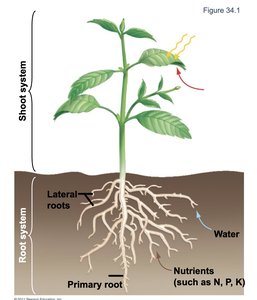
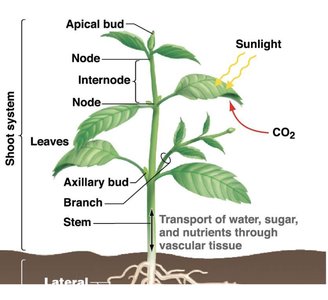
The plant body is divided into the root system (below ground) and shoot system (above ground), each with specialized functions.
Root system: Water/nutrient uptake, anchorage, storage.
Shoot system: Light/CO2 harvesting, gas exchange, transport, reproduction.
Roots and Shoots
Lateral roots: Increase reach of root system.
Root hairs: Site of water and nutrient absorption.
Root cap: Protects growing tip, perceives gravity.
Leaves: Main organ for photosynthesis, maximizes surface area for light capture.
Plant Cells and Tissues
Plant cells have cell walls, plastids, and large central vacuoles. Tissues are organized into dermal, ground, and vascular types.
Dermal tissue: Epidermis, cuticle, guard cells, trichomes.
Ground tissue: Parenchyma (photosynthesis, storage), collenchyma (flexible support), sclerenchyma (rigid support).
Vascular tissue: Xylem (water/nutrient transport), phloem (sugar/hormone transport).
Primary Growth in Plants
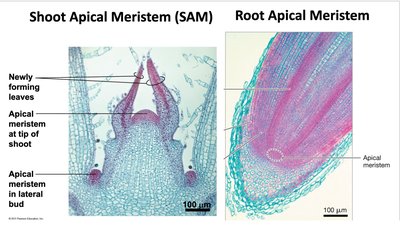
Primary growth increases the length of roots and shoots via apical meristems. Meristematic cells are totipotent and can differentiate into any cell type.
Shoot Apical Meristem (SAM): Produces new cells at shoot tips.
Root Apical Meristem (RAM): Produces new cells at root tips.
Secondary Growth in Plants
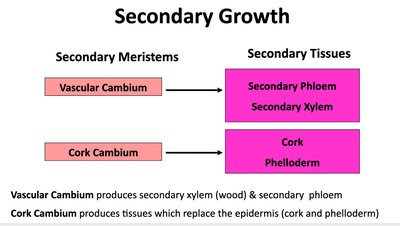
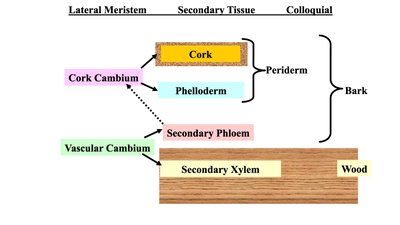
Secondary growth increases the width of stems and roots via lateral meristems (vascular cambium and cork cambium).
Vascular cambium: Produces secondary xylem (wood) and secondary phloem.
Cork cambium: Produces cork and phelloderm, forming the periderm (bark).
Secondary xylem forms annual rings, allowing age determination of trees.
Water and Sugar Transport in Plants
Water Potential
Water potential () is the potential energy of water in a system, determining the direction of water movement. It is measured in megapascals (MPa).

Water moves from high to low water potential.
Solute potential (): Lowered by higher solute concentration.
Pressure potential (): Physical pressure on water; positive (turgor) or negative (tension).
Total water potential:
Water Uptake and Transport Pathways
Water enters roots by osmosis and moves through the symplast (cytoplasm via plasmodesmata) or apoplast (cell wall matrix). The Casparian strip in the endodermis blocks apoplastic flow, forcing water through cell membranes for selective uptake.
Xylem: Transports water and minerals from roots to shoots.
Phloem: Transports sugars and other organic molecules.
Transpiration and Cohesion-Tension Theory
Transpiration is the evaporation of water from leaf surfaces, creating a negative pressure that pulls water upward through the plant. The cohesion-tension theory explains this process:
Water evaporates from mesophyll cells and exits via stomata.
Water potential drops, drawing water from adjacent cells and xylem.
Cohesion of water molecules pulls the column upward.
Negative pressure reaches roots, pulling water in from the soil.
Mechanisms to Prevent Water Loss
Sunken stomata and trichomes maintain humidity and reduce water potential gradient.
Thick cuticle, multiple epidermal layers, and reduced surface area minimize diffusion loss.
Timing of stomatal opening (e.g., CAM plants open stomata at night).
