 Indietro
Transport Across the Cell Membrane: Passive and Active Mechanisms
Guida di studio - Note intelligenti
 Appunti personalizzati basati sui tuoi materiali, ampliati con definizioni chiave, esempi e contesto.
Transport Across the Cell Membrane
Overview of Membrane Transport
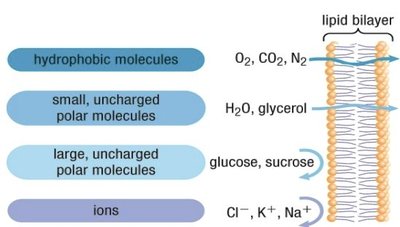
The cell membrane is a semi-permeable barrier that regulates the movement of substances into and out of the cell. Transport mechanisms are classified as passive (no energy required) or active (energy required), depending on whether substances move down or against their concentration gradients.
Semi-permeable membrane: Allows selective passage of certain molecules.
Concentration gradient: The difference in concentration of a substance across a membrane.
Passive Transport
Diffusion
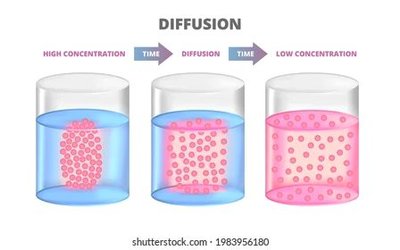
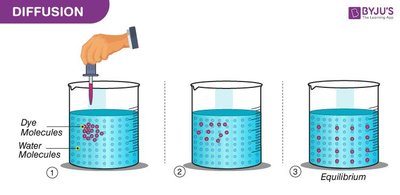
Diffusion is the net movement of molecules or ions from an area of higher concentration to an area of lower concentration, driven by the concentration gradient. No energy is required for this process.
Factors affecting diffusion rate: Molecule size, charge, polarity, temperature, and pressure.
Equilibrium: Achieved when concentrations are equal on both sides.
Simple Diffusion
Simple diffusion occurs when substances move directly across the membrane, provided they are permeable to it.
Examples: Oxygen (O2), carbon dioxide (CO2), and other small, nonpolar molecules.
No energy required: Movement is driven solely by the concentration gradient.
Water Balance in Cells: Osmosis
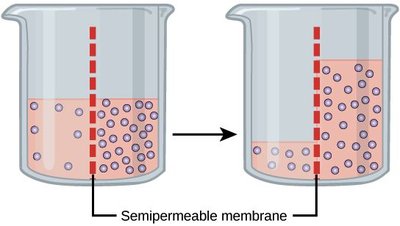
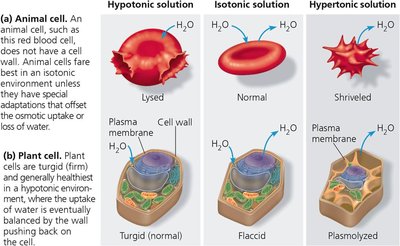
Osmosis is the diffusion of water across a semi-permeable membrane. The direction of water movement depends on the osmotic concentration of solutes.
Isotonic: Equal solute concentration; no net water movement.
Hypertonic: Higher solute concentration; water moves out of the cell.
Hypotonic: Lower solute concentration; water moves into the cell.
Passive Transport: Facilitated Diffusion
Facilitated Diffusion
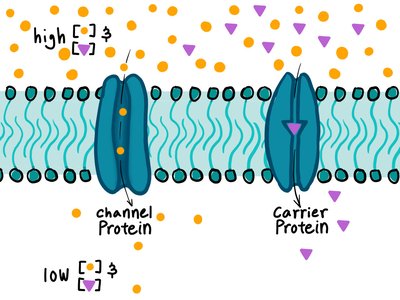
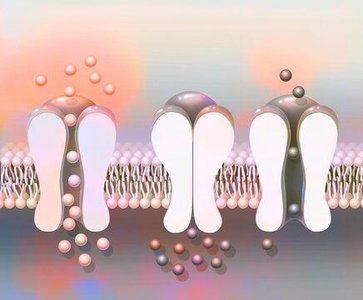
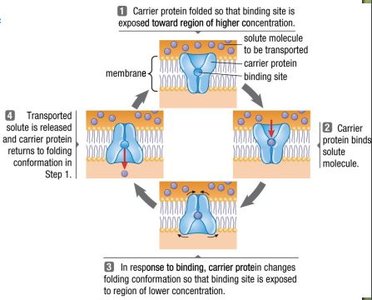
Facilitated diffusion is the movement of molecules across the membrane with the help of transport proteins. This process is used for molecules that cannot pass through the membrane unassisted.
Channel proteins: Form hydrophilic pathways for specific ions or polar molecules.
Carrier proteins: Bind to specific molecules and change shape to transport them across the membrane.
Direction: Always moves substances from high to low concentration.
Active Transport
Active Transport Mechanisms
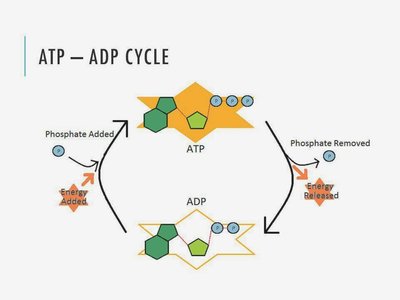
Active transport moves solutes against their concentration gradients (from low to high concentration), requiring energy, usually in the form of ATP.
Primary active transport: Direct use of ATP to move substances.
Secondary active transport: Indirect use of ATP; utilizes electrochemical gradients created by primary active transport.
Primary Active Transport: Sodium-Potassium Pump
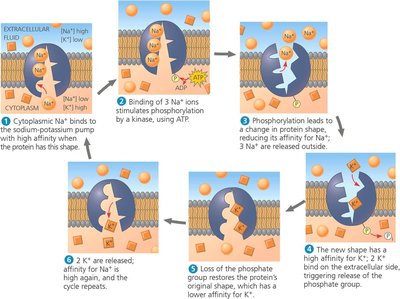
The sodium-potassium pump is a classic example of primary active transport, maintaining high K+ and low Na+ concentrations inside animal cells.
Mechanism: Uses ATP to pump Na+ out and K+ into the cell.
Importance: Maintains cell potential and volume.
Electrochemical Gradient
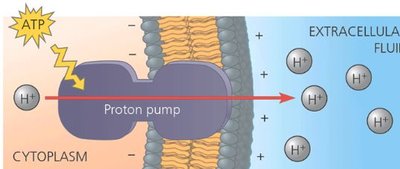
Ion pumps create both concentration and electrical gradients across membranes, known as electrochemical gradients. These gradients are essential for secondary active transport and cellular signaling.
Example: Proton pump uses ATP to move H+ ions, creating a gradient.
Secondary Active Transport: Co-Transport
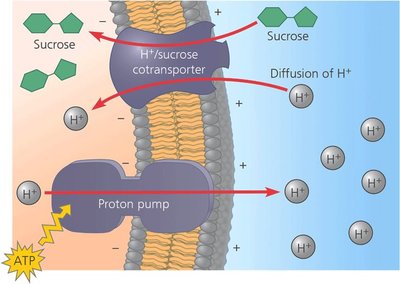
Secondary active transport couples the movement of one solute down its gradient with the movement of another solute against its gradient.
Example: H+/sucrose cotransporter uses the proton gradient to drive sucrose uptake.
ATP hydrolysis: Indirectly provides energy by establishing the gradient.
Membrane-Assisted Transport (Bulk Transport)
Endocytosis and Exocytosis
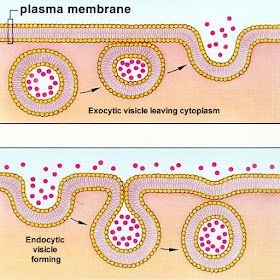
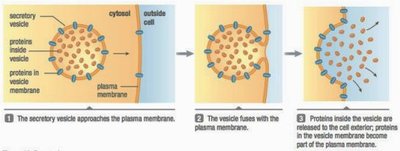
Membrane-assisted transport is used for macromolecules too large to pass through transport proteins. The cell forms vesicles to move materials in (endocytosis) or out (exocytosis).
Endocytosis: Cell membrane folds inward to bring materials into the cell.
Types of endocytosis: Phagocytosis (solid particles), pinocytosis (liquids), receptor-mediated endocytosis (specific molecules).
Exocytosis: Vesicles fuse with the membrane to release contents outside the cell.
Summary Table: Types of Membrane Transport
Type | Energy Required | Direction | Example |
|---|---|---|---|
Simple Diffusion | No | High to Low | O2, CO2 |
Facilitated Diffusion | No | High to Low | Glucose, ions |
Osmosis | No | High to Low (water) | Water |
Active Transport | Yes (ATP) | Low to High | Na+/K+ pump |
Bulk Transport | Yes (ATP) | In/Out | Endocytosis, Exocytosis |
Key Equations
Diffusion rate:
Osmotic pressure:
ATP hydrolysis:
Additional info: Academic context was added to clarify mechanisms, provide examples, and summarize key equations for exam preparation.
