 Indietro
Unit 3 Lab Packet Study Guide: Enzymes, Cellular Respiration, ATP, and Photosynthesis
Guida di studio - Note intelligenti
 Appunti personalizzati basati sui tuoi materiali, ampliati con definizioni chiave, esempi e contesto.
Q1. What is the role of enzymes in biological reactions?
Background
Topic: Enzyme Function
This question tests your understanding of how enzymes act as catalysts in biological systems, speeding up reactions without being consumed.
Key Terms:
Enzyme: A protein that speeds up chemical reactions in cells.
Catalyst: A substance that increases the rate of a reaction without being changed.
Activation Energy: The energy required to start a reaction.
Step-by-Step Guidance
Recall that enzymes lower the activation energy needed for reactions.
Think about how enzymes bind to substrates at their active site, forming an enzyme-substrate complex.
Consider how this interaction helps convert substrates into products more efficiently.
Reflect on the fact that enzymes are not used up in the reaction and can be reused.
Try solving on your own before revealing the answer!
Final Answer:
Enzymes act as biological catalysts, lowering the activation energy required for reactions and increasing the rate at which they occur. They bind to substrates, facilitate their conversion to products, and are not consumed in the process.
Q2. What is the chemical equation for cellular respiration?
Background
Topic: Cellular Respiration
This question tests your ability to recall the overall chemical equation for cellular respiration, which is a fundamental process in biology.
Key Terms and Formula:
Glucose ()
Oxygen ()
Carbon dioxide ()
Water ()
ATP (energy)
Step-by-Step Guidance
Identify the reactants: glucose and oxygen.
Identify the products: carbon dioxide, water, and ATP.
Recall the stoichiometry: 1 glucose molecule reacts with 6 oxygen molecules.
Think about the energy released in the form of ATP.
Try solving on your own before revealing the answer!
Final Answer:
The chemical equation for cellular respiration is:
This equation summarizes the breakdown of glucose in the presence of oxygen to produce carbon dioxide, water, and energy (ATP).
Q3. What is the function of ATP in cells?
Background
Topic: ATP and Cellular Energy
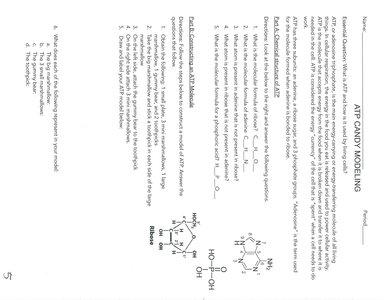
This question tests your understanding of ATP (adenosine triphosphate) as the primary energy carrier in cells.
Key Terms:
ATP: Adenosine triphosphate, a molecule that stores and transfers energy in cells.
Phosphate groups: The bonds between these groups store energy.
ADP: Adenosine diphosphate, formed when ATP loses a phosphate.
Step-by-Step Guidance
Recall that ATP stores energy in its phosphate bonds.
Think about how cells use ATP to power various processes, such as muscle contraction and active transport.
Consider what happens when ATP is hydrolyzed to ADP and a phosphate, releasing energy.
Reflect on the importance of ATP regeneration in cellular metabolism.
Try solving on your own before revealing the answer!
Final Answer:
ATP functions as the main energy currency of the cell, providing energy for cellular processes by releasing energy when its phosphate bonds are broken. Cells regenerate ATP from ADP and phosphate to maintain energy supply.
Q4. How does light intensity affect photosynthesis?
Background
Topic: Photosynthesis and Light Intensity
This question tests your understanding of how environmental factors, such as light intensity, influence the rate of photosynthesis in plants.
Key Terms:
Photosynthesis: The process by which plants convert light energy into chemical energy.
Light intensity: The amount of light energy available to plants.
Rate of photosynthesis: How quickly plants produce glucose and oxygen.
Step-by-Step Guidance
Recall that photosynthesis requires light energy to drive the conversion of carbon dioxide and water into glucose and oxygen.
Think about how increasing light intensity generally increases the rate of photosynthesis up to a certain point.
Consider the concept of limiting factors—other factors may limit the rate if light is no longer the limiting factor.
Reflect on how experimental data can be graphed to show the relationship between light intensity and photosynthesis rate.
Try solving on your own before revealing the answer!
Final Answer:
Light intensity affects the rate of photosynthesis: as light intensity increases, the rate of photosynthesis increases until another factor becomes limiting. This relationship can be observed experimentally and graphed.
Q5. What are the main steps of cellular respiration and where do they occur?
Background
Topic: Cellular Respiration Pathways
This question tests your knowledge of the stages of cellular respiration and their locations within the cell.
Key Terms:
Glycolysis: Occurs in the cytoplasm.
Krebs Cycle (Citric Acid Cycle): Occurs in the mitochondrial matrix.
Electron Transport Chain: Occurs in the inner mitochondrial membrane.
Step-by-Step Guidance
Recall the three main steps: glycolysis, Krebs cycle, and electron transport chain.
Identify the location of each step within the cell.
Think about the products of each step (ATP, NADH, FADH2, CO2).
Consider how these steps are interconnected and how energy is transferred.
Try solving on your own before revealing the answer!
Final Answer:
The main steps of cellular respiration are glycolysis (cytoplasm), Krebs cycle (mitochondrial matrix), and electron transport chain (inner mitochondrial membrane). Each step produces different products and contributes to ATP generation.
