 Indietro
Vaccines: Principles, Types, and Challenges – General Biology Study Notes
Guida di studio - Note intelligenti
 Appunti personalizzati basati sui tuoi materiali, ampliati con definizioni chiave, esempi e contesto.
Vaccines: Principles, Types, and Challenges
Introduction to Vaccination
Vaccination is a cornerstone of modern medicine, providing immunity against infectious diseases by stimulating the body's immune system. The principle of vaccination is based on exposing the immune system to antigens from pathogens in a controlled manner, allowing the body to develop a defense without causing disease.
Definition: Vaccination (or immunization) is the process of making a person immune or resistant to an infectious disease, typically by administering a vaccine.
Effectiveness: Vaccines have prevented millions of deaths annually and remain the most effective method for controlling infectious diseases.
Historical context: The term "vaccine" comes from the Latin vacca (cow), referencing Edward Jenner's use of cowpox to protect against smallpox in 1796.
Principles of Immunization
The acquired immune system relies on two key elements: specificity and memory. Vaccines utilize these principles to provide long-lasting protection.
Specificity: The immune system targets specific antigens presented by pathogens.
Memory: Memory cells allow for a faster and more effective response upon subsequent exposure to the same antigen.
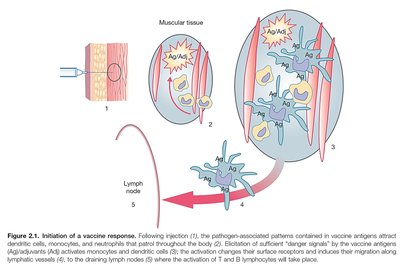
Types of Immunity
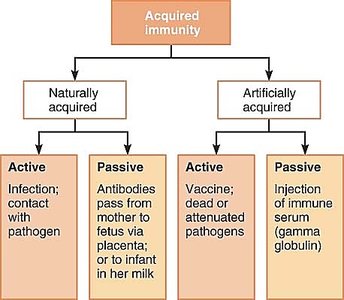
Immunity can be classified as active or passive, and as naturally or artificially acquired. Understanding these distinctions is crucial for comprehending how vaccines work.
Active immunity: Produced by the individual's own immune system; usually long-lasting.
Passive immunity: Provided by products from another human or animal; temporary.
Activation of Antibody Synthesis
Vaccines stimulate the production of antibodies by activating B-lymphocytes. The primary response is slow, but subsequent exposures trigger a rapid and robust secondary response due to memory cells.
Primary response: Initial encounter with antigen; slow and limited.
Secondary response: Faster and stronger due to memory B cells.
Characteristics of an Ideal Vaccine
An ideal vaccine should be safe, effective, stable, and economically feasible. It must induce a sufficient immune response across a broad population and provide long-lasting protection.
Safety: Minimal risk of causing disease or severe side effects.
Stability: Suitable for storage and transport.
Economic feasibility: Affordable production and distribution.
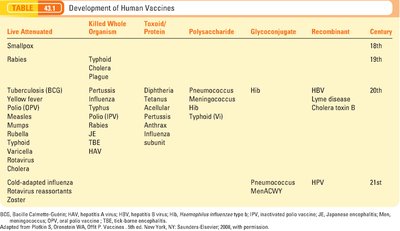
Types of Vaccines
Vaccines are classified based on their composition and method of preparation. Each type has unique advantages and disadvantages.
Live-attenuated vaccines: Contain weakened microorganisms; elicit strong immune responses but may cause disease in immunocompromised individuals.
Inactivated (killed) vaccines: Contain dead microorganisms; safer but require booster doses.
Subunit vaccines: Made of purified antigenic components; reduced risk of adverse reactions but development is complex.
Viral vector-based vaccines: Use viruses as carriers for antigen genetic material; mimic natural infection.
Nucleic acid-based vaccines: Use DNA or mRNA to produce antigens in host cells; rapid manufacturing but delivery challenges.
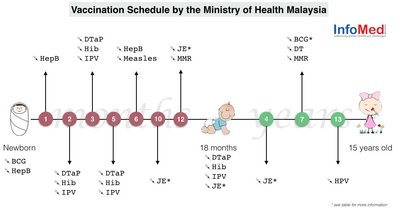
Childhood Immunization Schedule
Immunization schedules are designed to provide protection against common infectious diseases from infancy through adolescence. The schedule varies by country and is based on epidemiological data.
Newborn: BCG, HepB
Infancy: DTaP, Hib, IPV, Measles, MMR
Adolescence: HPV, booster doses
Live-attenuated Vaccines
Live-attenuated vaccines use living microorganisms with reduced virulence. They replicate in the host, causing mild or subclinical infection and often confer lifelong immunity.
Advantages: Strong and persistent immune response.
Disadvantages: Risk of reversion to virulent form; not suitable for immunocompromised individuals.
Examples: MMR, varicella, rotavirus, BCG.
Inactivated (Killed) Vaccines
These vaccines contain microorganisms killed by physical or chemical agents. They cannot replicate but still provoke immunity.
Advantages: Safer and more stable.
Disadvantages: Lower antigenic stimulation; require booster doses.
Examples: Rabies, Hepatitis A, COVID-19 (Sinovac, Sinopharm), pertussis, cholera.
Subunit Vaccines
Subunit vaccines are composed of purified antigenic components. They include toxoids, protein vaccines, recombinant proteins, viral-like particles, polysaccharides, and glycoconjugates.
Toxoid vaccines: Inactivated toxins; require booster doses. E.g., tetanus, diphtheria.
Protein vaccines: Purified proteins; risk of contaminants. E.g., acellular pertussis, influenza.
Recombinant protein vaccines: Produced using recombinant DNA technology; safer but may require adjuvants.
Viral-like particles (VLPs): Non-infectious protein structures; e.g., Hepatitis B.
Polysaccharide-based vaccines: Target bacterial capsules; limited immunologic memory.
Glycoconjugate-based vaccines: Polysaccharides conjugated to proteins; induce long-term protection.
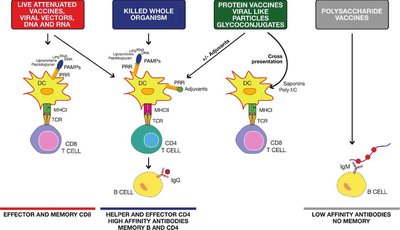
Mode of Action of Different Vaccines
Different vaccine types stimulate the immune system in distinct ways, leading to varying levels of antibody production and memory cell formation.
Live-attenuated and viral vector vaccines: Induce strong CD8 and CD4 responses.
Killed and protein vaccines: Induce high-affinity antibodies and memory B cells.
Polysaccharide vaccines: Induce low-affinity antibodies without memory.
Viral Vector-Based Vaccines
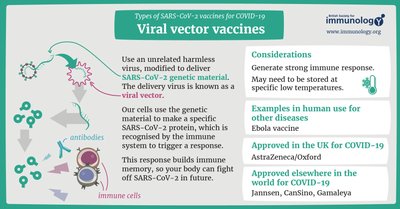
These vaccines use attenuated viruses to deliver antigen genetic material into host cells, closely mimicking natural infection and stimulating robust immune responses.
Advantages: Strong immune response; effective stimulation of both humoral and cellular immunity.
Disadvantages: Complex manufacturing; pre-existing immunity to the vector; cold chain requirements.
Examples: Ebola, COVID-19 (AstraZeneca, Johnson & Johnson, Sputnik V).

Nucleic Acid-Based Vaccines
Nucleic acid-based vaccines use plasmid DNA or mRNA to produce antigens in host cells, triggering immune responses. They are rapid to manufacture but face delivery and storage challenges.
Advantages: Strong cellular and antibody response; rapid manufacturing.
Disadvantages: Delivery barriers; cold chain requirements; potential risk of DNA integration.
Examples: COVID-19 (Pfizer/BioNTech, Moderna).
Challenges of Vaccine Development
Both conventional and modern vaccine approaches face significant challenges, including safety, efficacy, manufacturing complexity, and delivery systems.
Conventional vaccines: Long development time; difficulty cultivating pathogens; risk of reversion.
Modern vaccines: Lower immunogenicity; need for adjuvants; technical delivery challenges.
Viral vector vaccines: Risk of vector-induced immunogenicity; pre-existing immunity.
Nucleic acid vaccines: DNA integration risk; control of expression; cold chain requirements.
Vaccine Adjuvants
Adjuvants are substances added to vaccines to enhance their efficacy by boosting the immune response. They stimulate local immune cells and increase cytokine production.
Examples: Aluminium salts, emulsions, liposomes.
Function: Enhance antigen uptake, prolong retention, increase immunogen size.
Booster Dose
Booster doses are additional vaccine doses given after the initial series to re-expose the host to the antigen and maintain immunity.
Indications: Large antigen quantity needed; antibody levels drop below acceptable threshold.
Risks: High antibody levels can cause Arthus reaction (Type III hypersensitivity).
Example: Hepatitis B vaccine schedule (0, 1, 6 months).
Potential Risks and Contraindications
Vaccines may cause adverse reactions, especially in certain populations. Immunization should be postponed in individuals with acute illness or high fever, and live vaccines are contraindicated in immunocompromised and pregnant individuals.
Risks: Reversion to wild type, severe disease, hypersensitivity, contamination.
Contraindications: Acute illness, immunocompromised, pregnancy, previous anaphylaxis.
Herd Immunity
Herd immunity occurs when a significant portion of a population is vaccinated, providing indirect protection to unvaccinated individuals by reducing disease spread.
Importance: Prevents outbreaks; protects vulnerable populations.
Vaccine Controversies
Vaccine safety and efficacy have been subjects of controversy, often fueled by misinformation. Notable controversies include alleged links between vaccines and autism, and concerns over preservatives like thimerosal.
DTP controversy: Alleged neurological risks; led to anti-vaccination movements.
MMR controversy: Fraudulent claims of autism link; disproven by extensive research.
Thimerosal: Mercury-containing preservative; removed from most vaccines as precaution.
Summary
Vaccines are essential tools in disease prevention, relying on principles of immunology to provide protection. Understanding their types, mechanisms, and challenges is crucial for informed public health decisions.
