 Indietro
Vascular Plant Structure, Growth, Transport, and Nutrition
Guida di studio - Note intelligenti
 Appunti personalizzati basati sui tuoi materiali, ampliati con definizioni chiave, esempi e contesto.
Vascular Plant Development
Seed Germination
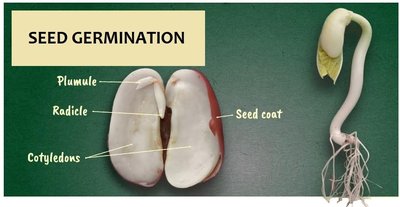
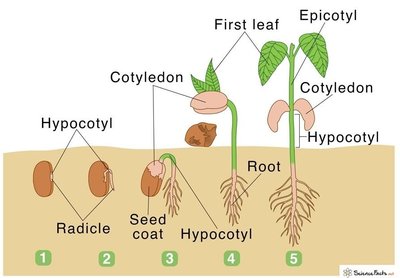
Seed germination is the process by which a seed develops into a new plant. Eudicot seeds contain a dormant diploid embryo, triploid endosperm, and a diploid seed coat. Under suitable conditions, the seed absorbs water, swells, and the radicle emerges first to anchor the seed and absorb water. Cotyledons provide nourishment until the leaves develop chlorophyll and begin photosynthesis.
Embryo: Contains plumule (baby leaves) and radicle (embryonic root).
Endosperm: Provides nutrients to the developing embryo.
Seed coat: Protective outer layer derived from maternal tissue.
Sequence: Radicle emerges first, followed by cotyledons and plumule.
Example: Germination of a bean seed.
Plant Growth and Meristems
Apical (Primary) Meristems
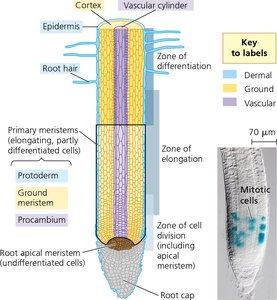
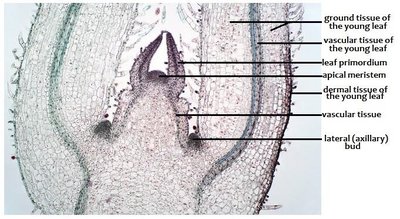
Meristems are regions of undifferentiated cells responsible for plant growth. Apical meristems are found at the tips of shoots and roots and produce three primary tissues: protoderm, procambium, and ground tissue. Growth at the apical meristem is indeterminate in most plants, meaning it continues as long as resources are available.
Protoderm: Forms protective tissues (epidermis, periderm).
Procambium: Forms vascular tissues (xylem, phloem).
Ground tissue: Forms cells for metabolism, support, and storage.
Growth direction: Shoot meristem grows away from gravity; root meristem grows toward gravity.
Mature Plant Tissues
Types of Plant Cells
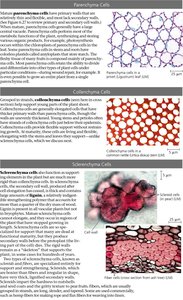
As meristematic cells mature, they differentiate into specialized cell types with distinct functions. The three main tissue types are dermal, vascular, and ground tissues.
Dermal tissue: Protoderm-derived; includes epidermis (herbaceous plants) and periderm (woody plants).
Vascular tissue: Procambium-derived; includes xylem (water/mineral transport) and phloem (sugar/organic transport).
Ground tissue: Ground meristem-derived; includes parenchyma (metabolism/storage), collenchyma (support), and sclerenchyma (support).
Root & Shoot Systems
Structure and Function
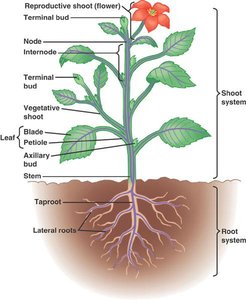
Plants are organized into root and shoot systems. The shoot system includes stems, leaves, and flowers, while the root system includes primary and secondary roots. Roots anchor the plant and absorb water and minerals; stems support aerial organs and house vascular tissue; leaves are the main site of photosynthesis.
Root system: Primary roots, tap roots, fibrous roots, root hairs.
Shoot system: Stem, leaves, flowers.
Leaf function: Mesophyll cells capture light; stomates regulate gas exchange.
Root Structure
Anatomy of Roots
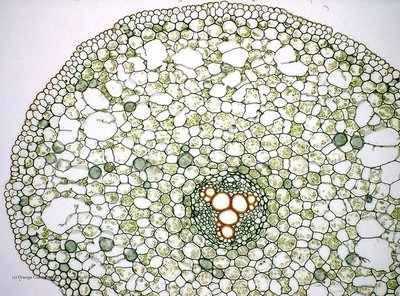
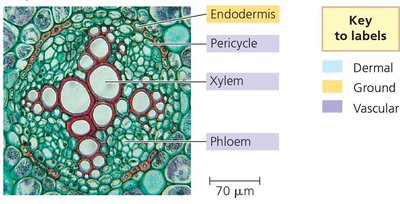
Roots are covered by an epidermis with root hairs for absorption. The vascular cylinder in the center contains xylem and phloem. Cortex cells store carbohydrates, and the endodermis regulates water movement into the vascular cylinder.
Epidermis: Protective layer; root hairs increase surface area.
Vascular cylinder: Central region with xylem and phloem.
Cortex: Ground tissue for storage.
Endodermis: Waxy layer restricting water movement.
Stem Structure
Anatomy and Growth
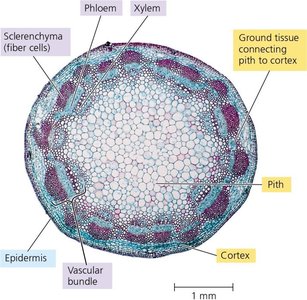
Stems support aerial organs and facilitate long-distance transport. Nodes are sites of leaf formation; internodes separate nodes. Axillary buds form branches. Vascular bundles in eudicot stems are arranged in a ring, with cortex outside and pith inside. Specialized stems include rhizomes, stolons, and tubers.
Nodes: Sites of leaf and bud formation.
Internodes: Spaces between nodes.
Axillary buds: Form branches.
Vascular bundles: Ring arrangement in eudicots.
Specialized stems: Rhizomes, stolons, tubers.
Leaf Structure
Anatomy and Arrangement
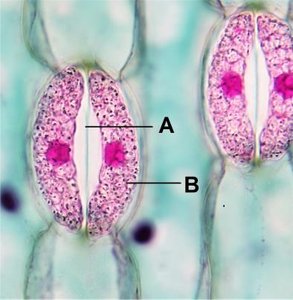
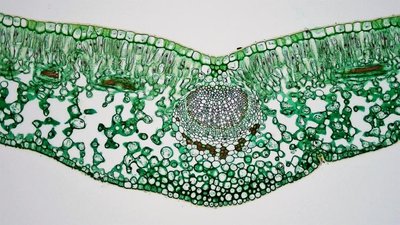
Leaves are adapted for maximum light capture and gas exchange. They are attached by a petiole, and veins branch in a net-like pattern in eudicots. The upper and lower epidermis sandwich mesophyll cells, which are divided into compact and loose layers. Guard cells regulate stomatal opening for gas exchange.
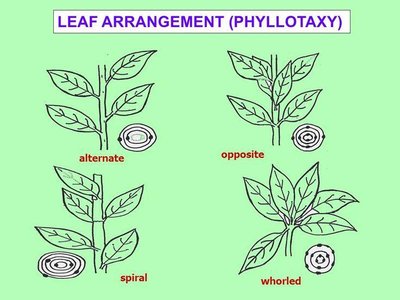
Leaf arrangement: Opposite, alternate, spiral, or whorled.
Petiole: Connects stem to leaf.
Veins: Net-like pattern in eudicots.
Mesophyll: Photosynthetic cells.
Guard cells: Regulate stomatal opening.
Vascular Transport
Xylem and Phloem
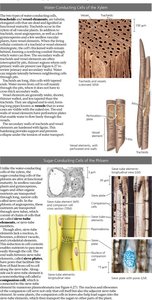
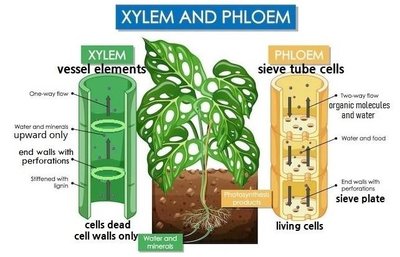
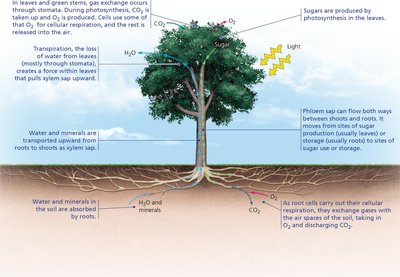
Vascular tissues transport water, minerals, and sugars throughout the plant. Xylem vessel elements are dead at maturity and conduct water upward. Phloem sieve tube cells are alive and conduct sugars and organics. Companion cells assist phloem function.
Xylem: Dead cells; water/mineral transport; one-way upward flow.
Phloem: Living cells; sugar/organic transport; two-way flow.
Companion cells: Support phloem function.
Water & Mineral Transport: Cohesion-Tension Theory
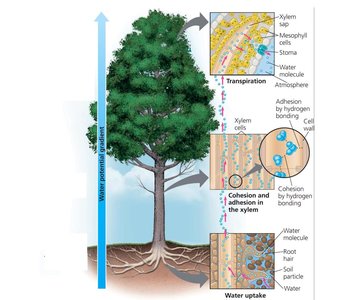
Water and minerals are absorbed by root hairs and move through the apoplast to the xylem. Transpiration from leaves creates negative pressure, pulling water upward through the xylem. Water only moves upward in the xylem.
Apoplast: Pathway outside cell membranes.
Endodermis: Regulates entry into xylem.
Transpiration: Water loss from leaves drives upward movement.
Sugar Transport: Translocation
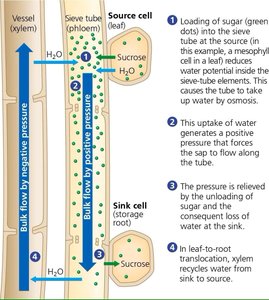
Phloem sieve tube cells form a symplast for sugar transport. Sugars move from sources (high concentration, e.g., leaves) to sinks (low concentration, e.g., roots, fruits) via bulk flow. Active transport loads sugars into sieve tubes, and osmotic pressure drives flow. Phloem can move sugars in either direction.
Source: Area of high sugar concentration (e.g., leaves).
Sink: Area of low sugar concentration (e.g., roots, fruits).
Bulk flow: Driven by osmotic pressure differences.
Companion cells: Assist in loading sugars.
Plant Nutrition
Soil and Nutrient Uptake
Plants absorb water and nutrients from soil, which consists of inorganic minerals and organic humus. Macronutrients are required in large amounts for growth and reproduction, while micronutrients are needed in small amounts as enzyme cofactors. Deficiencies can cause chlorosis and reduced growth.
Macronutrients: Carbon, oxygen, hydrogen, nitrogen, potassium, phosphorus, calcium, magnesium, sulfur.
Micronutrients: Chlorine, iron, manganese, boron, zinc, copper, nickel.
Example: Nitrogen is essential for proteins, nucleic acids, and chlorophyll.
The Nitrogen Cycle
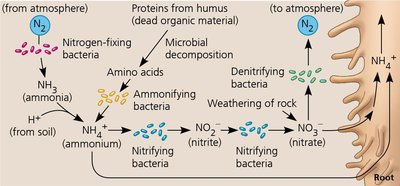
The nitrogen cycle involves soil organisms decomposing organic matter and converting nitrogen into forms usable by plants. Nitrogen-fixing bacteria in legume root nodules convert atmospheric N2 to ammonia. Nitrifying bacteria convert ammonia to nitrite and nitrate, which plants absorb. Denitrifying bacteria return nitrogen to the atmosphere.
Ammonifying bacteria: Decompose organic matter to ammonia.
Nitrogen-fixing bacteria: Convert N2 gas to ammonia.
Nitrifying bacteria: Convert ammonia to nitrite and nitrate.
Denitrifying bacteria: Convert nitrate to N2 gas.
Carnivorous Plants
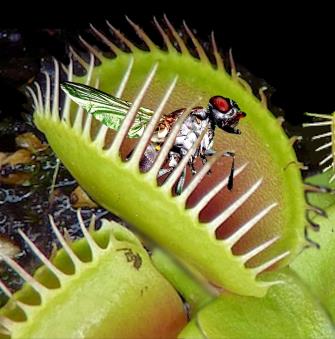
Carnivorous plants have evolved to capture animals and extract nitrogen from their tissues, an adaptation to nitrogen-poor soils. Examples include Venus flytrap, pitcher plant, butterwort, sundew, and cobra lily. These plants are angiosperms and produce flowers.
Adaptation: Capture and digest insects for nitrogen.
Examples: Venus flytrap, pitcher plant, sundew, butterwort.
Mycorrhizae
Mycorrhizae are mutualistic associations between plant roots and fungal hyphae. The fungus absorbs water and minerals, sharing them with the plant, while the plant provides glucose to the fungus. This relationship enhances nutrient uptake and will be discussed further in the next lecture.
Mutualism: Fungal mycelium and plant roots exchange nutrients.
Benefit: Increased water and mineral absorption.
Additional info: Academic context was added to clarify cell types, transport mechanisms, and nutrient cycles.
