 Indietro
Viruses, Eukaryote Origins, and Protist Diversity: Study Notes for General Biology
Guida di studio - Note intelligenti
 Appunti personalizzati basati sui tuoi materiali, ampliati con definizioni chiave, esempi e contesto.
Viruses
Definition and Characteristics
Viruses are non-cellular entities that require living cells to replicate. They lack a plasma membrane and ribosomes, distinguishing them from cellular life forms. Viruses hijack the nucleic acid replication and protein manufacturing machinery of their host cells to reproduce.
Capsid: Protein shell surrounding the viral genome.
Genome: Composed of either DNA or RNA, which may be single- or double-stranded.
Size: Viral genomes can be extremely small, encoding as few as two proteins, or very large, as in Pandoravirus (up to 2000 proteins).
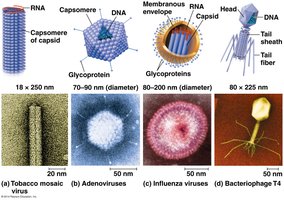
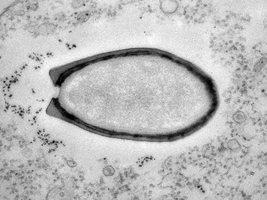
Viral Diversity and Abundance
Viruses infect all cellular life forms and are the most abundant biotic entities on Earth. For example, seawater contains approximately 10 million virus particles per drop, most of which are bacteriophages (viruses that infect bacteria).
Viral Replication Cycles
Viruses replicate inside host cells, using the host's DNA replication and protein synthesis machinery. After replication, new virus particles burst out to infect new cells.
Lytic Cycle: Virus replicates and destroys the host cell.
Lysogenic Cycle: Viral DNA integrates into the host genome and replicates along with it, remaining dormant until triggered.
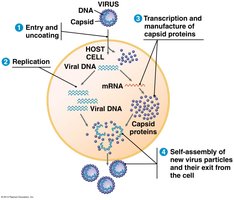
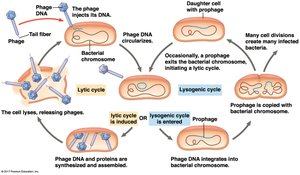
Origins of Viruses
Understanding viral origins is challenging due to the lack of viral fossils, small genomes, and rapid evolution. Three main hypotheses are:
Viruses evolved from mobile genetic elements (e.g., plasmids) that gained capsid protein genes.
Viruses evolved from prokaryotes that became obligate intracellular parasites.
Viruses arose before cellular life.
Evolution of Eukaryotic Cells
Timeline and Environmental Context
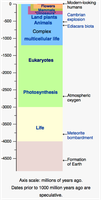
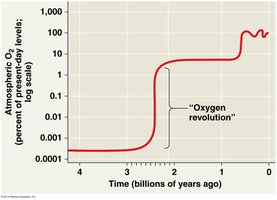
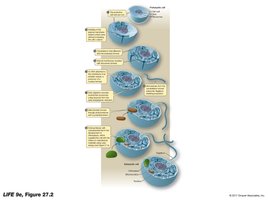
Eukaryotes arose approximately 1.8 billion years ago, after the oxygen revolution, which increased atmospheric oxygen and enabled symbiosis with aerobic bacteria.
Key Steps in Eukaryote Evolution
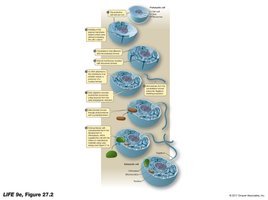
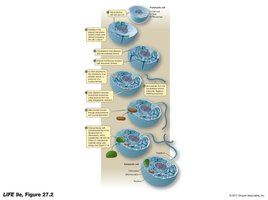
Loss of Cell Wall: The ancestral prokaryotic cell wall was lost, allowing for a flexible cell surface. Eukaryotic cell walls, where present, are made of different materials and evolved independently.
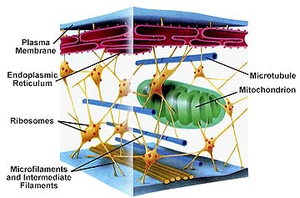
Origin of Cytoskeleton: Mechanical support was provided by microfilaments and microtubules, enabling cell shape changes and motility.
Functions of the Cytoskeleton
Supports the cell and allows shape changes.
Enables motile extensions (e.g., flagella).
Aids in intracellular transport.
Origin of Nuclear Envelope and Endocytosis
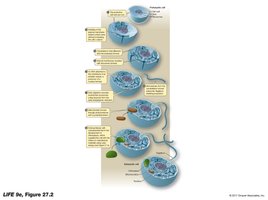
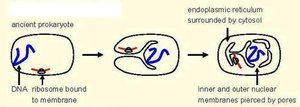
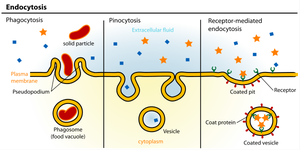
The nuclear envelope likely developed from infoldings of the plasma membrane, with prokaryote DNA attached to the membrane. Endocytosis, including phagocytosis and pinocytosis, requires a flexible cell surface and cytoskeleton. 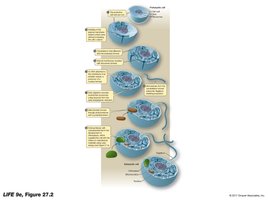
Endosymbiosis: Acquisition of Organelles
Mitochondria
An ancestral eukaryote phagocytosed aerobic, nonphotosynthetic gram-negative bacteria, which were not digested and evolved into mitochondria. Mitochondria initially detoxified O2 and later became central to ATP production. 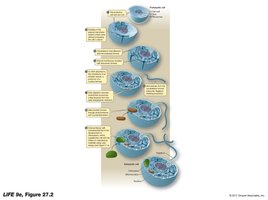
Mitochondria have two membranes, circular DNA, and their own ribosomes.
They divide by binary fission and are homologous across all eukaryotes.
The engulfed bacterium was an alpha-proteobacterium.
Plastids (Chloroplasts)
Plastids originated when an ancestral eukaryote phagocytosed photosynthetic cyanobacteria. Plastids have two or more membranes, circular DNA, and their own ribosomes, dividing by binary fission.
Primary and Secondary Endosymbiosis
Primary Endosymbiosis: Direct engulfment of a cyanobacterium by a eukaryote, giving rise to plastids in Archaeplastida (green algae, land plants, red algae, glaucophytes).
Secondary Endosymbiosis: Engulfment of a eukaryote (with a plastid from primary endosymbiosis) by another eukaryote, resulting in plastids with additional membranes.
Protist Diversity
Definition and Classification
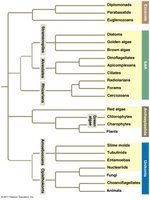
Protists include all eukaryotes except plants, animals, and fungi. Most eukaryotic lineages are protists, which are highly diverse in morphology, nutrition, and reproduction.
Morphological and Nutritional Diversity
Many protists are unicellular (microbial eukaryotes), but some are multicellular and can be very large (e.g., giant kelp).
Protists may be photoautotrophs (algae), chemoheterotrophs (protozoans), or mixotrophs (e.g., Euglena).
Reproductive Diversity
Protists exhibit all three major eukaryotic sexual life cycles:
Diplontic: Only multicellular stage is diploid (characteristic of animals and some protists).
Haplontic: Multicellular stage is haploid; only diploid stage is unicellular (characteristic of fungi and some protists).
Alternation of Generations: Both haploid and diploid multicellular stages (characteristic of many protists, all plants, some fungi).
Ecological and Human Importance
Photosynthetic protists (phytoplankton) are major primary producers, responsible for ~30% of global photosynthesis.
Some protists cause harmful algal blooms (HABs), producing toxins and creating anoxic dead zones.
Protists are important endosymbionts (e.g., dinoflagellates in corals, protists in termites).
Historic protist populations contributed to petroleum and natural gas deposits, and foraminiferan shells are used in geological dating.
Some protists are human pathogens (e.g., Plasmodium causes malaria, trypanosomes cause sleeping sickness and Chagas' disease).
Essential Vocabulary
Element cycling
Symbiosis
Mutualism
Commensalism
Parasitism
Pathogen
Viral capsid
Bacteriophage
Lytic
Lysogenic
Endocytosis
Phagocytosis
Pinocytosis
Primary, secondary (tertiary!) endosymbiosis
Protist
Mixotroph
Diplontic
Haplontic
Alternation of generations
Heteromorphic
Isomorphic
Phytoplankton
Harmful algal bloom
Red tide
Dead zone
Coral bleaching
Study Questions
Why are prokaryotes important to the world in general, and to humans in particular?
What are viruses composed of? How do they differ from cellular life? What is their basic life cycle? Describe lytic and lysogenic cycles in bacteriophages. What are three hypotheses about how viruses originated?
Describe in detail the steps involved in the evolution of eukaryotes from prokaryotic ancestors. Why is the ability to phagocytose particles particularly important in the evolution of eukaryotes?
Describe the evidence that mitochondria and plastids are ancient prokaryotic endosymbionts (from which clades?) of eukaryotic cells.
Describe the difference between primary and secondary (and higher order!) endosymbioses in the evolution of plastids.
Where did all the membranes around the plastids of various photosynthetic protists come from?
Name and briefly describe the eukaryotic sexual life cycles!
Why are protists important to the world in general, and to humans in particular?
