 Indietro
Lecture 21 (Unit 2) - Viruses: Structure, Replication, and Host Defenses
Guida di studio - Note intelligenti
 Appunti personalizzati basati sui tuoi materiali, ampliati con definizioni chiave, esempi e contesto.
Viruses: Structure, Replication, and Host Defenses
What is a Virus?
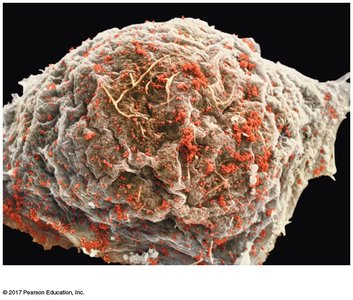
Viruses are extremely small infectious particles that consist of genetic material (either DNA or RNA) enclosed in a protein coat, and sometimes surrounded by a membranous envelope. Unlike cells, viruses cannot reproduce or carry out metabolic processes independently; they require a host cell to replicate.
Not cells: Viruses are structurally simpler than prokaryotic or eukaryotic cells and are not considered living organisms by most definitions.
Obligate intracellular parasites: They depend entirely on host cellular machinery for replication and metabolism.
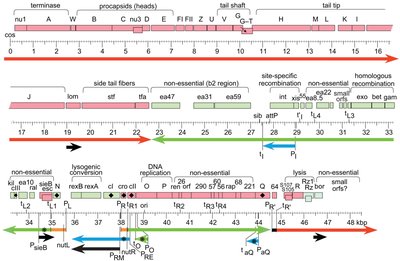
Genome diversity: Viral genomes may be double- or single-stranded DNA or RNA, and can be linear or circular. Genome sizes range from as few as 3 genes to over 2,000 genes.
Discovery of Viruses
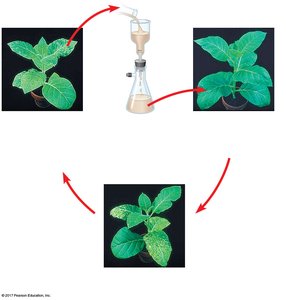
The first virus was discovered in plants through studies of tobacco mosaic disease. Experiments showed that infectious agents smaller than bacteria could cause disease in tobacco plants, leading to the identification of viruses.
Key experiment: Sap from diseased plants, filtered to remove bacteria, could still transmit disease to healthy plants.
Viral Structure
Viruses display a variety of structural forms, but all share some common features:
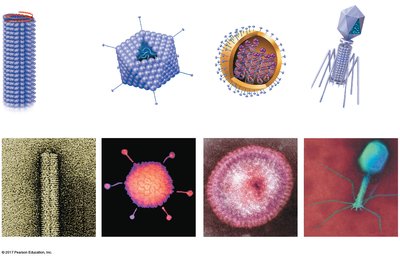
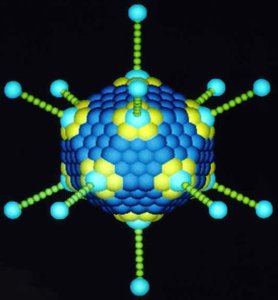
Capsid: The protein shell that encloses the viral genome, built from protein subunits called capsomeres.
Capsid shapes: Can be helical (rod-shaped), icosahedral (polyhedral), or more complex (e.g., bacteriophages).
Viral envelope: Some viruses, especially animal viruses, have a membrane envelope derived from the host cell membrane, containing both host and viral proteins.
Viral Genomes
Viral genomes are highly variable:
Types: DNA or RNA, single- or double-stranded, linear or circular.
Classification: Viruses are classified as DNA viruses or RNA viruses based on their genetic material.
Genome organization: Some viruses have segmented genomes (multiple pieces of nucleic acid).
Viral Replication Cycles
General Replication Cycle
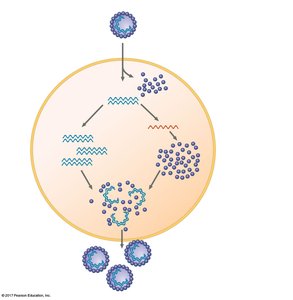
All viruses follow a general pattern of infection and replication:
Entry: The viral genome enters the host cell by fusion, endocytosis, or injection.
Replication and gene expression: The host cell machinery is hijacked to replicate the viral genome and synthesize viral proteins.
Assembly: New viral particles self-assemble from the replicated genomes and proteins.
Release: New viruses exit the cell, often destroying it in the process.
Bacteriophages (Phages)
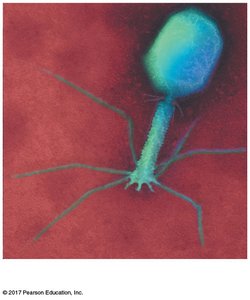
Bacteriophages are viruses that infect bacteria. They are among the best-studied viruses and have contributed greatly to our understanding of molecular biology.
Structure: Typically have an elongated capsid head containing DNA, and a tail apparatus for injecting DNA into the host.
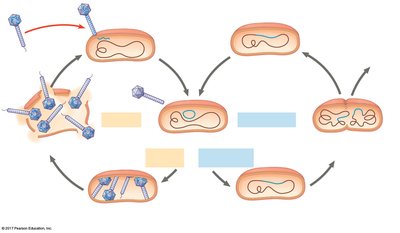
Life cycles: Phages can undergo a lytic cycle (destroying the host) or a lysogenic cycle (integrating into the host genome as a prophage).
Lytic Cycle
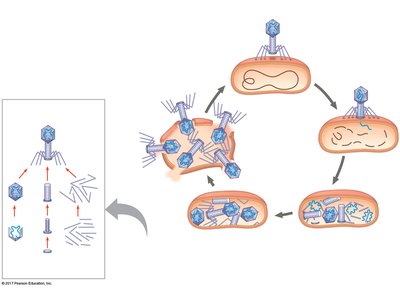
In the lytic cycle, the phage replicates rapidly, leading to host cell lysis and release of new phages.
Attachment to host cell
Injection of phage DNA
Degradation of host DNA
Synthesis of viral components
Assembly and release of new phages
Lysogenic Cycle
In the lysogenic cycle, the phage DNA integrates into the host genome and is replicated along with it, remaining dormant until induced to enter the lytic cycle.
Prophage: The integrated phage DNA in the bacterial chromosome.
Induction: Environmental triggers can cause the prophage to excise and enter the lytic cycle.
Host Defenses Against Viruses
Restriction-Modification Systems
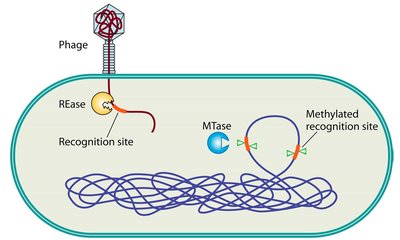
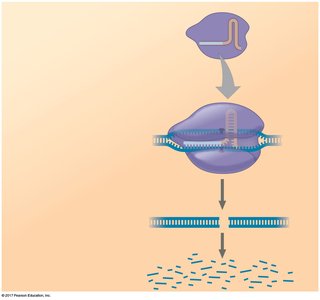
Bacteria defend against phages using restriction enzymes that cut foreign DNA at specific sequences. Host DNA is protected by methylation.
Restriction enzymes: Recognize and cleave unmethylated foreign DNA.
Methylation: Host DNA is methylated at recognition sites, preventing cleavage.
CRISPR-Cas Systems
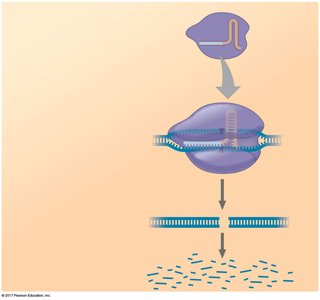
Both bacteria and archaea use the CRISPR-Cas system as an adaptive immune defense against viruses. The system stores fragments of viral DNA (spacers) in the genome, which are transcribed into guide RNAs that direct Cas proteins to cut matching viral DNA during future infections.
CRISPR: Clustered Regularly Interspaced Short Palindromic Repeats, a genetic memory of past infections.
Cas proteins: Endonucleases guided by RNA to cleave complementary viral DNA.

Comparison: CRISPR-Cas and miRNA-RISC
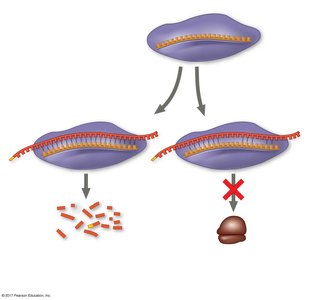
Both CRISPR-Cas (in prokaryotes) and miRNA-RISC (in eukaryotes) are RNA-guided endonuclease systems that use base pairing for target specificity. CRISPR-Cas targets DNA, while miRNA-RISC targets RNA for degradation or translational repression.
Types of Viral Genomes and Replication Strategies
Positive-Sense and Negative-Sense RNA Viruses
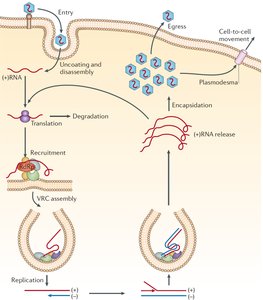
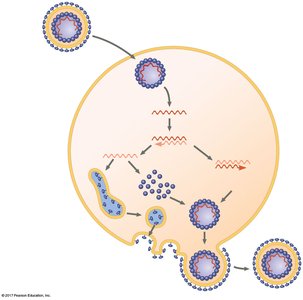
Positive-sense (+) ssRNA: Genome can serve directly as mRNA for translation (e.g., Tobacco Mosaic Virus, coronaviruses).
Negative-sense (–) ssRNA: Genome is complementary to mRNA and must be copied into (+) sense RNA by an RNA-dependent RNA polymerase (RdRp) before translation (e.g., influenza virus).
Retroviruses
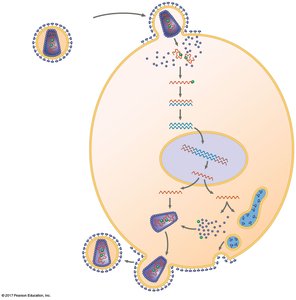
Retroviruses, such as HIV, are RNA viruses that use reverse transcriptase to convert their RNA genome into DNA, which integrates into the host genome as a provirus. The provirus is transcribed by host RNA polymerase II to produce new viral genomes and proteins.
Reverse transcriptase: Enzyme that synthesizes DNA from an RNA template.
Integrase: Enzyme that inserts viral DNA into the host genome.
Provirus: Integrated viral DNA that remains a permanent part of the host genome.
Eukaryotic Defenses Against Viruses
RNA Interference (RNAi)
Many eukaryotes use RNA interference as an antiviral defense. Double-stranded RNA from viruses is processed into small interfering RNAs (siRNAs), which are loaded into the RNA-induced silencing complex (RISC) to target viral RNAs for degradation or translational repression.
siRNAs: Small interfering RNAs derived from viral dsRNA.
RISC: RNA-induced silencing complex that uses siRNAs to guide cleavage of complementary viral RNA.
Emerging Viruses, Epidemics, and Pandemics
Emerging Viruses
Emerging viruses are those that suddenly become apparent, often due to high mutation rates, spread from isolated populations, or zoonotic transmission (from animals to humans). Examples include Ebola, Zika, and SARS coronaviruses.
High mutation rates: Especially in RNA viruses, facilitate adaptation and host switching.
Zoonosis: Many new human diseases originate from animal viruses.
Epidemics and Pandemics
An epidemic is a localized outbreak of disease, while a pandemic is a global epidemic. Influenza A viruses and coronaviruses have caused major pandemics in human history.
Influenza A: Named by envelope proteins (e.g., H1N1, H5N1).
SARS-CoV-2: The cause of COVID-19, a recent global pandemic.
SARS-CoV-2 (COVID-19)
SARS-CoV-2 is an enveloped, positive-sense ssRNA virus with a large genome. The spike (S) protein on its surface binds to the ACE2 receptor on host cells, facilitating viral entry. The genome encodes several structural and non-structural proteins essential for replication and assembly.
Spike (S) protein: Mediates attachment and entry into host cells; main target for vaccines.
Envelope (E), Membrane (M), and Nucleocapsid (N) proteins: Structural proteins involved in virus assembly and genome packaging.
Antiviral Drugs and Vaccines
Antiviral Drugs
Antiviral drugs inhibit viral replication by targeting viral enzymes (e.g., RNA-dependent RNA polymerase, proteases). For example, Paxlovid inhibits the main protease (MPRO) of SARS-CoV-2.
Vaccines
Vaccines stimulate the immune system to recognize and respond to viral antigens. The most effective COVID-19 vaccines target the spike (S) protein of SARS-CoV-2.
mRNA vaccines: Deliver mRNA encoding the spike protein, encapsulated in lipid nanoparticles. Host cells translate the mRNA, produce the spike protein, and present it to the immune system, generating antibodies and immune memory.
Other platforms: Recombinant protein vaccines and viral vector vaccines also target the spike protein.
Summary Table: Classes of Animal Viruses
Class/Family | Envelope? | Examples That Cause Human Diseases |
|---|---|---|
Double-Stranded DNA (dsDNA) | Yes/No | Herpes simplex, chickenpox, smallpox, warts, tumors |
Single-Stranded DNA (ssDNA) | No | B19 parvovirus (mild rash) |
Double-Stranded RNA (dsRNA) | No | Rotavirus (diarrhea) |
Single-Stranded RNA (ssRNA) (+) | Yes/No | Poliovirus, rhinovirus, coronavirus (SARS, MERS, COVID-19), Zika, hepatitis C |
Single-Stranded RNA (ssRNA) (–) | Yes | Influenza, Ebola, measles, rabies |
Retrovirus (ssRNA as template for DNA) | Yes | HIV (AIDS), tumor viruses |
Key Concepts Review
Viruses are non-cellular infectious agents with diverse genome types and structures.
They replicate only inside host cells, using host machinery.
Bacteriophages can undergo lytic or lysogenic cycles.
Bacteria and archaea defend against viruses using restriction-modification and CRISPR-Cas systems.
Eukaryotes use RNA interference (RNAi) as an antiviral defense.
Emerging viruses and pandemics are major public health concerns, often originating from animal reservoirs.
Vaccines and antiviral drugs are critical tools for controlling viral diseases.
